



All auctions / Coins & Banknotes / 1795 Liberty Cap Cent. S-80, B-11b. Rarity-5-. Jefferson Head, Plain

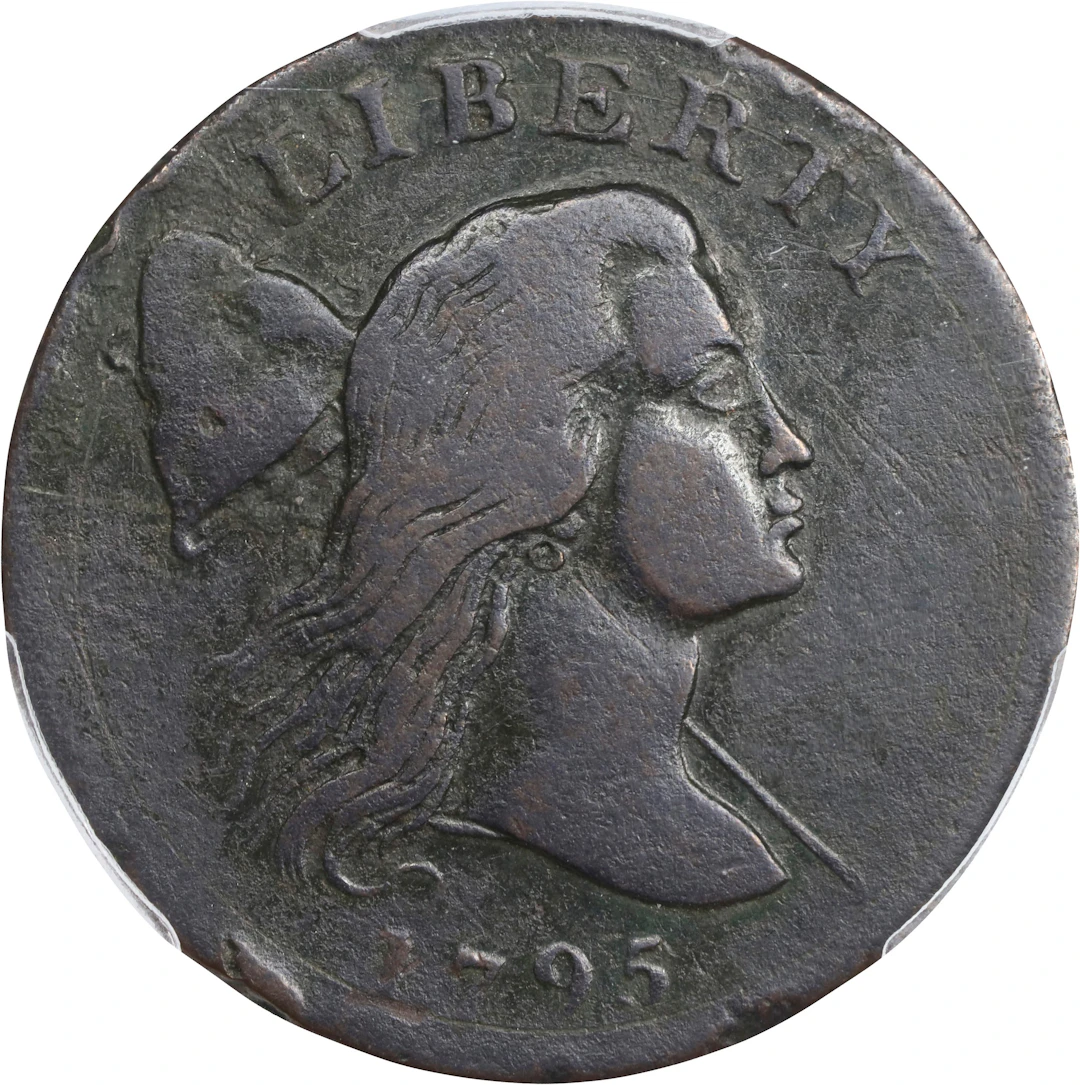
Intriguing 1795 Jefferson Head Cent Rarity 1795 Liberty Cap Cent. S-80, B-11b. Rarity-5-. Jefferson Head, Plain Edge. Fine-15 (PCGS). An inviting example of this enigmatic rarity from the early large cent series. Deep copper-rose patina blankets both sides, the detail of which is bold for the grade apart from minor softness along the upper and lower right reverse border. The surfaces are uniformly microporous with light olive-russet encrustation that is largely confined to the protected areas around the devices. There are few sizeable marks, however, a few shallow scuffs at the digit 1 in the date and a tiny void on the liberty cap being the most useful identifying features. This variety was coined outside the United States Mint by John Harper in an attempt to win a private coining contract. Harper's name is well known to numismatists, as his humble saw shop (sometimes mistakenly called a "cellar") is thought to have been where the first 1792 half dismes were struck, standing in for the still-unfinished United States Mint building nearby. Harper's talents as a blacksmith and machinist were well known to the Mint when Elias Boudinot, then a congressman, sought advice from Mint assayer Albion Cox on how to improve the Mint's processes and production. Cox recommended he talk to "John Harper, now very extensively in the saw-making business near the iron works at Trenton." According to Pete Smith, Joel J. Orosz, and Leonard Augsburger in the book 1792: Birth of a Nation's Coinage, Harper "visited the Mint on January 23, 1795, and suggested improvements but [Director David] Rittenhouse and the staff of the Mint were not impressed." Rittenhouse resigned the following June, followed in the director's office by Henry deSaussure, who lasted until just October. The next Mint director was Elias Boudinot. Harper reached out to Boudinot almost immediately after his appointment and, attempting to display what he could do, Harper made dies and struck the coins that we today call Jefferson Head cents. Elias Boudinot reported to Congress on Harper's work on February 3, 1796. A few weeks later, according to Smith et al.: Without Congressional authority, Harper produced dies, built a press, and invited the committee [of the House of Representatives] to observe his ability to produce cents faster and more efficiently than the Mint. The committee was impressed and dug into their own pockets to reimburse Harper for the copper used. Perhaps they took home a few of his cents as mementos. It made Boudinot nervous that Harper had dies that looked so much like federal cents, so he informed Congress that when he "found the dies used by the memorialist [Harper] still in his possession and conceiving this to be very improper [he] took them into the Mint." When he realized that he had no power to reimburse Harper for the dies or his other labors, Boudinot offered him a job as assistant coiner. Harper declined. Within 70 years, Harper's cents were valuable collectibles. The origin of the name is unknown. The first reference to the "Jefferson Head" of which we are aware is Edward Cogan's sale of June 1864, where one was listed under the heading of "Fabrications." The desirability of the "Jefferson Head" cents is noted in W. Elliot Woodward's sale of October of that same year, where lot 617 was described as "1795 Sometimes called the Jefferson Head, in rather poor condition but an extremely rare type." If Cogan could simply call it a "Jefferson Head" and Woodward could use the same name just a few months later, it implies that the name was enough in use that bidders would recognize what was being described. By the 20th century, the Jefferson Head cent was revered as a distinctive rarity in the early copper series. Initially dismissed as a counterfeit intended for circulation, Walter Breen appears to have been the first to make the connection between these cents and John Harper's experiment. Nearly all surviving specimens are heavily circulated, and many are impaired. Three varieties are known: Sheldon-80, as here, with a plain edge; 1795 NC-1, with a different reverse die and a lettered edge; and 1795 NC-4, from the same dies as Sheldon-80 but with a lettered edge. Among the three varieties, not a single example exceeds Very Fine and, indeed, survivors are highly prized regardless of level of preservation. The present example would certainly serve as a centerpiece in an advanced numismatic cabinet. Provenance: Property from an Alabama Family. Earlier from our sale of the Collection of Thaddeus A. Tatum III, August 2018 ANA Auction, lot 1024. PCGS# 1386. NGC ID: 2722. Click here for certification details from PCGS. Image with the PCGS TrueView logo is obtained from and is subject to a license agreement with Collectors Universe, Inc. and its divisions PCGS and PSA.
Estimate:£0.74
To the auctionView all items fromStack's BowersorCoins & Banknotes
Estimate:
£0.74
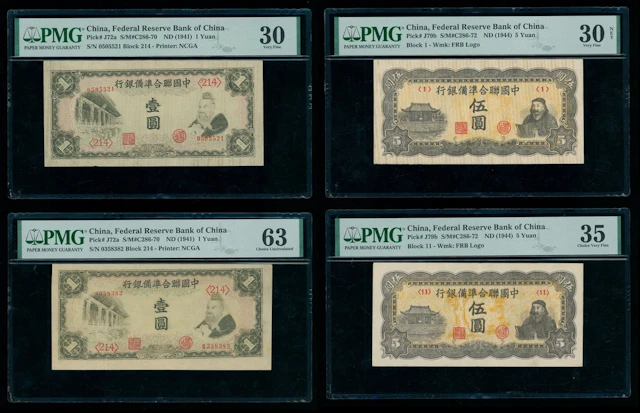
Federal Reserve Bank of China, a group of 4x, including, 1 yuan (2)
10/21/2026
£38.08
Est: £19.28
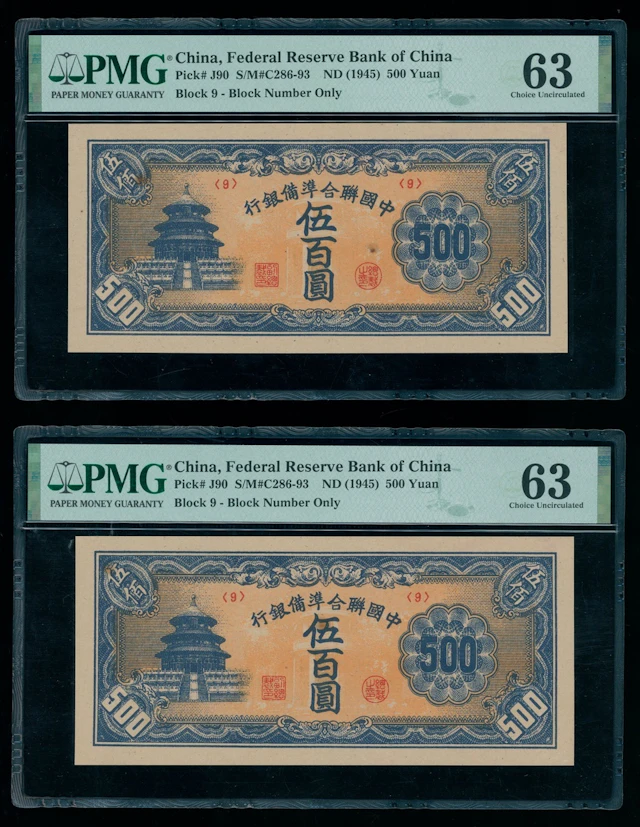
Federal Reserve Bank of China, 500 yuan (2), ND (1945), block 9, (Pick J90)
10/21/2026
£76.16
Est: £48.21


OCT 27 | 4:00 PM
Bring your auction to collectors worldwide!
Get listed nowBy subscribing, you are agreeing to the privacy policy. Unsubscribe anytime.
Barnebys HQ
Brahegatan 10
BOX 5038
114 37 Stockholm
