



OCT 17 | 10:00 PM

All auctions / Ethnographical / 83g Green Moss Agate – Dendrites

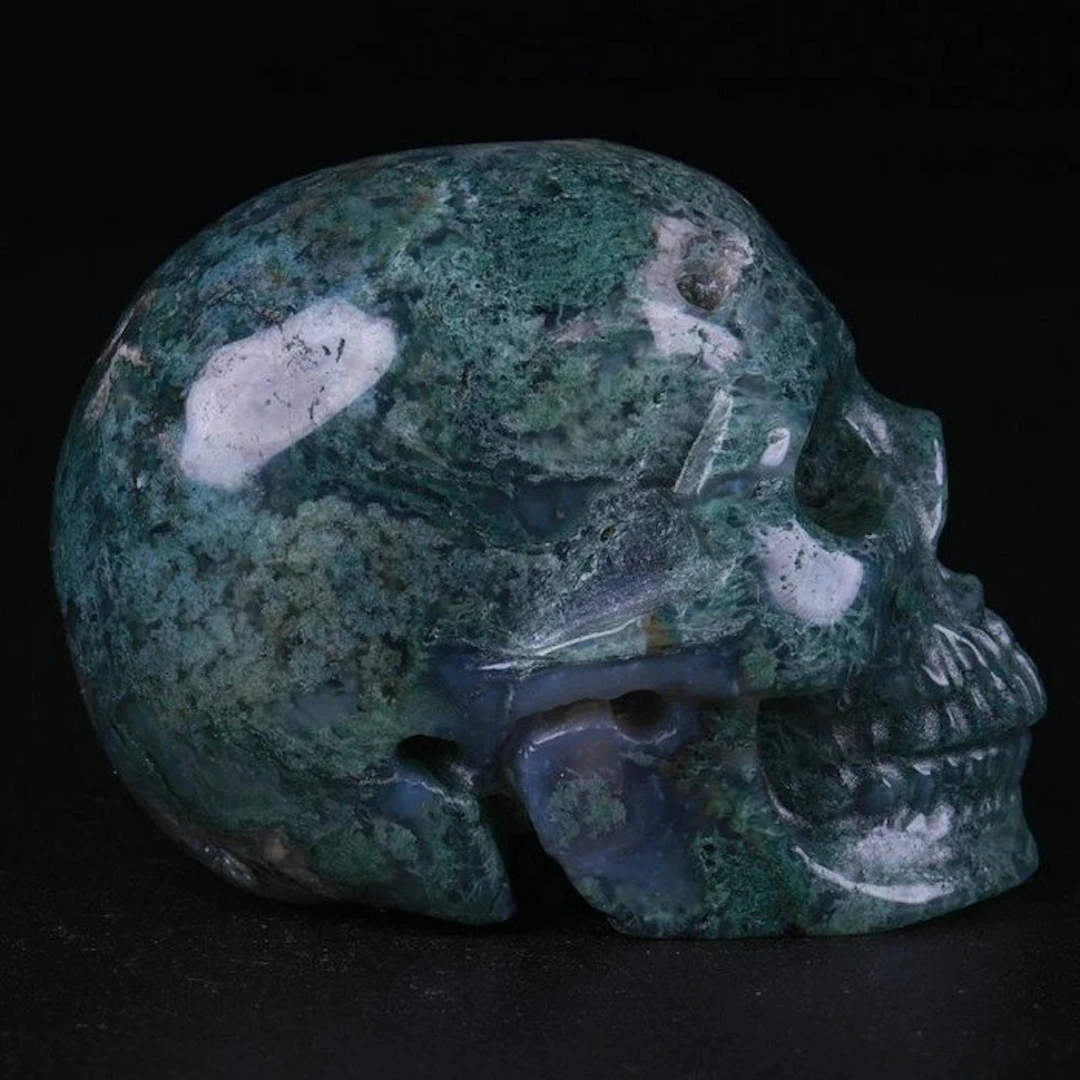
I am 37. In his Natural History, Pliny the Elder cataloged the gemstones of the world known at that time. Among the agates he also listed dendrachates, the “Tree Agate,” named after the Greek dendron, tree. Centuries later such stones were called Mokka stones, after the Yemeni port city Mocha, whose name lives on today in coffee as well. We call it Moss Agate. Three names from two millennia describe the same wonder: a forest that seems to grow inside the stone. In this head it grows densely and fibrous. Through the clear, semi-transparent agate run fine green structures. Some look like flakes or small moss patches, others like filaments that branch and disappear into the interior. Behind it opens another level: fine inner fracture surfaces catch and refract light, so the gaze is drawn ever deeper into the stone. Behind the first moss lies a second, behind the green a shimmering blue. Thus, filaments, clarity, and depth combine into a piece of quiet elegance. Despite its name, moss agate contains no trace of organic life. It is chalcedony, i.e., cryptocrystalline quartz, formed from silica-rich solutions in the voids of volcanic rock. The “moss” consists of green mineral inclusions, usually chlorite or hornblende. They branched out before the chalcedony solidified and have been enclosed in it ever since. Material: Green Moss Agate (Moosachat) – Chalcedony (cryptocrystalline quartz) with green, moss-like mineral inclusions Origin: India Dimensions: 5.0 x 3.6 x 3.2 cm Weight: 83 g Features: dense, fibrous-moss-like green inclusions, partly fluffy, partly filamentous; clear, semi-transparent agate with bluish-translucent areas; fine inner fracture surfaces with added depth; light, white agate areas and small natural druzy openings on the skull cap
Estimate:£4.21
To the auctionView all items fromCatawikiorEthnographical
Estimate:
£4.21
OCT 17 | 10:00 PM




OCT 23 | 8:00 AM
Bring your auction to collectors worldwide!
Get listed nowBy subscribing, you are agreeing to the privacy policy. Unsubscribe anytime.
Barnebys HQ
Brahegatan 10
BOX 5038
114 37 Stockholm
