





All auctions / Ethnographical / A bronze bracelet - Baule - Côte d'Ivoire (No reserve price)

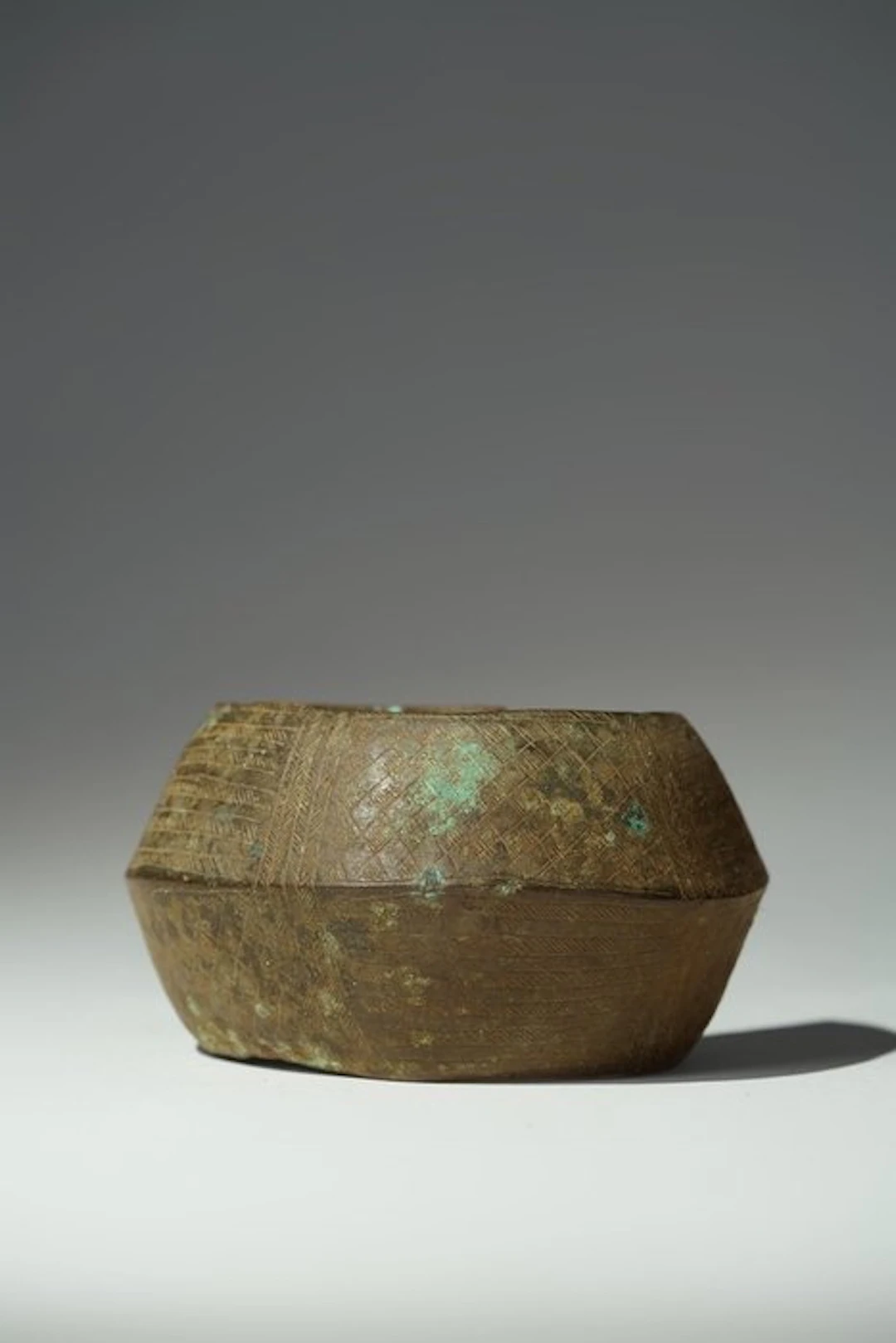
Baule Carved Bracelet Origin: Bouaké region, Ivory Coast Type: ankle ring or foot bracelet Material: copper alloy, traditionally referred to as bronze or brass Comparative dating: 19th century–first half of the 20th century, subject to documented provenance and material analysis. Comparable Baoulé ankle bracelets from the 19th and 20th centuries are held in the collections of the Metropolitan Museum of Art and the National Museum of African Art. Description The object takes the form of a wide, open ring, nearly circular in plan, with two vertical ends forming a large slit that presumably allowed it to be slipped around the ankle. Its massive body features a faceted cross-section: two oblique bands—one upper and one lower—meet at a continuous central ridge. This construction accentuates the piece's width and gives it an almost architectural presence. The edges of the opening are straight, thick, and slightly irregular, while the interior remains rougher than the exterior surface. The outer surface is almost entirely covered with fine incisions arranged in geometric patterns. One can distinguish crosshatching, diagonal hatching, chevrons, parallel lines, and long vertical bands. These patterns change orientation from one panel to the next and form a dense design that may visually evoke weaving, basketry, or fabric. However, they should not be assigned a specific symbolic meaning without local evidence. The overall color ranges from golden brown to olive, with green patches of copper corrosion, particularly visible near the rim and in the recesses. The blunted edges, scratches, and variations in polish attest to a long history of use and preservation, but are not sufficient to establish the piece's age. Historical and Artistic Analysis The closest comparisons are the large, C-shaped Baoulé ankle rings held in several museums. The National Museum of African Art describes these ornaments as emblems of status and wealth, characterized by surfaces covered with incised lines, ribs, and geometric patterns. These examples are generally associated with women's adornment, and some are hollow. The aesthetic of the photographed object relies less on figuration than on the organization of volume and graphic repetition. The central ridge visually stabilizes the ring, while the numerous hatches fragment the light and enliven the metallic surface. The decoration is therefore not a mere addition: it transforms a heavy mass into a visually rhythmic shell. This combination of monumentality, symmetry, and decorative precision is part of the diversity of Baoulé art, which includes sculptures as well as embellished everyday objects and works made of gold or copper alloys. Attributing the piece to the Bouaké region is geographically consistent with a Baoulé origin, but it cannot be proven by style alone. Metal ornaments circulated among owners, markets, and neighboring communities. An old collection record, the name of a village, the name of a foundry worker, or a story of family transmission would therefore be of essential documentary value. Scientifically Grounded Description The term "bronze" must be used with caution. Appearance alone does not allow one to distinguish a bronze composed mainly of copper and tin from a brass combining copper and zinc, or from a more complex alloy that also contains lead. The term "copper alloy" is therefore the most precise until X-ray fluorescence analysis has determined the elemental composition. The most likely manufacturing technique is lost-wax casting. In this process, a wax model is encased in clay and then heated to remove the wax. The molten metal is then poured into the resulting cavity. Since the mold is broken after cooling, each casting is, in principle, a unique piece. For hollow objects, the wax can be molded around a clay core that is retained during casting. Similar Baoulé rings in the Smithsonian collection are described as having been cast using the lost-wax process; they are generally hollow and may sometimes have contained small elements that produced a jingling sound. In this case, only an X-ray could confirm the internal structure and reveal a residual core, sound beads, porosity, or previous repairs. Microscopic examination would also help determine whether the patterns were carved into the wax or incised with a chisel after casting. Finally, the green patina indicates the weathering of copper compounds, but it does not, on its own, constitute proof of antiquity. Social and Ritual Function The most well-established function is that of a women's ankle ornament, used as a visible sign of wealth, family status, and personal presentation. Museum descriptions explicitly characterize large Baoulé bracelets of this type as emblems of status and prosperity. Their size, weight, and luster made the ornament highly conspicuous. When sound-producing elements were placed inside, it is reasonable to infer that the wearer's movements also produced a rhythmic sound. Use during ceremonies, dances, or public appearances is possible, but no visible characteristics allow this piece to be linked to a specific ritual. It would therefore be an overstatement to automatically identify it as an object of worship, fertility, divination, or initiation. Its potential ritual significance would lie instead in its integration into the ceremonial presentation of the body, the assertion of prestige, and the commemoration of an owner or lineage. Only field research could clarify this function. Bibliography Vogel, Susan Mullin. *Baule: African Art, Western Eyes*. New Haven: Yale University Press, 1997. Boyer, Alain-Michel. *Baule*. Milan: 5 Continents Éditions, 2008. Brincard, Marie-Thérèse, ed. *The Art of Metal in Africa*. New York: African-American Institute, 1982. Apley, Alice. "African Lost-Wax Casting." Heilbrunn Timeline of Art History, Metropolitan Museum of Art, 2001. National Museum of African Art. "Anklet," Baule artist, early 20th century, object no. 69-6-8. The publications mentioned serve for comparative art historical classification. They do not establish the specific cultural attribution, dating, or original use of the sculpture in question. Copyright and Scientific Documentation Some of the information and photographs have been generated with the assistance of artificial intelligence and are based on published sources in ethnography, archaeology, and art history. Original texts and photographs may be protected by copyright. All rights held by the respective copyright holders are reserved. Inv. No. MAZ32820 Informant: Bakari Bouafle
Estimate:£175.89
To the auctionView all items fromCatawikiorEthnographical
Estimate:
£175.89


OCT 27 | 4:00 PM
Bring your auction to collectors worldwide!
Get listed nowBy subscribing, you are agreeing to the privacy policy. Unsubscribe anytime.
Barnebys HQ
Brahegatan 10
BOX 5038
114 37 Stockholm
