


OCT 17 | 10:00 PM

All auctions / Ethnographical / A bronze pendant - Gan - Burkina Faso (No reserve price)

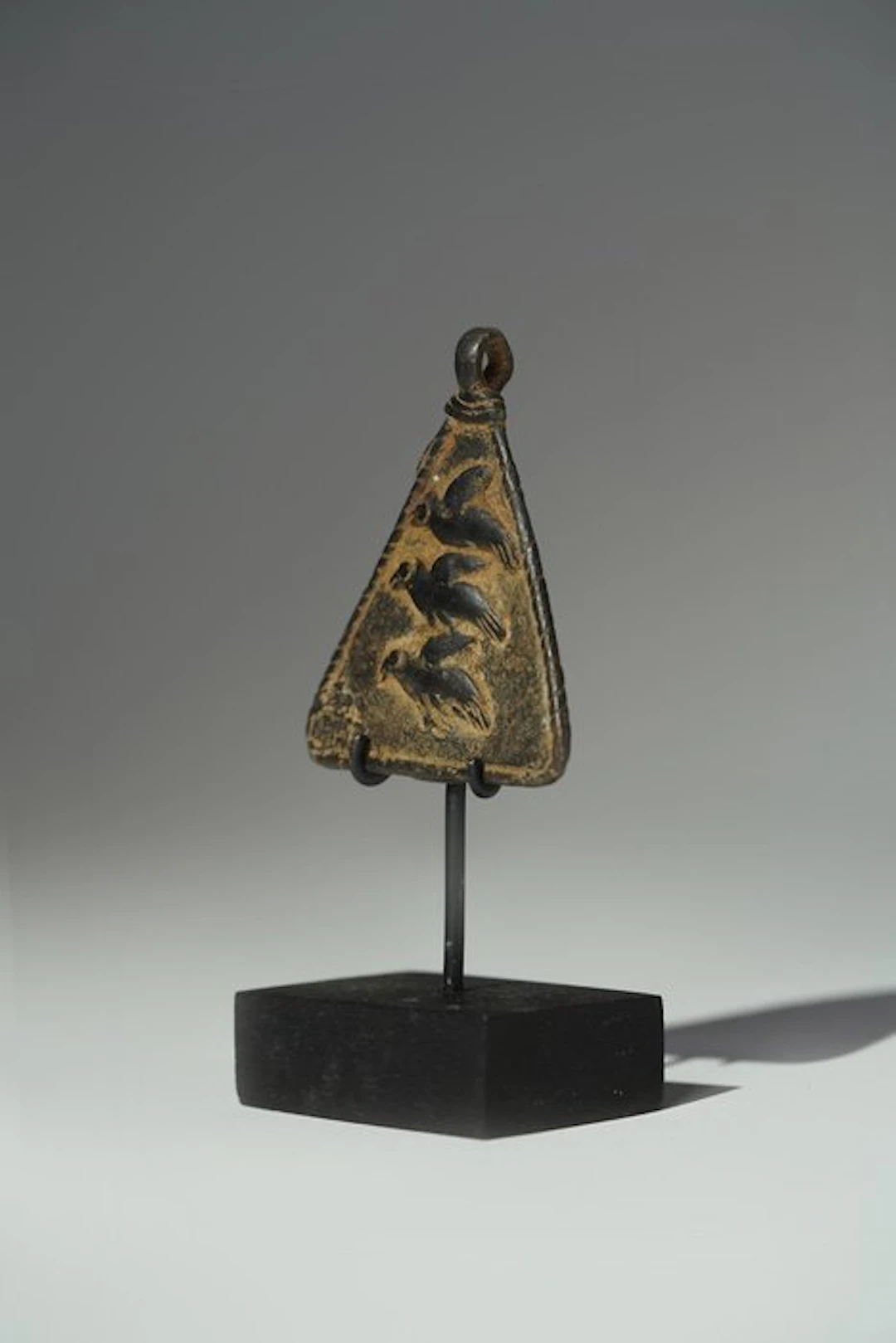
Bronze Gan pendant sculpture, Banfora region, Burkina Faso. A brown-black coloration with ochre patches. This bronze pendant, known as a “Gan,” features a triangular plaque with rounded corners, surmounted by a thick suspension ring whose base is highlighted by two raised ridges. A raised border, marked with oblique incisions resembling a twisted cord, frames the main face. Three stylized birds are arranged vertically on the front, all facing left, each with a protruding beak, a circular eye, a raised wing, and a tail rendered with parallel lines. Their repetition structures the design, while the reverse, which is nearly flat, bears no apparent figurative motif. The surface combines a brown-black coloration with areas of ochre and deposits lodged in the recesses; the raised areas feature smoother, slightly glossy sections. From an ethnological perspective, this piece can be compared to the metal amulets documented among the Gan people of southwestern Burkina Faso, some of which serve a protective function; animal representations also play an important role in objects associated with guardian deities and the memory of the kingdom. The Banfora region of southwestern Burkina Faso is a geographically and culturally rich area located near the borders of Ivory Coast and Mali. Centered around the town of Banfora, the region lies within the Cascades Region, named for its dramatic natural features, including the well-known Cascades de Karfiguéla (Karfiguéla Waterfalls). With its fertile plains, lush vegetation, and scenic landscapes, Banfora stands in contrast to the more arid northern parts of Burkina Faso and plays a key role in the country’s agriculture and tourism. Banfora is home to several ethnic groups, most notably the Gan, Gouin (Gwini), Turka, Diarra, and Senufo peoples. Each group maintains distinct cultural practices, languages, and artistic traditions. The Gan, in particular, are renowned for their bronze casting, producing pendants, figurines, and ritual objects using the lost-wax technique. Their metalwork is spiritually charged and plays a role in religious and ancestral rites. The isolation of the Gan in the nearby hills of Obiré has helped preserve their artistic legacy and royal traditions, including a still-existing local kingship. The Gan pendant is a distinctive piece of cast metalwork associated with the Gan people, a small but culturally rich group known for their sophisticated bronze casting traditions. These pendants, often made of brass or bronze using the lost-wax casting technique, typically depict stylized human or zoomorphic forms, sometimes combining both in a single, composite figure. The motifs—such as riders on horses, mythic animals, or ancestral figures—are deeply symbolic and tied to Gan beliefs about protection, authority, and the spiritual world. Unlike purely decorative ornaments, Gan pendants often served as amulets or status symbols, worn by chiefs, spiritual leaders, or initiated individuals. They were believed to embody spiritual power (nyama) and offer protection against misfortune or malevolent forces. Their intricate designs reflect not only technical mastery but also an oral tradition where symbolism is key; for example, a rider may symbolize leadership or ancestral guidance, while animal features might represent traits like strength or vigilance. These pendants are unique within West African art due to their fusion of abstract and figurative elements, and they are rare because the Gan have preserved their metalcasting traditions in relative isolation, even as neighboring groups adopted other artistic forms. Today, Gan pendants are valued both as spiritual objects and as remarkable examples of indigenous African metallurgy. Roy, Christopher D. Art of the Upper Volta Rivers. Alain and Francoise Chaffin, 1987. Himmelheber, Hans. Negerkunst und Negerkünstler. F. Bruckmann, 1960. Elliott, David. Art of Burkina Faso. Indiana University Press, 1984. Some of the information and photos are generated by artificial intelligence and is based on published sources from the fields of ethnography, archaeology, and art history documents. All information and photos are protected by copyright. Inv. No. MAZ29826 Height: 6,5 cm Weight: 70 g (incl. stand)
Estimate:£127.08
To the auctionView all items fromCatawikiorEthnographical
Estimate:
£127.08
OCT 17 | 10:00 PM


Bring your auction to collectors worldwide!
Get listed nowBy subscribing, you are agreeing to the privacy policy. Unsubscribe anytime.
Barnebys HQ
Brahegatan 10
BOX 5038
114 37 Stockholm
