




All auctions / Ethnographical / A bronze sculpture - Senufo - Côte d'Ivoire (No reserve price)

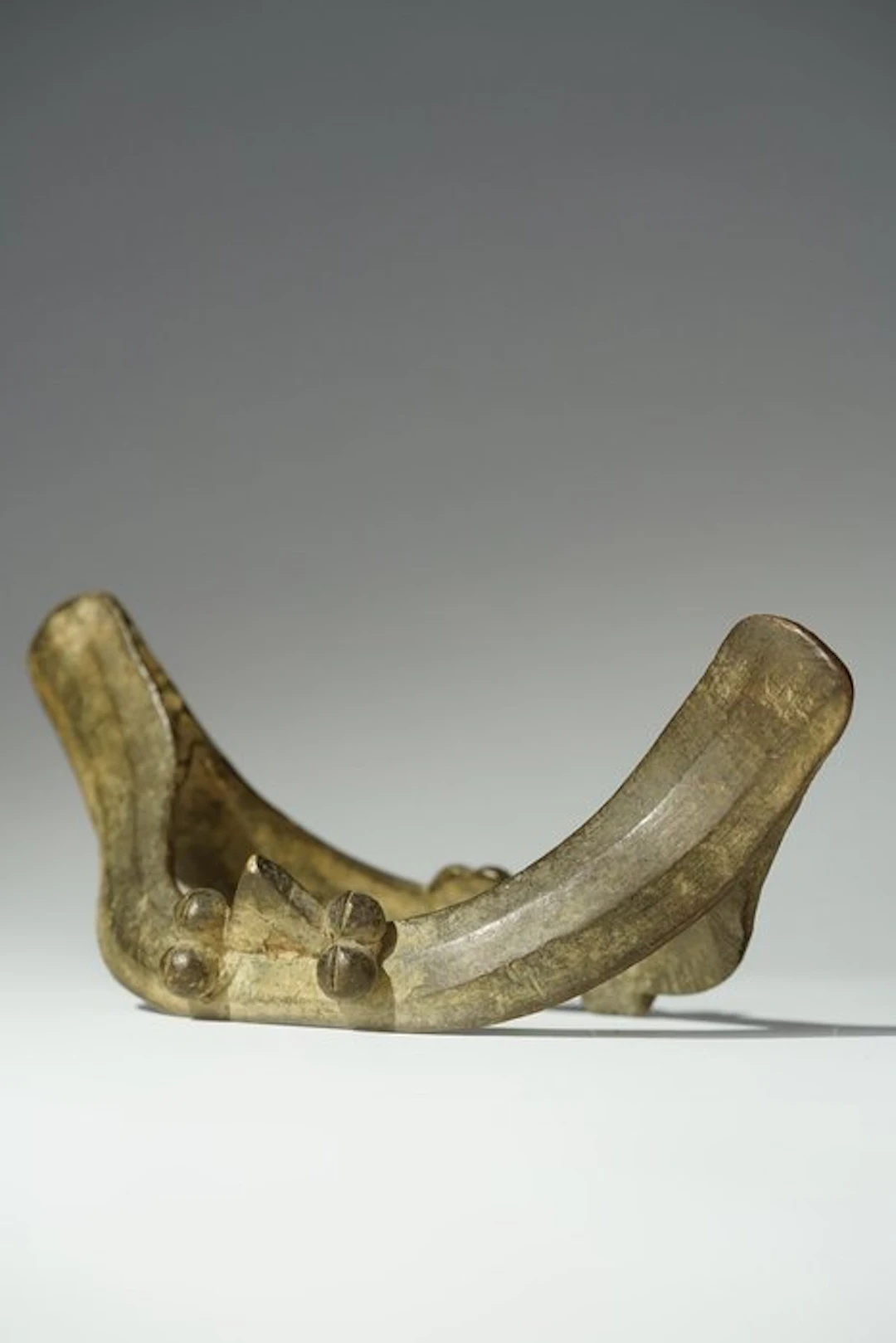
Sculpture Senufo bronze anklets Origin: Northern Côte d'Ivoire, Korhogo region Apparent material: cast copper alloy, traditionally referred to as bronze or brass Description The set pictured appears to consist of two matching pieces, each taking the form of a widely open U-shape, resembling a small boat or a pair of upturned horns. The arms are thick, massive, and gradually widen toward their ends. These ends terminate in flattened, nearly rectangular surfaces with rounded corners. The upper surface of each arm features a long, slightly concave area, edged by lines smoothed by polishing and wear. The overall curvature is highly symmetrical. The lower center is the lowest point of the object, while the ends rise obliquely. Viewed in profile, the piece has a thick cross-section and an almost architectural structure: the arms form a sort of open arch, anchored to the ground by lower widenings that also appear to have contributed to the ornament's stability on the base. The central section is embellished with a relief decoration. On one side there is a central element that is quadrangular or slightly domed in shape, two pairs of annular ridges, and, on the other side, a small triangular point surrounded by four rounded protuberances. These forms are modeled directly from the solid mass of metal and arranged in a balanced composition. The ridges create a repetitive rhythm and emphasize the center of the large curve. The surfaces exhibit a brownish-yellow to olive coloration, with darker areas in the recesses and along certain edges. The protruding parts and the long inner surfaces are lighter and shinier, likely due to friction, handling, or past cleaning. Scratches, small casting irregularities, file marks, and signs of abrasion are visible. The ends show mild wear, with no major fractures apparent in the photographs. Typological Identification The shape closely corresponds to that of objects designated in museum collections as Senufo "foot rings" or "foot bracelets." The National Museum of African Art describes examples made of copper alloy as flared U-shaped or boat-shaped ornaments, featuring a central knob accompanied by ridges. It specifies that these objects were worn in pairs by Senufo women and rested on the tops of their feet. A comparable example is also held at the Metropolitan Museum of Art under the designation "Foot Ring," attributed to northern Côte d'Ivoire and broadly dated to the 19th–20th centuries. The photographs indeed show two objects of similar dimensions and form. It is therefore preferable to identify them as a functional pair rather than as two independent sculptures. The Korhogo region is a plausible attribution given the historical importance of metalworking workshops and markets for metal objects in northern Ivory Coast. However, a precise collection provenance remains necessary to distinguish local Senufo production from an object manufactured or traded by neighboring communities. Historical and Artistic Analysis From a formal perspective, these bracelets straddle the line between body adornment and sculpture. Their aesthetic appeal does not rest on complex figurative iconography, but on the monumental quality of their curve. The central opening becomes a space as significant as the mass of metal surrounding it. The two branches trace an upward movement, while the central decoration visually anchors the composition. The overall form possesses a character that is both supple and powerful. Although cast in solid metal, it evokes a material that is taut or curved. The contrast between the large, continuous curve and the small ridges in the center creates a balance between geometric simplicity and ornamentation. The wide, relatively flat ends accentuate the object's visual presence and would have remained clearly visible when worn. The repetition of the central ridges creates a rhythmic effect. These elements may recall the rings, ligatures, or coils found in other metalwork or sculptural pieces from the region. It would nevertheless be unwise to automatically attribute to them a meaning related to fertility, ancestors, or an initiatory society. In Senufo metalwork, the resemblance of a motif is not sufficient to determine its meaning: this could depend on the owner, the workshop, a divinatory prescription, or a specific local context. The golden color of the metal likely contributed to the object's aesthetic value. Till Förster has demonstrated the importance of the luster of yellow alloys in Senufo metallurgy, which were sometimes valued as an evocation or visual substitute for gold. Polishing, use, and friction renewed this luster, making the metal surface an active quality of the ornament rather than a mere finish. Senufo workshops produced bracelets, rings, pendants, and small figurines using specialized metallurgical techniques, while often working with imported or salvaged metal. The designation "Senufo," however, must be viewed critically. The term encompasses numerous and diverse communities spread across Côte d'Ivoire, Mali, Burkina Faso, and Ghana. Metal objects also circulated among neighboring groups, specialized artisans, traders, and regional markets. Contemporary studies therefore emphasize the need to avoid reducing the label "Senufo art" to a single, static, and exclusively ethnic style. Scientifically Grounded Description The commercial term "bronze" does not reveal the metal's actual composition. African cast objects labeled as such may be bronze in the strict sense—copper and tin—brass—copper and zinc—or a complex alloy containing copper, zinc, tin, and lead. A yellow or brown appearance is not sufficient to distinguish between these compositions. A portable X-ray fluorescence analysis would be necessary to measure the main metallic elements. Lost-wax casting is the most likely technical hypothesis. This method involves modeling the object in wax, encasing it in a clay mold, removing the wax by heating, and then pouring the molten metal into the cavity thus created. Since the mold is destroyed during demolding, each casting is, in principle, unique. The continuity of the forms, the central reliefs integrated into the mass, and the apparent absence of mechanical assembly are consistent with this process. Direct observation should look for remnants of casting channels, chisel marks, file marks, porosity, and any old repairs. An X-ray would reveal the presence of internal cavities, inclusions, casting defects, or added elements. Microscopic examination of corrosion products would make it possible to distinguish naturally formed patinas from layers resulting from treatments, cleaning, or recent applications. Visible patina is not sufficient evidence of age. Olive-brown surfaces, golden areas, and dark marks may result from oxidation, skin contact, dust, oily substances, past cleaning, or intentional patination. Similarly, scratches and polish alone do not allow the object to be dated. Metals cannot be directly dated using carbon-14; reliable dating relies primarily on provenance, typological comparison, technological analysis, and, in exceptional cases, the analysis of associated organic residues. Comparable examples in the collection of the Metropolitan Museum date from the 19th–20th centuries, while those in the Smithsonian's collection are generally dated to the 20th century. It is therefore reasonable to propose this period as a comparative range, without considering it a definitive date for the pair pictured. Social and Ritual Function The best-documented function for this specific form is that of women's jewelry worn in pairs. The rings were placed on the tops of the feet; their weight and opening allowed them to be held in place without completely encircling the ankle. Smaller examples have also been identified as children's jewelry, which were replaced as the girl grew older. Wearing both objects simultaneously created a strong sense of bodily symmetry. Their size, luster, and visibility may have signaled wealth, the care taken in one's appearance, and membership in a family capable of owning significant metal objects. Copper-based metal was indeed a highly valued material, acquired through trade networks and crafted by specialized artisans. This function of prestige remains plausible, but the wearer's exact social status cannot be determined based on the form alone. A protective or divinatory function is also possible, but should not be automatically assumed. Among the Senufo, certain pendants, rings, bracelets, and anklets could be prescribed by a diviner under the name yawiige, "that which follows you." These ornaments helped resolve a problem identified through divination or protect their owner. The Metropolitan Museum notes, however, that the shape alone does not reveal the specific reason why an ornament was prescribed or worn. Other Senufo metal bracelets, notably certain so-called "python" bracelets, are associated with the Sandogo diviners and the powers of the bush. Large, highly ornate examples might have been displayed during divination consultations rather than worn daily. The pair pictured, however, belongs to a different morphological type: it features neither a clearly depicted snake nor an identifiable animal head. It would therefore be scientifically excessive to directly classify it as a Sandogo insignia. The most cautious statement would be as follows: these objects primarily served as women's adornments and symbols of social status; depending on their owner's history, they could take on a secondary protective, ceremonial, or divinatory function. Only field notes or oral history interviews would allow for the establishment of a precise ritual function. Historical and Artistic Assessment This pair demonstrates a remarkable sculptural conception of body ornamentation. The mass of the metal is skillfully shaped to produce a continuous, stable curve that appears visually light despite its thickness. The upturned ends frame a vast empty space, while the reliefs in the center organize the composition and provide it with a focal point. The object should therefore not be considered a mere utilitarian accessory. Its design transforms the foot and alters the wearer's overall silhouette. The bracelet becomes a small, mobile architectural structure whose value lies in its repetition, symmetry, weight, luster, and interaction with the body's movement. Surface wear is part of its history. The polished areas, scratches, and variations in coloration indicate that the object was likely handled or worn, but these features must be preserved as material evidence. Abrasive cleaning or modern polishing would risk erasing the traces of manufacture and use necessary for its study. Bibliography Förster, Till. Glänzend wie Gold: Gelbguß bei den Senufo, Elfenbeinküste. Berlin: Dietrich Reimer, Museum für Völkerkunde, 1987. A major work devoted to the casting of yellow alloys, the artisans, and the uses of Senufo metal ornaments. Förster, Till. Paroles de devin: Lost-Wax Casting Among the Senufo of Côte d'Ivoire. Cahier de l'ADEIAO, no. 6. Paris: National Museum of African and Oceanic Arts, 1988. A catalog focusing on the technique, metal objects, and their relationship to divination. Bourgois, Geert Gabriel. Decorated Rings in Lost-Wax Casting from the Senufo. Ghent: State University of Ghent, Department of Ethnic Art, 1988. A specialized study of Senufo rings, bracelets, decorative motifs, and casting techniques. Glaze, Anita J. Art and Death in a Senufo Village. Bloomington: Indiana University Press, 1981. A seminal ethnographic study of Senufo art, social divisions, ritual specialists, and ceremonial practices. Gagliardi, Susan Elizabeth. *Senufo Unbound: Dynamics of Art and Identity in West Africa*. Cleveland: Cleveland Museum of Art, 2015. An essential critical work for understanding the diversity of communities and challenging the notion of a uniform Senufo style. The publications mentioned serve for comparative art historical classification. They do not establish the specific cultural attribution, dating, or original use of the sculpture in question. Copyright and Scientific Documentation Some of the information and photographs have been generated with the assistance of artificial intelligence and are based on published sources in ethnography, archaeology, and art history. Original texts and photographs may be protected by copyright. All rights held by the respective copyright holders are reserved. Inv. No. MAZ32753
Estimate:£175.89
To the auctionView all items fromCatawikiorEthnographical
Estimate:
£175.89
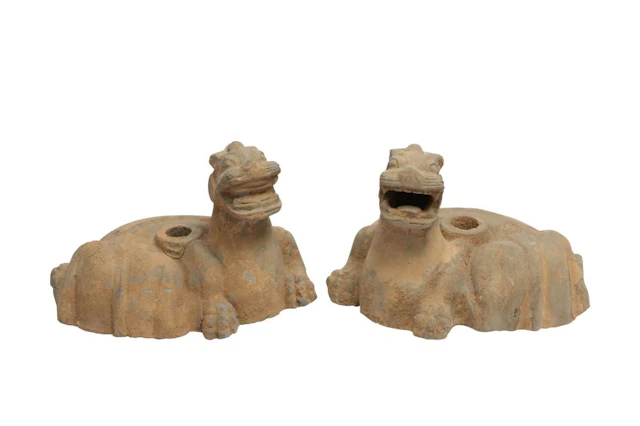
A PAIR OF CHINESE POTTERY 'MYTHICAL BEASTS' CANDLESTICKS.
02/22/2022
£220
Est: £100
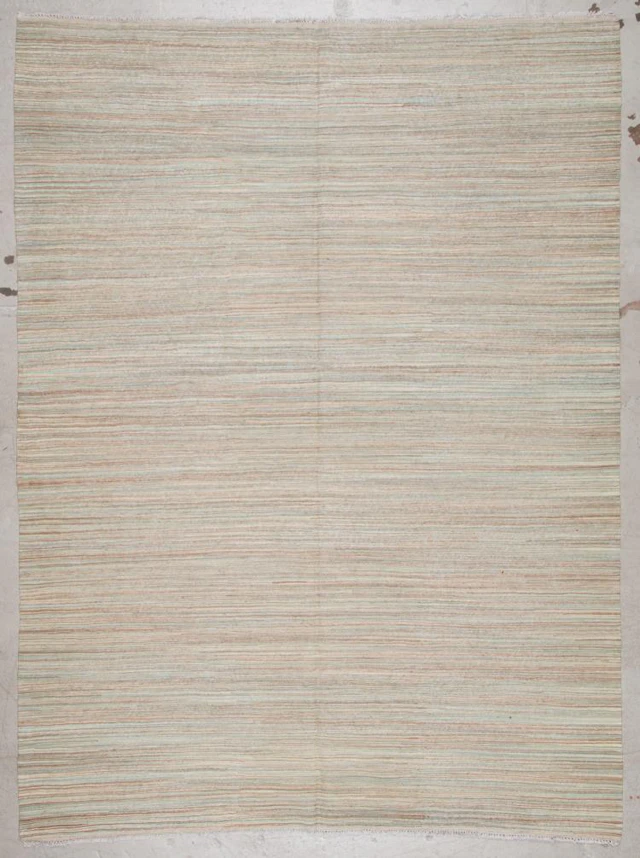
Modern Mid Century Style Kilim: 7'1'' x 9'8'' (216 x 295 cm)
08/21/2017
£170.32
Est: £302.8


OCT 27 | 4:00 PM
Bring your auction to collectors worldwide!
Get listed nowBy subscribing, you are agreeing to the privacy policy. Unsubscribe anytime.
Barnebys HQ
Brahegatan 10
BOX 5038
114 37 Stockholm
