



OCT 8 | 3:00 PM

Bring your auction to collectors worldwide!
Get listed nowBy subscribing, you are agreeing to the privacy policy. Unsubscribe anytime.
Barnebys HQ
Brahegatan 10
BOX 5038
114 37 Stockholm
All auctions / Watches & Clocks / A FINE AND VERY RARE GEORGE III EIGHT-DAY MARINE CHRONOMETER
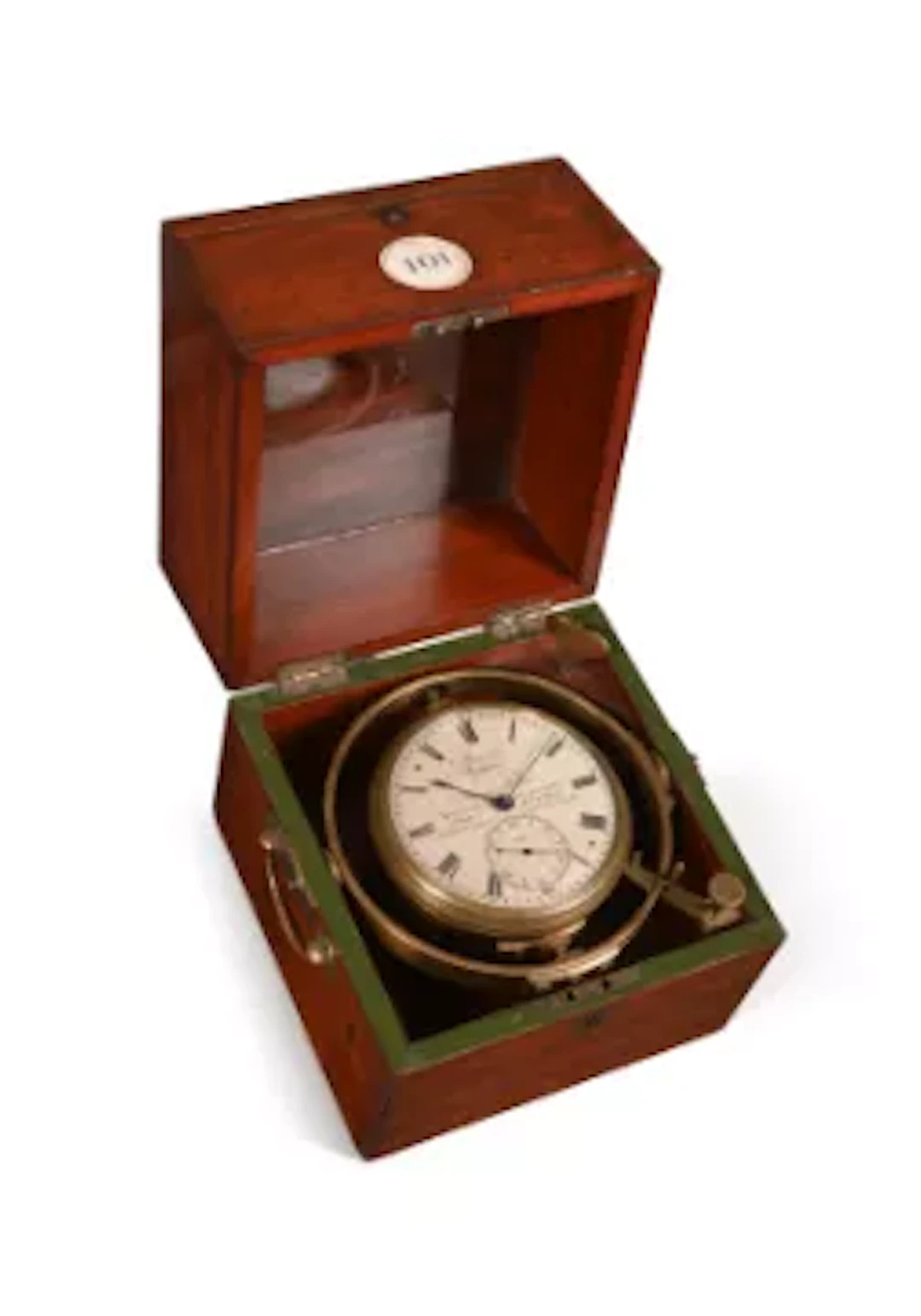
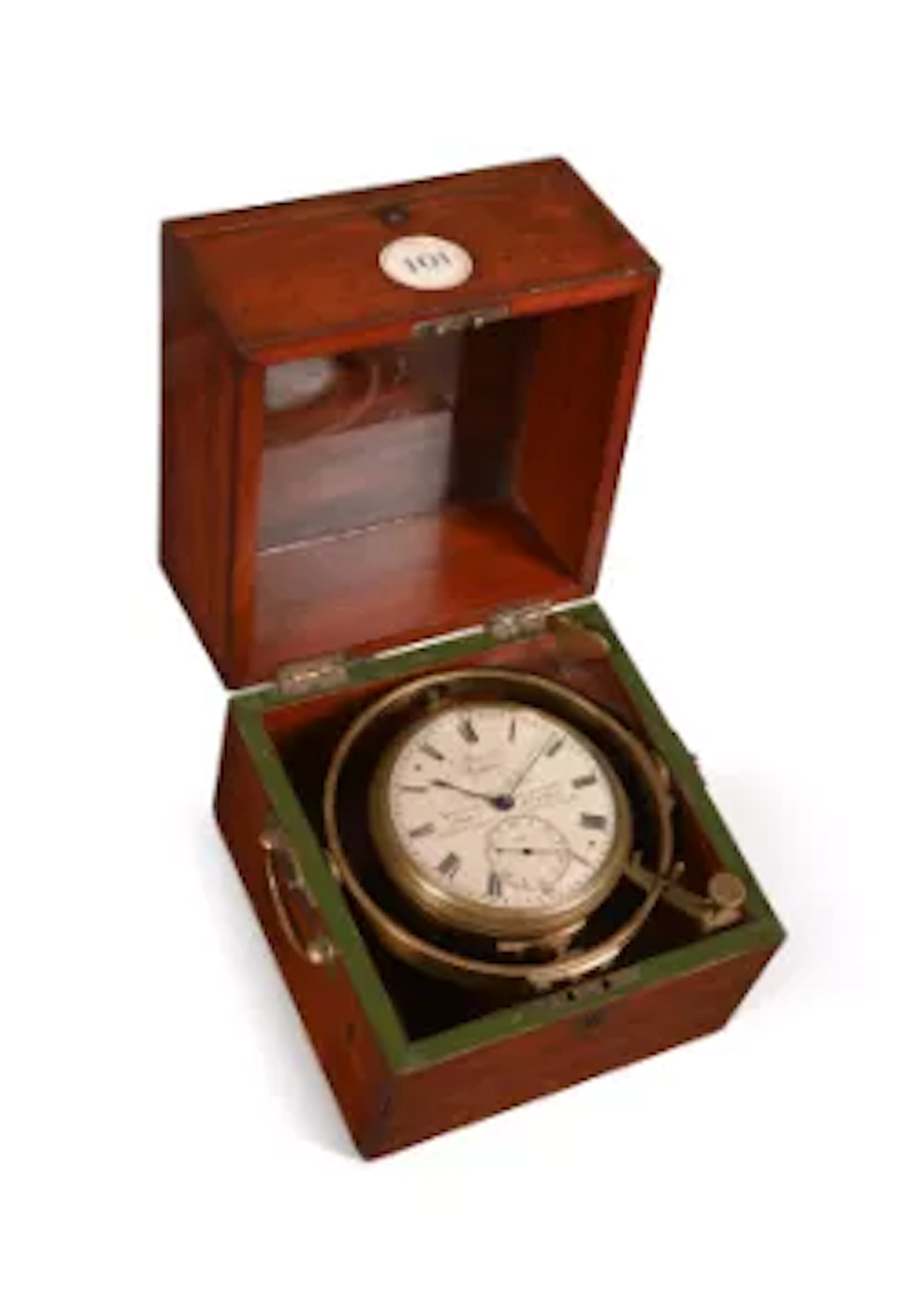
A FINE AND VERY RARE GEORGE III EIGHT-DAY MARINE CHRONOMETER GEORGE MARGETTS, LONDON, NO. 101 CIRCA 1798 The circular single chain fusee movement with four distinctive baluster turned steel pillars secured by screws through the three-quarter backplate enclosing the wheel train up to the fourth wheel, with five/six-spoke crossings, Harrison's maintaining power, and cocks mounted on the pillar plate for both the third and fourth wheel pivots with the latter set on the dial side beyond a circular aperture, the fusee with a further set of teeth to allow side-winding via a perpendicular wheel fitted with clicks and a square pivoted between a tab applied to the pillar plate and a bridge spanning both plates, the escapement and balance assembly set on a sunken sub-frame platform constructed with three small pinned pillars, with Earnshaw type spring detent and escapewheel pivoted beneath a jewelled cock visible next to the blued steel helical sprung bimetallic balance, fitted with cylindrical timing weights and screws to the pierced rim below a faceted diamond endstone, now fitted with a 4.5 inch circular silvered brass Roman numeral dial with subsidiary seconds dial at six o'clock enclosing serial engraved number 101 beneath inscription Margetts, London, Corrected, by, Morris Tobias. New balance and spring by, JOHN HUTTON, 10 Mark Lane, LONDON. AD 1858 to centre, with blued steel hands set behind a friction-fit moulded cast brass convex glazed bezel secured by screws into a plain cylindrical bowl, now mounted via gimbals alongside the brass typsy winding key into a mahogany three tier box, inset with a turned circular ivory plaque inscribed 101 to the middle tier over scallop-edged circular brass escutcheon to front, the sides with hinged brass carrying handles. 22cm (8.75ins) cubed. Provenance: The property of a private collector. George Margetts is recorded in Betts, Jonathan MARINE CHRONOMETERS AT GREENWICH, A Catalogue of Marine Chronometers at the National Maritime Museum, Greenwich as born in Old Woodstock, Oxfordshire in 1748. His family were wheelwrights however his talents were recognised at the age of eighteen after he devised and constructed a form of tellurium followed by an astronomical clock. This brought him to the attention of the Duke of Marlborough who went on to finance Margett's move to London and development of his skills and a clock and watchmaker. George Margetts married Mary Bellamy on 22nd March 1776 and gained his Freedom of the Clockmakers' Company in 1779 (by redemption). Working from 12 Ludgate Street he specialised in the production of fine astronomical watches and also devised and published his own charts and tables to allow Longitude to be calculated by the lunar distance method. He was also awarded fifty guineas by the Board of Longitude for correcting navigational tables. In addition to this Margetts produced timepieces for the Asian markets facilitated through connections with the East India Company. Unfortunately, a downturn in the Indian trade (precipitated by political affairs in Hindostan) led to Margetts becoming bankrupt in 1788. Through dogged determination George Margetts re-established himself and turned his attention to the production of marine chronometers. In 1790 he took in James Hatton as an apprentice and sought to obtain support from the Board of Longitude to develop a new form of detached escapement. This was not forthcoming however they did subsequently fund printing of navigational tables amounting to £370 by the end of 1794. In 1796 George Margetts again approached the Board in an attempt to obtain financial support for the production of marine chronometers. Whether he succeeded in his request is not clear however he went on to produce around 220 marine timekeepers by 1804. In order for his chronometers to stand-out from his competitors, he tended to produce timepieces longer duration often incorporating high pinion and wheel counts. Very few of his chronometers went into service with the Royal Navy with most apparently being personally acquired by Officers of the East India Company, perhaps assisted by connections established prior to his bankruptcy in 1788. In 1798 Margetts took-in James Hatton into partnership hence the firm became known as Margetts and Hatton. From 1802 the business traded from 3 Cheapside however Margetts health declined resulting in his death in 1804. James Hatton continued trading under his own name until 1816 when he took another former Margetts apprentice, Clement Harris, into partnership. Harris continued after Hatton's death in 1824 until 1842 when the business was taken-on by Richard Webster of Cornhill. George Margetts chronometers are characterised through their relatively long duration, provision of side winding and use of distinctive baluster-turned polished steel pillars within their construction. They were originally supplied with white enamel dials and without gimbal mounts being designed to simply rest on a pillow. Almost all surviving examples have been subsequently converted to be supported within gimbal mounts and converted to rear winding. The present chronometer is a rare survivor in that it still retains its original side winding mechanism. The cylindrical brass bowl and bezel are also original however the gimbal mounts and box most probably date from relatively soon after Margett's death in 1804. The conversion to a three-quarter back plate (with the escapement set on a recessed sub plate) mirrors that seen on Margetts number 163 illustrated by Betts on page 246 (Figure 4.12.10). In the text Betts indicates that the conversion was done by James Hatton in around 1811 hence it is likely he performed the same modification to the present lot around the same time, as well as adding gimbal mounts and a box. The chronometer was subsequently re-dialled by the Morris Tobias circa 1825 whilst undertaking further 'corrections'. Interestingly, rather than just sign the dial with his name (which would have been common practice at this time), Tobias chose to also include 'Margetts' most likely as a mark of high esteem for the original maker. Finally, a further inscription denoting the fitting of a 'New Balance and spring' by John Hutton (worked from 9 Lucas Place, Commercial Road, London 1830-68) was added in 1858. The present chronometer is a very rare and interesting example retaining Margetts original side-winding mechanism to the bowl and with later updates clearly recorded on the dial. As such it provides an interesting window into re-use and updating employed within the chronometer trade during the first half of the 19th century, as well as an indication as to the high regard given to the original maker, George Margetts, by subsequent chronometer makers over a span of at least fifty years. Condition Report: Please note Dreweatts have an ivory exemption certificate licence for this lot N13PYBGM. CONDITION REPORT AVAILABLE FROM THE DEPARTMENT ON REQUEST. Condition Report Disclaimer, A FINE AND VERY RARE GEORGE III EIGHT-DAY MARINE CHRONOMETER, GEORGE MARGETTS, LONDON, NO. 101 CIRCA 1798, A FINE AND VERY RARE GEORGE III EIGHT-DAY MARINE CHRONOMETER GEORGE MARGETTS, LONDON, NO. 101 CIRCA 1798 The circular single chain fusee movement with four distinctive baluster turned steel pillars secured by screws through the three-quarter backplate enclosing the wheel train up to the fourth wheel, with five/six-spoke crossings, Harrison's maintaining power, and cocks mounted on the pillar plate for both the third and fourth wheel pivots with the latter set on the dial side beyond a circular aperture, the fusee with a further set of teeth to allow side-winding via a perpendicular wheel fitted with clicks and a square pivoted between a tab applied to the pillar plate and a bridge spanning both plates, the escapement and balance assembly set on a sunken sub-frame platform constructed with three small pinned pillars, with Earnshaw type spring detent and escapewheel pivoted beneath a jewelled cock visible next to the blued steel helical sprung bimetallic balance, fitted with cylindrical timing weights and screws to the pierced rim below a faceted diamond endstone, now fitted with a 4.5 inch circular silvered brass Roman numeral dial with subsidiary seconds dial at six o'clock enclosing serial engraved number 101 beneath inscription Margetts, London, Corrected, by, Morris Tobias. New balance and spring by, JOHN HUTTON, 10 Mark Lane, LONDON. AD 1858 to centre, with blued steel hands set behind a friction-fit moulded cast brass convex glazed bezel secured by screws into a plain cylindrical bowl, now mounted via gimbals alongside the brass typsy winding key into a mahogany three tier box, inset with a turned circular ivory plaque inscribed 101 to the middle tier over scallop-edged circular brass escutcheon to front, the sides with hinged brass carrying handles. 22cm (8.75ins) cubed. Provenance: The property of a private collector. George Margetts is recorded in Betts, Jonathan MARINE CHRONOMETERS AT GREENWICH, A Catalogue of Marine Chronometers at the National Maritime Museum, Greenwich as born in Old Woodstock, Oxfordshire in 1748. His family were wheelwrights however his talents were recognised at the age of eighteen after he devised and constructed a form of tellurium followed by an astronomical clock. This brought him to the attention of the Duke of Marlborough who went on to finance Margett's move to London and development of his skills and a clock and watchmaker. George Margetts married Mary Bellamy on 22nd March 1776 and gained his Freedom of the Clockmakers' Company in 1779 (by redemption). Working from 12 Ludgate Street he specialised in the production of fine astronomical watches and also devised and published his own charts and tables to allow Longitude to be calculated by the lunar distance method. He was also awarded fifty guineas by the Board of Longitude for correcting navigational tables. In addition to this Margetts produced timepieces for the Asian markets facilitated through connections with the East India Company. Unfortunately, a downturn in the Indian trade (precipitated by political affairs in Hindostan) led to Margetts becoming bankrupt in 1788. Through dogged determination George Margetts re-established himself and turned his attention to the production of marine chronometers. In 1790 he took in James Hatton as an apprentice and sought to obtain support from the Board of Longitude to develop a new form of detached escapement. This was not forthcoming however they did subsequently fund printing of navigational tables amounting to £370 by the end of 1794. In 1796 George Margetts again approached the Board in an attempt to obtain financial support for the production of marine chronometers. Whether he succeeded in his request is not clear however he went on to produce around 220 marine timekeepers by 1804. In order for his chronometers to stand-out from his competitors, he tended to produce timepieces longer duration often incorporating high pinion and wheel counts. Very few of his chronometers went into service with the Royal Navy with most apparently being personally acquired by Officers of the East India Company, perhaps assisted by connections established prior to his bankruptcy in 1788. In 1798 Margetts took-in James Hatton into partnership hence the firm became known as Margetts and Hatton. From 1802 the business traded from 3 Cheapside however Margetts health declined resulting in his death in 1804. James Hatton continued trading under his own name until 1816 when he took another former Margetts apprentice, Clement Harris, into partnership. Harris continued after Hatton's death in 1824 until 1842 when the business was taken-on by Richard Webster of Cornhill. George Margetts chronometers are characterised through their relatively long duration, provision of side winding and use of distinctive baluster-turned polished steel pillars within their construction. They were originally supplied with white enamel dials and without gimbal mounts being designed to simply rest on a pillow. Almost all surviving examples have been subsequently converted to be supported within gimbal mounts and converted to rear winding. The present chronometer is a rare survivor in that it still retains its original side winding mechanism. The cylindrical brass bowl and bezel are also original however the gimbal mounts and box most probably date from relatively soon after Margett's death in 1804. The conversion to a three-quarter back plate (with the escapement set on a recessed sub plate) mirrors that seen on Margetts number 163 illustrated by Betts on page 246 (Figure 4.12.10). In the text Betts indicates that the conversion was done by James Hatton in around 1811 hence it is likely he performed the same modification to the present lot around the same time, as well as adding gimbal mounts and a box. The chronometer was subsequently re-dialled by the Morris Tobias circa 1825 whilst undertaking further 'corrections'. Interestingly, rather than just sign the dial with his name (which would have been common practice at this time), Tobias chose to also include 'Margetts' most likely as a mark of high esteem for the original maker. Finally, a further inscription denoting the fitting of a 'New Balance and spring' by John Hutton (worked from 9 Lucas Place, Commercial Road, London 1830-68) was added in 1858. The present chronometer is a very rare and interesting example retaining Margetts original side-winding mechanism to the bowl and with later updates clearly recorded on the dial. As such it provides an interesting window into re-use and updating employed within the chronometer trade during the first half of the 19th century, as well as an indication as to the high regard given to the original maker, George Margetts, by subsequent chronometer makers over a span of at least fifty years. 101, Margetts, London, Corrected, by, Morris Tobias. New balance and spring by, JOHN HUTTON, 10 Mark Lane, LONDON. AD 1858, Provenance:, MARINE CHRONOMETERS AT GREENWICH, A Catalogue of Marine Chronometers at the National Maritime Museum, Greenwich, Condition Report:, Please note Dreweatts have an ivory exemption certificate licence for this lot N13PYBGM. CONDITION REPORT AVAILABLE FROM THE DEPARTMENT ON REQUEST. Condition Report Disclaimer
Estimate:£7,000
To the auctionView all items fromDreweattsorWatches & Clocks
Estimate:
£7,000
OCT 8 | 3:00 PM


OCT 8 | 3:00 PM

Bring your auction to collectors worldwide!
Get listed now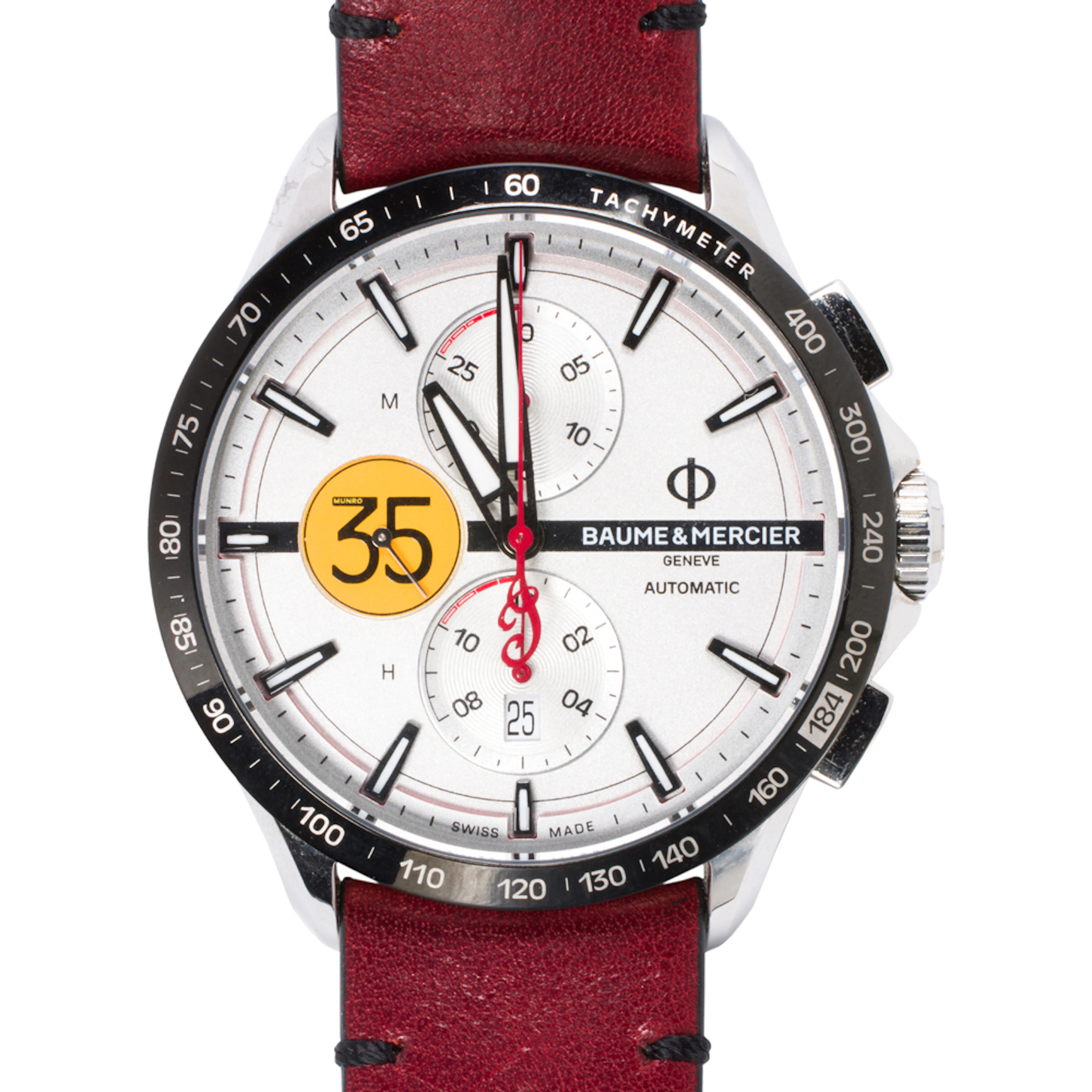
A Baume and Mercier Clifton-Club Indian Motorcycle stainless steel watch
10/16/2026
£603.02
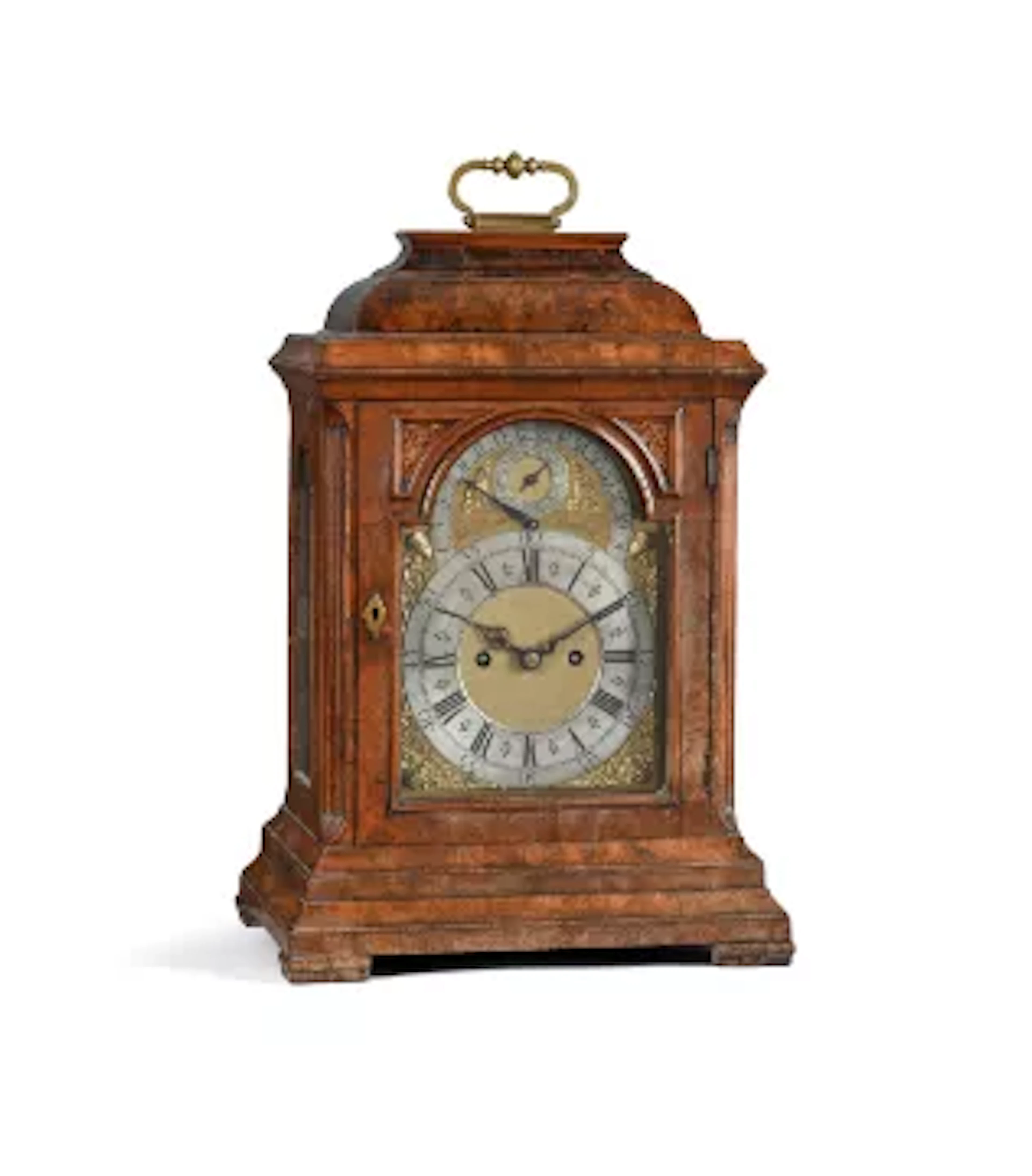
A FINE GEORGE II BURR WALNUT TABLE/BRACKET CLOCK WITH FLY-BACK CALENDAR
09/10/2026
£18,000
Est: £5,000
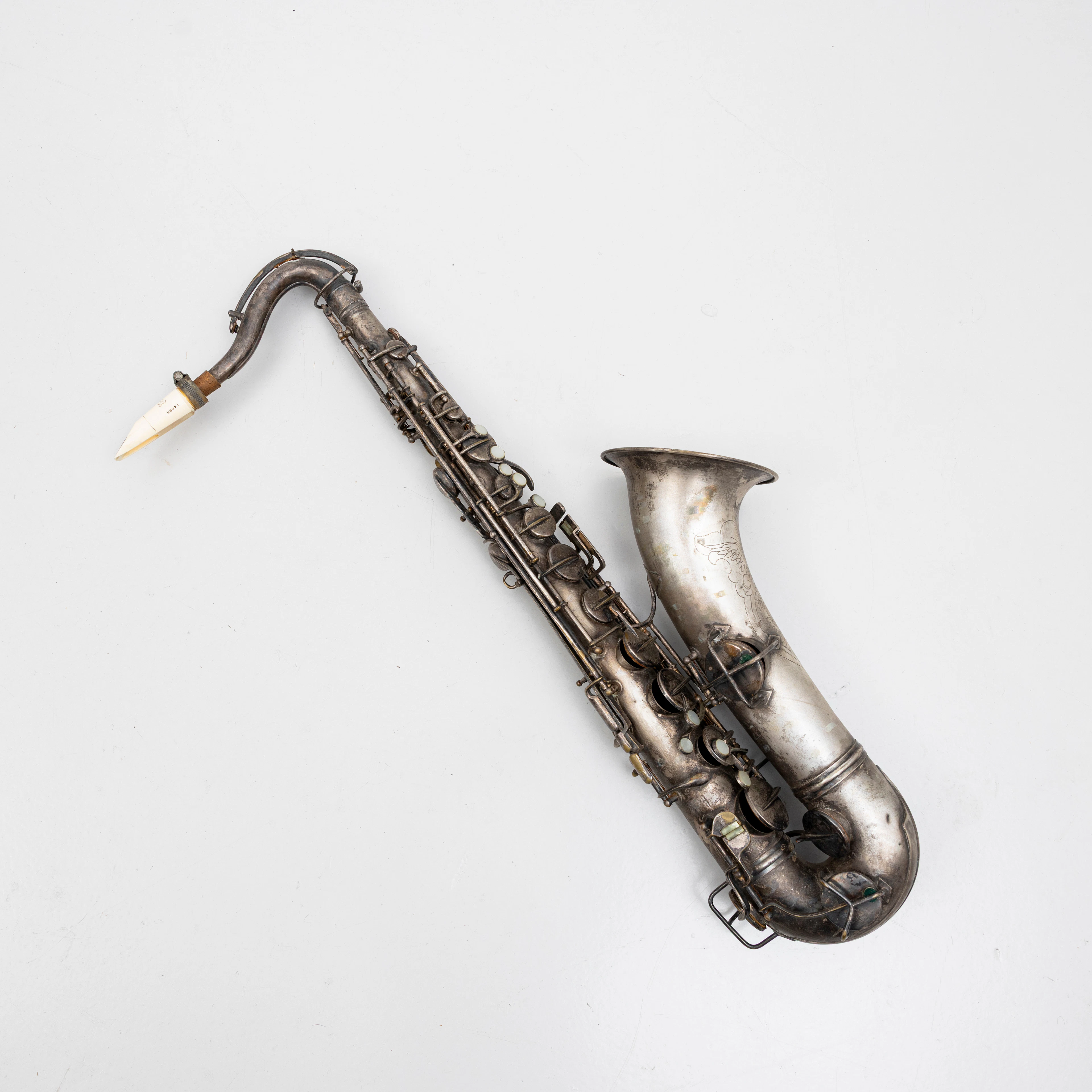
TENORSAXOFON. Cavalier, Elkhart Indiana, producerad av The Pan American
08/17/2026
£232.4
Est: £387.77