



All auctions / Ethnographical / A iron sculpture - Mumuye - Nigeria (No reserve price)

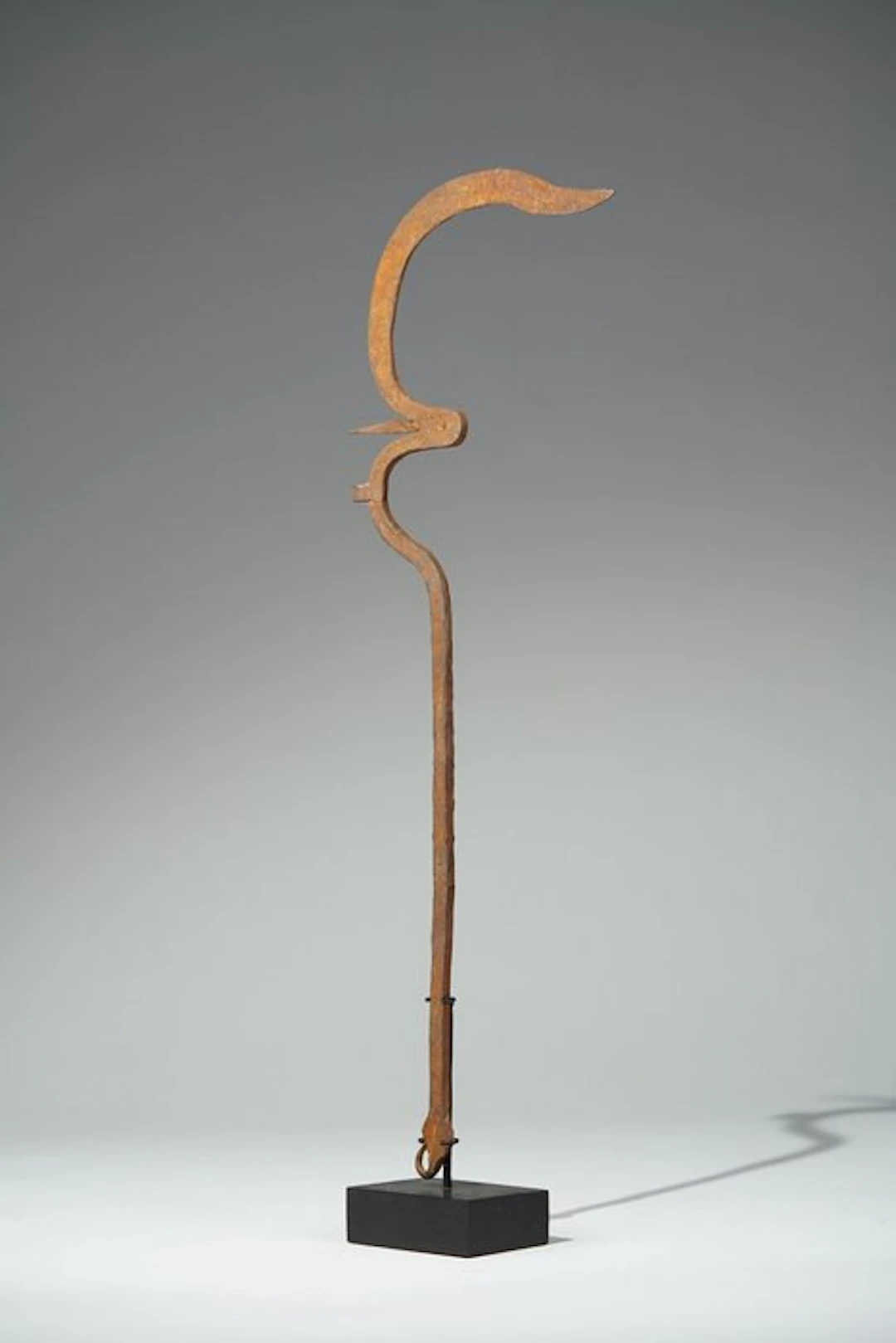
Iron Sculpture by Mumuye – Abstract Iron Sculpture with Curved Silhouette Origin: Taraba Region, Northeast Nigeria Cultural Attribution: Mumuye, attributed Material: Iron, forged, with a reddish-brown oxidation patina, incl stand. Dating: Uncertain Description This iron sculpture from the Taraba region of northeastern Nigeria is characterized by an exceptionally minimalist yet dynamic formal language. Its slender, vertically oriented form develops from a long, almost straight iron shaft, which transitions in the upper section into a complex sequence of curved and hook-shaped elements. The object possesses a distinctly linear silhouette, the effect of which arises primarily from the interplay between straight, curved, and pointed forms. The lower shaft is crafted from a narrow iron rod, the irregular surface of which suggests hand-forged workmanship. At its lower end is a small ring-shaped eyelet, which may have originally served for fastening or suspension. The current black display base is a modern addition. In the upper third, the shaft initially develops into a gently curving line extending to the left, which transitions into a small, hook-like projection. Above this, a second, more pronounced bend follows, turning sharply to the right. A short, tapered extension protrudes laterally from this area. The upper main form then describes a wide, almost semicircular arc, the end of which extends horizontally to the right and tapers to a narrow point. This large, crescent-shaped curve forms the visual focal point of the entire composition. The surface is covered with a uniform, reddish-brown oxidation layer of varying intensity in places. Minor irregularities, slight thickening of the material, and the not entirely symmetrical rendering of the contours underscore the hand-forged character. The figure achieves its unique effect through the deliberate limitation to a single, continuous axis of movement, which dissolves in the upper section into a series of rhythmically interrelated curves. Cultural and Geographical Context The Mumuye are an ethnic group in northeastern Nigeria, particularly in present-day Taraba State. Their historical settlement areas extend across the landscapes south of the Benue River and the adjacent savannah and hill country. The region is characterized by extraordinary cultural diversity, with the Mumuye, Chamba, Jukun, Wurkun, and other communities interacting over long periods. The material culture of these groups includes not only wooden sculptures but also metal tools, weapons, jewelry, and objects with potential ceremonial significance. The Mumuye's figurative wood carvings are particularly well-known, featuring anthropomorphic sculptures characterized by elongated bodies, abstracted limbs, and a pronounced rhythmic structure. These works were used in various social and religious contexts, including protective beliefs, healing practices, and connections to spiritual forces. Ironworking held both practical and symbolic significance in many societies of the Benue region. Blacksmiths possessed specialized technical knowledge that enabled the transformation of iron through fire and mechanical processing. However, the social standing of blacksmiths and religious beliefs about the material varied considerably between communities. The present iron sculpture has been culturally attributed to the Mumuye people. Whether its form actually corresponds to a specific Mumuye tradition or originated within a broader regional context cannot be definitively determined without documented comparative objects. Formal Language and Possible Symbolism The object's unusual shape opens up various possibilities for iconographic interpretation. The large upper curve is reminiscent of a bent neck, a sickle-shaped head, or an abstract animal form. The two smaller, lower curves could be interpreted as further anatomical allusions. The pointed projections, in particular, lend the form a certain resemblance to stylized beaks, horns, or other animal features. However, a definitive identification as a bird, snake, or other living being would be speculative. It could also be a symbolically designed iron object whose form does not explicitly intend a representational image. In various West African meta-cultures All traditions feature highly abstracted figures and symbols whose meaning only becomes clear from their original ritual or social context. The flowing lines could suggest notions of movement, vitality, or transformation. However, such interpretations should not be considered definitive cultural statements. The designation as a sculpture initially describes the object's current aesthetic perception, while its original purpose may have been more functional or ceremonial. Possible Ritual Function Forged iron objects could be part of protective rituals, ceremonial acts, or religious institutions in various societies of northeastern Nigeria. In certain regional traditions, metal objects were associated with spiritual powers, while others served as symbols of rank, implements, or symbolic attributes. Due to its slender form and the small eyelet at the bottom, the present form may originally have been mounted, placed on a surface, or integrated into a larger object arrangement. Its use as a finial, emblem, or component of ritual equipment seems plausible. Its resemblance to a functional hook or staff device should also be considered. The sweeping upper curve and the two lateral extensions may have served a practical purpose in addition to their symbolic function. Without information on the original context of discovery or acquisition, possible signs of use, and comparable ethnographic pieces, it is impossible to distinguish between these possibilities. Therefore, a concrete use in ancestor worship, initiations, or in connection with healing rituals has not been proven. Art Historical Analysis From an art historical perspective, the object bears a remarkable resemblance to an abstract, linear conception of sculpture. Unlike sculpture developed from closed volumes, its spatial effect arises almost exclusively from the movement of a slender iron form in space. The long vertical shaft forms a calm, stabilizing axis, while the upper section develops a series of increasingly sweeping curves. This composition creates a dynamic transition from static rectilinearity to dynamic movement. The large upper curve appears almost to float and lends the otherwise strictly vertical form a pronounced horizontal extension. The smaller hooks and points in the central area mediate between these two directions. The significance of the surrounding void is particularly noteworthy. The curved iron sections enclose open areas that become essential components of the overall sculptural effect. The viewer thus perceives not only the forged material but also the spaces it creates. From today's perspective, this aesthetic quality is reminiscent of principles in modern abstract metal sculpture. However, such a formal parallel should not be equated with a historical influence or a shared artistic intention. The traditional ironworking of the Benue region developed its own technical, social, and design prerequisites. The mastery of wrought iron is particularly evident here in the controlled creation of tight bends, the gradual alteration of the material's cross-section, and the precisely pointed ends. The irregular oxidation surface reinforces the sculpture's material character and forms a captivating contrast to the elegance of its contours. Art Historical Assessment The exceptional quality of this iron sculpture attributed to Mumuye lies in its extraordinary formal concentration. With just a few forged lines, a complex, rhythmically dynamic form emerges, its expressiveness arising from the interplay of material, contour, and negative space. The large, crescent-like curve lends the object a distinctive silhouette, while the smaller hook-like forms create a subtle inner tension. As a testament to a regional tradition of ironworking, the sculpture illustrates the creative possibilities of a material that could be used for both practical and symbolic purposes. Its contemporary aesthetic impact is undeniable, yet its original function, precise cultural context, and dating remain unclear without further documentation. It is precisely this combination of meticulous craftsmanship, radical abstraction, and potential symbolic meaning that makes the object a remarkable example of West African metalwork. Literature Frank Herreman (ed.): Mumuye Sculpture: Nigeria. The African Museum, Berg en Dal, 1997. Karl-Ferdinand Schaedler: Earth and Ore: 2500 Years of African Art in Terra-Cotta and Metal. Panterra Verlag, Munich, 1997. The publications mentioned serve to provide a general art historical context for Mumuye art and African metalworking traditions. They do not constitute direct documentation of the iron object in question or a definitive determination of its original function. Copyright and Scientific Documentation Some of the information and photographs have been generated with the assistance of artificial intelligence and are based on published sources in ethnography, archaeology, and art history. Original texts and photographs may be protected by copyright. All rights held by the respective copyright holders are reserved. Inv. No. MAZ31209 Informant: Amadou Dogo
Estimate:£230.33
To the auctionView all items fromCatawikiorEthnographical
Estimate:
£230.33


OCT 27 | 4:00 PM
Bring your auction to collectors worldwide!
Get listed nowBy subscribing, you are agreeing to the privacy policy. Unsubscribe anytime.
Barnebys HQ
Brahegatan 10
BOX 5038
114 37 Stockholm
