


OCT 17 | 10:00 PM

All auctions / Ethnographical / A wooden mask - Igbo - Nigeria (No reserve price)

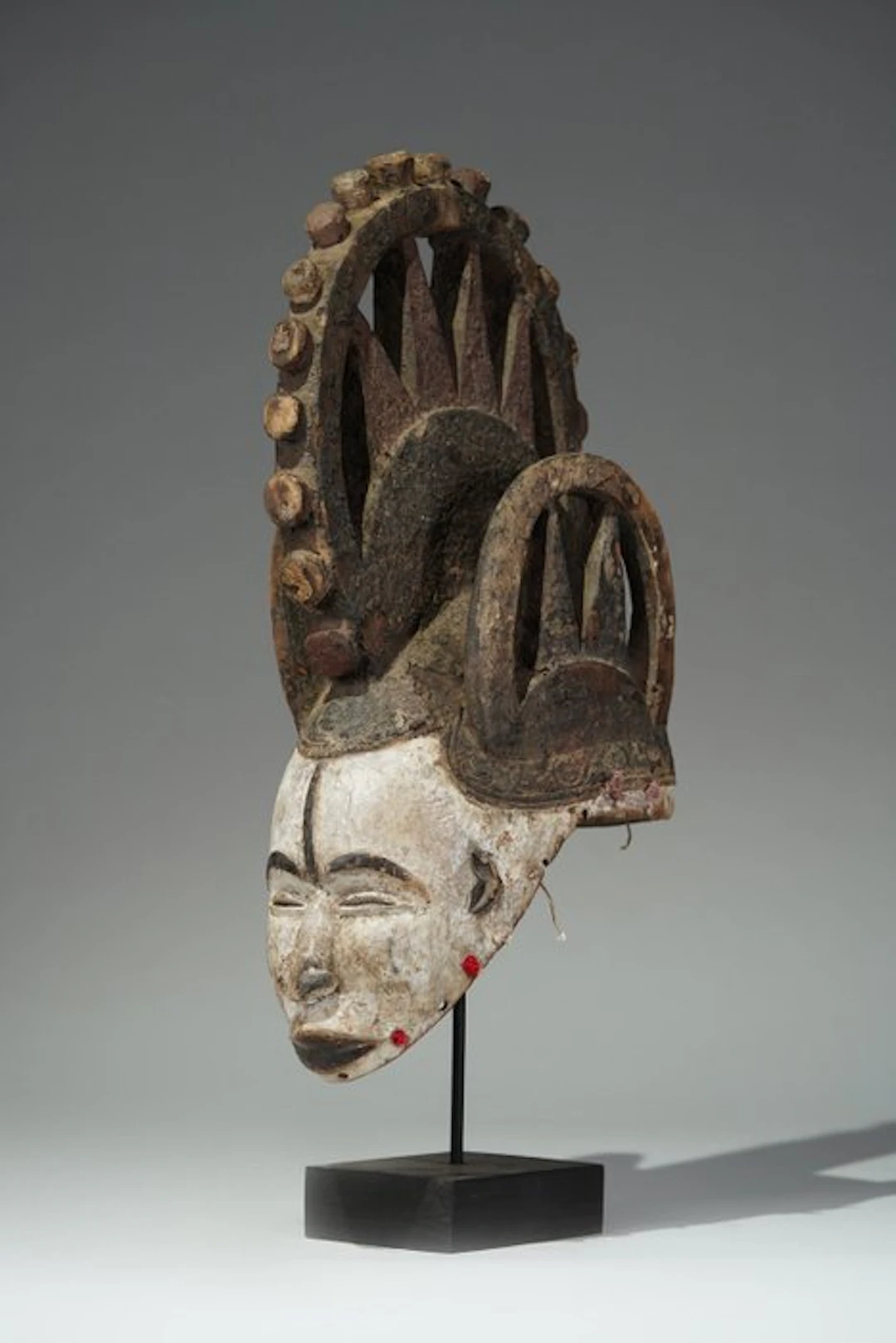
Igbo Girl Spirit Mask - Owerri Region, Nigeria, incl stand. The wooden mask combines a finely sculpted, white-painted face with an exceptionally tall, openwork hairstyle. Narrow eyes, a long nose, and a small mouth give the face a serene, idealized expression. Above this unfolds a complex structure of high crests, tapered ridges, and arched elements, their edges rhythmically punctuated by disc-like appliqués. Dark, reddish-brown, and light pigments, as well as small textile remnants, enliven the surface. Holes along the edge likely served to attach additional costume pieces. Formally, the work is closely related to the Agbogho-Mmuo masks ("girl spirit") of the Igbo people of southeastern Nigeria. Characteristic features include the pale face and the spectacularly elaborate hairstyle, which visualize notions of youthful beauty, grace, and socially valued feminine qualities. Such masks were worn by male dancers and could be used during the dry season, as well as at festivals and funerals. In the Owerri region, a particularly diverse art and ritual tradition developed; Herbert M. Cole extensively documented the interplay of artworks, dance, and religious practice there. Literature (selection): Herbert M. Cole / Chike C. Aniakor: Igbo Arts: Community and Cosmos. Los Angeles 1984. Herbert M. Cole: Mbari: Art and Life among the Owerri Igbo. Bloomington 1982. Herbert M. Cole: Visions of Africa: Igbo. Milan 2013. THE PHOTO Mask, Fashion, and the Question of Cultural Appropriation The image is constructed as a staged photographic tableau. A young, bald Black woman stands upright in an almost empty, worn room. She wears an opulent, historically inspired dress whose silhouette evokes the Baroque and Rococo while also recalling the visual world of Vivienne Westwood. With both hands, she holds an African mask directly in front of her face. She is not wearing it yet. It is the moment before—the instant of looking, examining, and perhaps deciding. Almost the entire photograph is monochrome. Body, dress, architecture, and even the blurred image in the background belong to the same black-and-white photographic world. Only the mask retains its earthy shades of brown, ochre, red, and ivory. This seemingly simple decision alters the hierarchy of the entire image. The mask does not become a decorative accessory to the dress; instead, it is the only object that resists the image’s aesthetic homogenization. Light assumes a second ordering function. Harsh side light enters through the tall window, casting geometric shadows that structure the wall, floor, and body. There is a distant echo here of **Neue Sachlichkeit (New Objectivity)** and its preference for formal clarity, materiality, and precise use of light. Yet the image is anything but objective. The austere architecture merely forms the stage for a psychologically and historically charged encounter. The imagined aesthetic of a Leica photograph from around 1970—grain, deep blacks, available light, and the apparent simplicity of the situation—establishes another art-historical connection. Here, the image touches upon European auteur photography of the 1960s and 1970s. The previously mentioned affinity with **Francesca Woodman**, too, lies less in direct stylistic imitation than in the question of how body, space, concealment, and identity can be interconnected. In the present version, this connection acquires additional significance through the **blurred image of a female figure in the background**. This image within the image is not merely decoration. Its figure is difficult to grasp, almost disembodied—half apparition, half memory. While the woman in the foreground possesses an extraordinary physical presence, the second woman exists only as a photographic representation. Different degrees of presence thus emerge: the real body, its potential second face in the form of the mask, and finally the body in the background that has already become an image. This layering recalls a central question of photographic modernism: **When is a body a subject, when does it become an image, and when does it become a surface for projection?** The background figure introduces this question quietly, without competing with the main figure. It functions almost like the photographic memory of the room. In this way, the image acquires a past that is not narrated but merely made visible as a trace. And it is precisely here that another, today unavoidable, art-historical reading begins: that of **cultural appropriation**. The combination of an African mask and European fashion is historically far from innocent. Classical European modernism appropriated African sculptures and masks on a large scale as aesthetic material. In doing so, these objects were often removed from their religious, social, and political contexts and reclassified according to European categories. European avant-garde artists could admire their forms and use them for their own artistic renewal, while the makers, communities, and original contexts of meaning largely remained invisible. Postcolonial critique is therefore not directed against cultural exchange as such. Rather, what matters are questions of **power, authorship, context, and economic benefit**: Who is permitted to use a cultural sign? Who defines its meaning? Who receives recognition? And who profits from its transformation into art, fashion, or commodity? It is precisely for this reason that the connection to **Vivienne Westwood** is both interesting and contradictory. Her work, too, belongs to a history of fashion in which the appropriation of historical and cultural signs forms part of the creative principle. Like few other designers, Westwood dismantled and recombined existing systems of signs—court dress, British tradition, punk, ethnographic references, and historical cuts. Yet from a postcolonial perspective, this freedom of quotation becomes fraught when the signs being used originate in cultures whose relationship with Europe has been shaped by colonialism and unequal power relations. Remarkably, the image does **not attempt to resolve this tension by making cultural difference invisible**. On the contrary: it allows the conflict to remain visible. On one side stands the Westwood dress. It embodies European fashion history, courtly silhouettes, punk, deconstruction, and the global luxury market. On the other stands the African mask—an object whose meaning cannot be fully translated into the language of European fashion. Between them stands the woman. What matters is her action: **She is not yet wearing the mask.** This may be the most important detail in the entire composition. In conventional fashion photography, the mask could easily have become a styling device. It would have been worn, combined with the dress, and thereby aesthetically assimilated. Cultural otherness would have become a *look*. Here, the opposite occurs. The woman holds the mask in front of her. A distance remains between her face and the face of the mask. This space between them can be understood as a form of **ethical distance**. The mask is seen, held, and contemplated, but it has not yet been appropriated. It remains an Other, a counterpart in its own right. Selective color also acquires a more precise meaning in this context. The Westwood dress is subjected to the monochrome photographic order. It even loses some of its luxurious material quality and becomes part of the same gray world as the body, architecture, light, and past. The mask, by contrast, retains its color, its patina, its traces of use, and thus its **material autonomy**. Formally speaking, it is allowed to remain different. This is precisely why it is important that the color does not spread to other elements of the image. The mask is not “exoticized” through color; rather, it is initially removed from the historical simulation of the black-and-white photograph. It possesses a different kind of presence from the rest of the scene. The woman’s position also alters a traditional colonial order of looking. She is neither an ethnographic object of observation nor a passive model to whom a Western photographer has added a supposedly exotic attribute. She is the active figure in the image. **She holds the mask. She looks at it. She determines the distance. And only she could decide whether the space between the two faces is to be closed.** The question thus shifts from *“May this mask be used?”* to a considerably more interesting one: **Under what conditions can an encounter between cultural forms take place without one consuming the other?** The image does not answer the postcolonial debate through a simple moral formula. Its response is instead visual: not possession, but encounter; not fusion, but relationship; not the erasure of cultural difference, but the willingness to sustain a distance. At this point, the blurred photograph in the background also acquires its full significance. It introduces a **third image of the human being**. In the foreground is the living face of the woman. Opposite it stands the carved face of the mask. Behind them appears a human body that has already become photography. This creates a remarkable iconographic sequence: Body – Mask – Image. The blurred figure in the background can almost be read as a warning. It shows what happens once a person has been transformed entirely into an image: they lose clarity, physical presence, and ultimately perhaps even their history. Against this background, the care with which the woman holds the mask becomes all the more significant. She does not immediately take possession of it. She first regards it as something that already possesses a history of its own. In this respect, the scene differs fundamentally from an older modernist principle of appropriation. European artists could absorb African forms into their own formal languages until the African object had almost disappeared behind the European artwork. Here, by contrast, the mask remains visibly a **mask**. It does not become Westwood. And Westwood does not become Africa. The two cultural systems stand side by side—and the woman’s body is not the site where one conquers the other, but the site where their relationship is negotiated. This also explains the photograph’s peculiar temporality. The dress refers to the eighteenth century and its European aristocratic order. The mask refers to another cultural genealogy. The photographic language suggests approximately the year 1970. The blurred photograph in the background, in turn, seems already to contain the memory of an even earlier photographic past. Yet the image itself is created in the twenty-first century and is read through our contemporary debates about colonialism, restitution, representation, and cultural appropriation. Several different times coexist within the same image. For this reason, the work can be situated art-historically as **contemporary staged photography with references to New Objectivity, Surrealist visual logic, and the subjective photography of the 1970s**, while at the same time being read essentially within the context of postcolonial image criticism. Its true subject, then, would not be identity in the sense of an unambiguous cultural belonging. Rather, it would be the question of **how identity can be negotiated in the presence of culturally and historically charged images and objects**. The photograph therefore does not answer the intense debate surrounding cultural appropriation with a simple yes or no. Instead, it proposes something visual that at least approaches a possible answer: **Recognition requires distance. Encounter does not have to mean possession. And cultural exchange may begin precisely where the Other does not first have to be stripped of its autonomy in order to become part of a shared image.** Seen in this way, the actual work resides neither in the mask, nor in the dress, nor in the woman alone. It resides in the **few centimeters between the two faces**. At the same time, the blurred image in the background reminds us of what is at stake: that a human being, an object, or a culture can become an image onto which others project their own ideas. The distance between the woman and the mask is therefore not empty. Some of the information and photos are generated by artificial intelligence and is based on published sources from the fields of ethnography, archaeology, and art history documents. All information and photos are protected by copyright. Inv. No. MAZ29314 Informant: Wassiu incl. Photo on FinArt Baryta paper ca 10 x 15 cm incl Passepartout 2/10 signed exemplars delivery time two weeks Height: 57 cm Weight: 2,8 kg (incl. stand)
Estimate:£275.34
To the auctionView all items fromCatawikiorEthnographical
Estimate:
£275.34
![[EXPOSITION — ART PRÉCOLOMBIEN]. — Art précolombien du Mexiq - Lot 16](https://bbys.imgix.net/3696/b519c06a7d60ab1d06569a9d8cbd76d0d5b9fa8d8827af22307153052be1674e.webp?auto=format&w=3840&q=75)
[EXPOSITION — ART PRÉCOLOMBIEN]. — Art précolombien du Mexiq - Lot 16
09/27/2026
£18.87
Est: £12.89
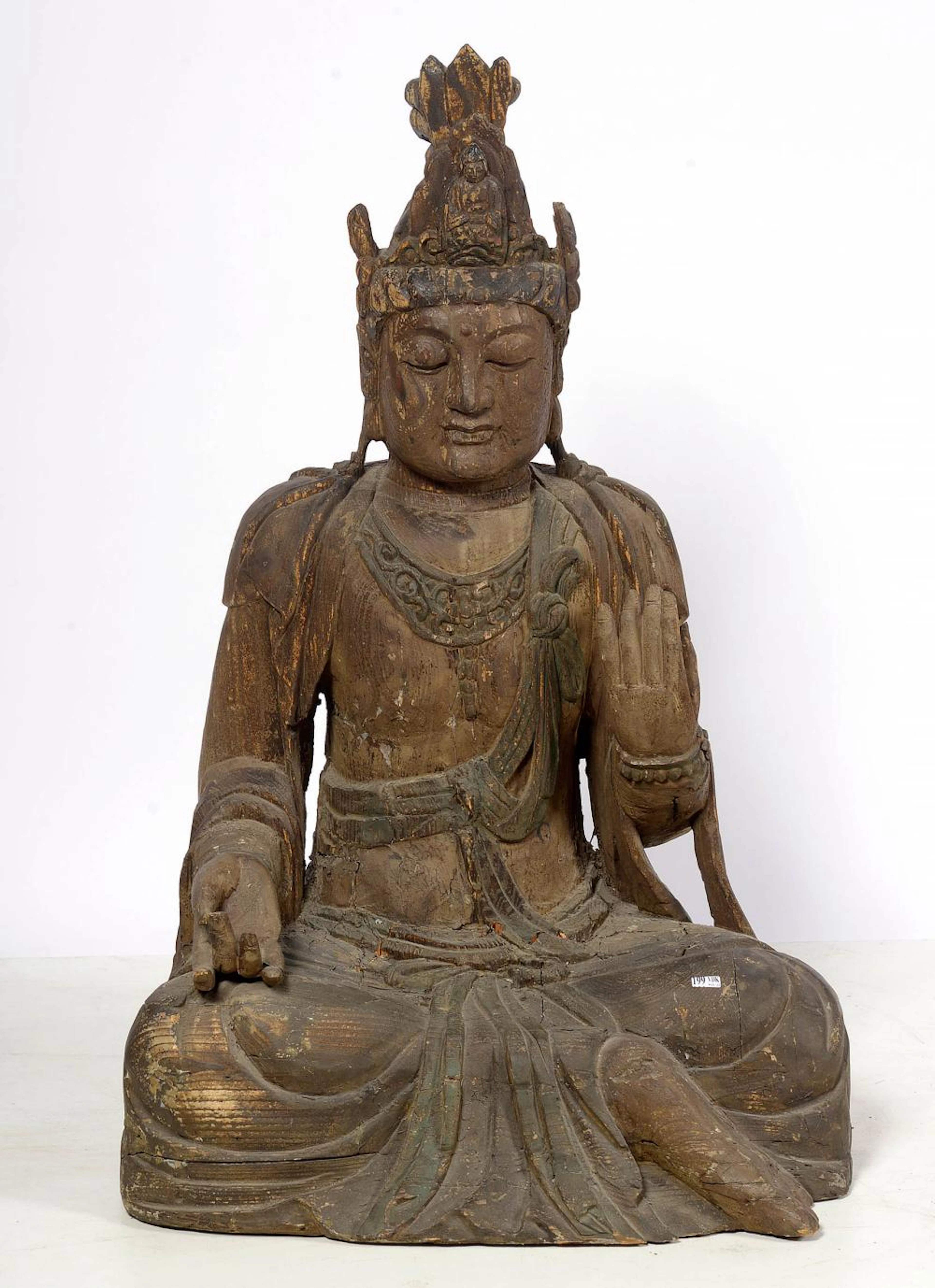
Art Asiatique "Grand Maitreya assis" en bois sculpté et portant des
11/14/2023
£1,740
Est: £1,740
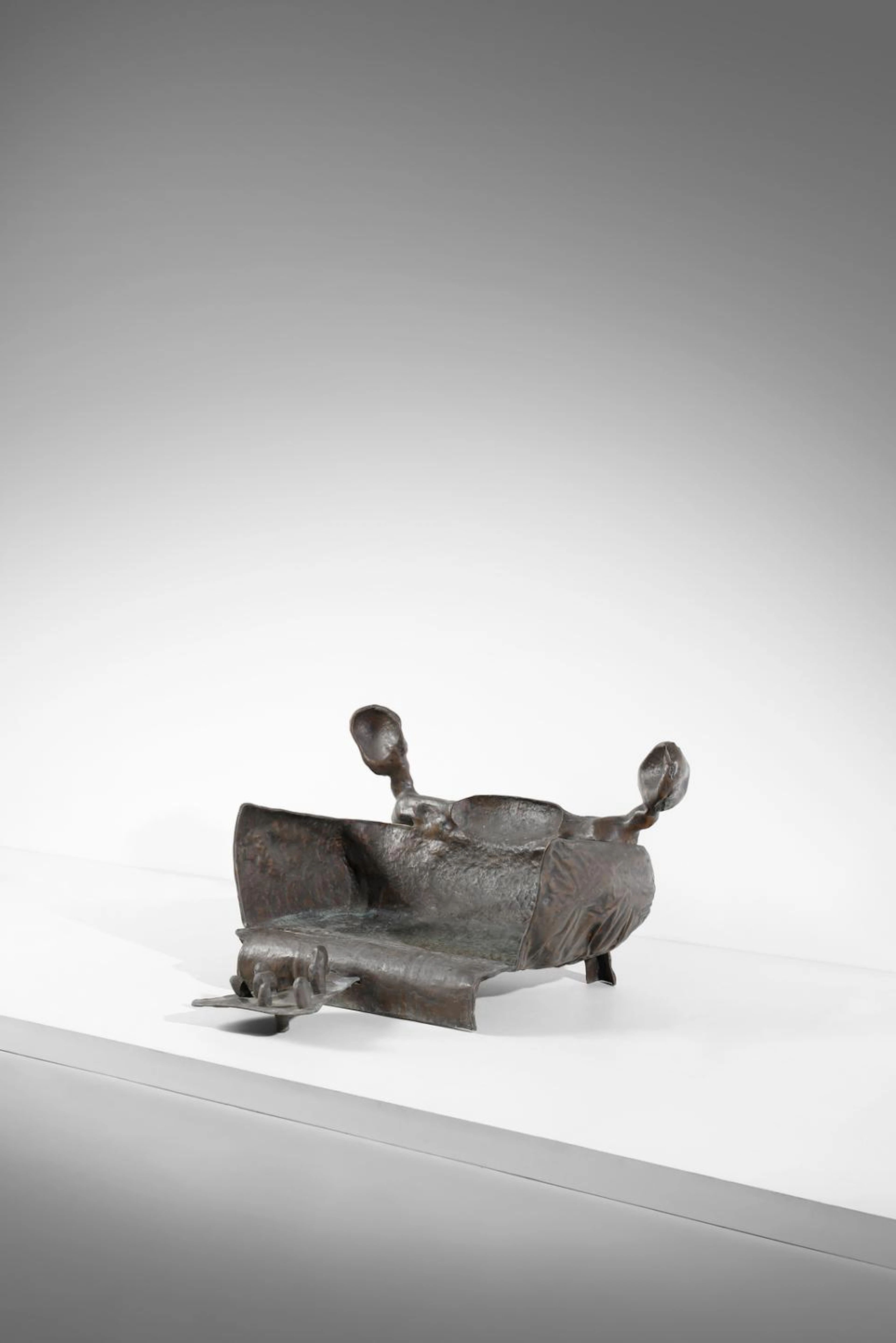
MATTA ROBERTO SEBASTIAN ANTONIO (1911 - 2002) Poltrona Eureka
05/18/2023

£6,307.2
Est: £13,140
OCT 17 | 10:00 PM


Bring your auction to collectors worldwide!
Get listed nowBy subscribing, you are agreeing to the privacy policy. Unsubscribe anytime.
Barnebys HQ
Brahegatan 10
BOX 5038
114 37 Stockholm
