



All auctions / Ethnographical / A wooden sculpture - Fon - Togo (No reserve price)

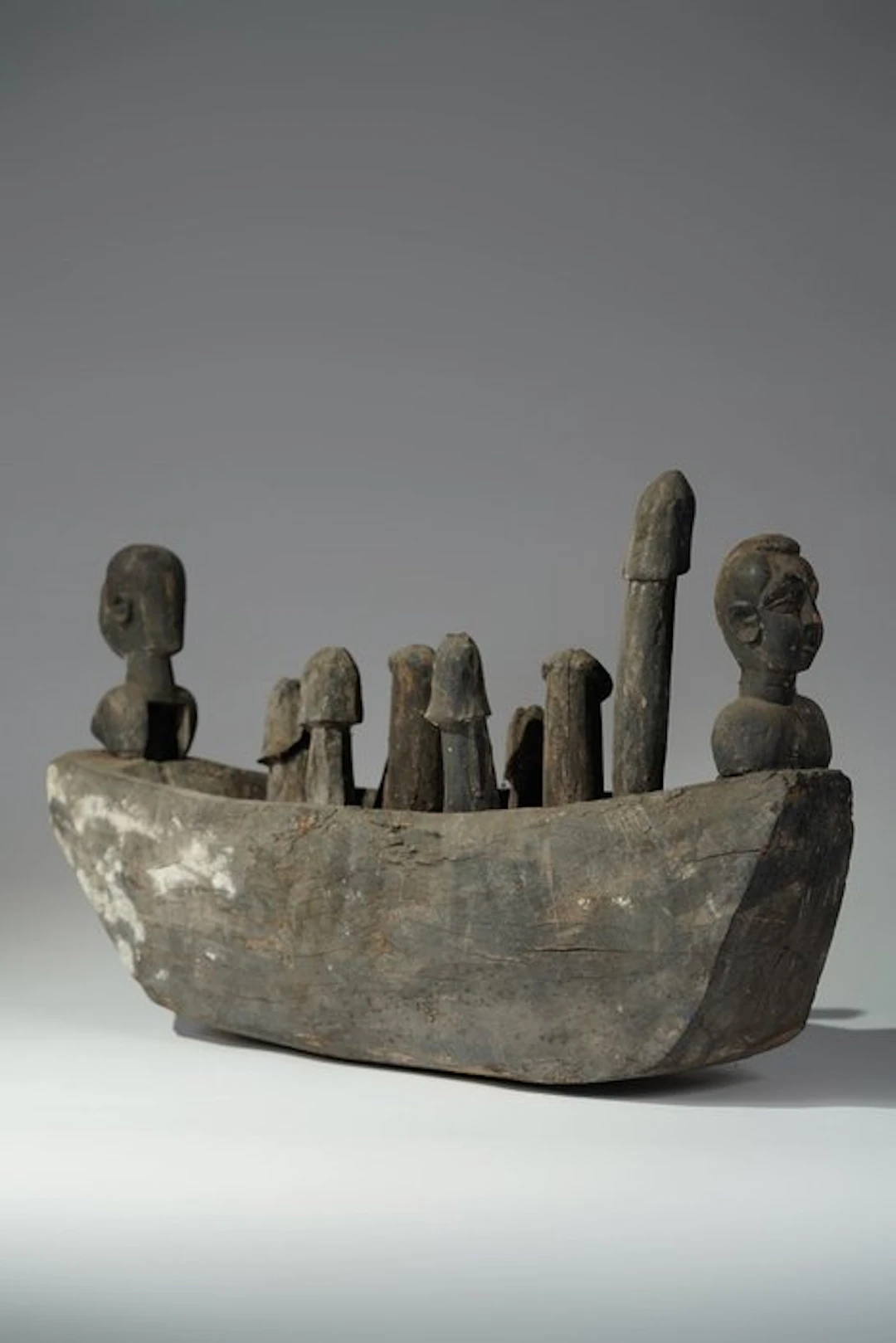
Fon/Ewe fetish sculpture, votive or altar canoe made of wood Origin: Aného region, Togo. Material: brown-black to gray wood, matte patina, numerous longitudinal cracks, erosion, traces of carving, and several whitish patches. Description The sculpture is centered around a hull that appears to be carved from a single piece of wood, thick and deeply hollowed out, with a silhouette resembling that of a boat with raised ends. The wood, which ranges from brown-black to gray, has a matte patina, numerous longitudinal cracks, signs of erosion, traces of carving, and several whitish patches. These patches could be kaolin, ash, sacrificial materials, or more recent alterations; however, their composition cannot be determined from the photograph alone. Two anthropomorphic busts are attached to the ends of the hull. Both face outward, as if watching over the bow and stern of the dugout canoe. Their forms are more elaborately rendered than those of the central figures: oval heads, ears in relief, elongated eyes, straight noses, open or protruding mouths, roughly indicated hairstyles, and strongly developed chests. Their opposing positions create a two-way surveillance system. Between these busts stand approximately eight vertical forms of varying sizes. Some appear to be extremely simplified figures, reduced to a cylindrical torso topped by a conical or wrapped head; others have a distinctly phallic shape. The tallest one dominates the composition near one end. This tightly packed arrangement gives the impression of a group of passengers, spirits, or deities on board rather than that of a simple household vessel. Historical-Artistic and Material Analysis The hull provides a stable horizontal mass, while the figures introduce a deliberately irregular vertical rhythm. The two terminal busts frame the scene like guardians, ancestors, or tutelary figures. The central figures form an assembly hierarchically arranged by size. The work does not seek naturalism: it emphasizes repetition, silhouette, accumulation, and evocative power. The figures appear to have been carved separately and then inserted into the shell using tenons. A comprehensive material analysis should identify the wood species through microscopic examination, verify the joints via X-ray, and analyze the white or organic deposits. The dark patina, cracks, and residues are insufficient to establish the object's date. In Vodun art, the visible form often results as much from the initial carving as from subsequent manipulations, libations, offerings, and substances intended to activate or maintain the object. This work likely belongs to the todjivu family, a Fongbe term used to refer to ritual canoes depicting humans, deities, animals, food, and beings from the invisible world. The Château Vodou describes them as "materialized prayers" and houses examples from Togo and Benin associated, depending on the case, with Dan, Sakpata, Toxosu, the twins, or the memory of enslaved people. A historical parallel is provided by a 19th-century Fon altar sculpture housed at the Nelson-Atkins Museum of Art: it depicts a large boat populated by nine figures and has been cautiously interpreted as a fishing or war fetish dedicated to Legba. This comparison confirms the existence of a distinct genre of ritual boat-shaped sculptures, though it does not allow for the automatic identification of the deity represented in this piece. Ritual Function The canoe here is less a miniature means of transportation than a condensed ritual space. In coastal Vodun shrines, it may represent the passage between the land, the lagoon, the sea, the human world, the ancestors, and invisible powers. Research conducted in an Ewe fishing community in southern Togo shows that the shrine constitutes a landscape that is simultaneously religious, ecological, economic, and social, in which water, fishing, historical memory, and spirits are closely intertwined. The phallic elements may refer to fertility, generative power, or Legba, a deity associated with thresholds, communication, and sexual potency; however, this interpretation remains hypothetical. They may also represent highly stylized figures, spirits, or objects intended to bear ritual offerings. The two busts placed at the ends may depict protectors, ancestors, a founding couple, or two complementary powers. The most likely function is that of a votive offering placed in a shrine to ask for protection, prosperity, fertility, a successful catch, safe travel on the water, or the appeasement of a spiritual power. The canoe may also have served a commemorative function: certain todjivu evoke those who drowned, children associated with Toxosu, or even the memory of the Atlantic slave trade. Nevertheless, without a local name, testimony from a priest, preserved ritual contents, or historical collection records, none of these interpretations should be considered definitive. Selected Bibliography Blier, Suzanne Preston. *African Vodun: Art, Psychology, and Power*. Chicago: University of Chicago Press, 1995. Rush, Dana. *Vodun in Coastal Benin: Unfinished, Open-Ended, Global*. Nashville: Vanderbilt University Press, 2013. Montgomery, Eric J., and Christian N. Vannier. An Ethnography of a Vodu Shrine in Southern Togo: Of Spirit, Slave, and Sea. Leiden-Boston: Brill, 2017. Agbanon II, Nicoué Lodjou Gayibor, Yves Marguerat, and Roberto Pazzi. History of Petit-Popo and the Guin Kingdom. Paris-Lomé, Karthala-Haho, 1991. Anézo, Jean-Yves. "The Piroges – Todjivu." Château Vodou, Strasbourg, museum dossier, 2024. The publications mentioned serve for comparative art historical classification. They do not establish the specific cultural attribution, dating, or original use of the sculpture in question. Copyright and Scientific Documentation Some of the information and photographs have been generated with the assistance of artificial intelligence and are based on published sources in ethnography, archaeology, and art history. Original texts and photographs may be protected by copyright. All rights held by the respective copyright holders are reserved. Inv. No. MAZ32801 Informant: Batoure
Estimate:£376.91
To the auctionView all items fromCatawikiorEthnographical
Estimate:
£376.91


OCT 27 | 4:00 PM
Bring your auction to collectors worldwide!
Get listed nowBy subscribing, you are agreeing to the privacy policy. Unsubscribe anytime.
Barnebys HQ
Brahegatan 10
BOX 5038
114 37 Stockholm
