



Bring your auction to collectors worldwide!
Get listed nowBy subscribing, you are agreeing to the privacy policy. Unsubscribe anytime.
Barnebys HQ
Brahegatan 10
BOX 5038
114 37 Stockholm
All auctions / Ethnographical / A wooden sculpture - Lega - DR Congo (No reserve price)

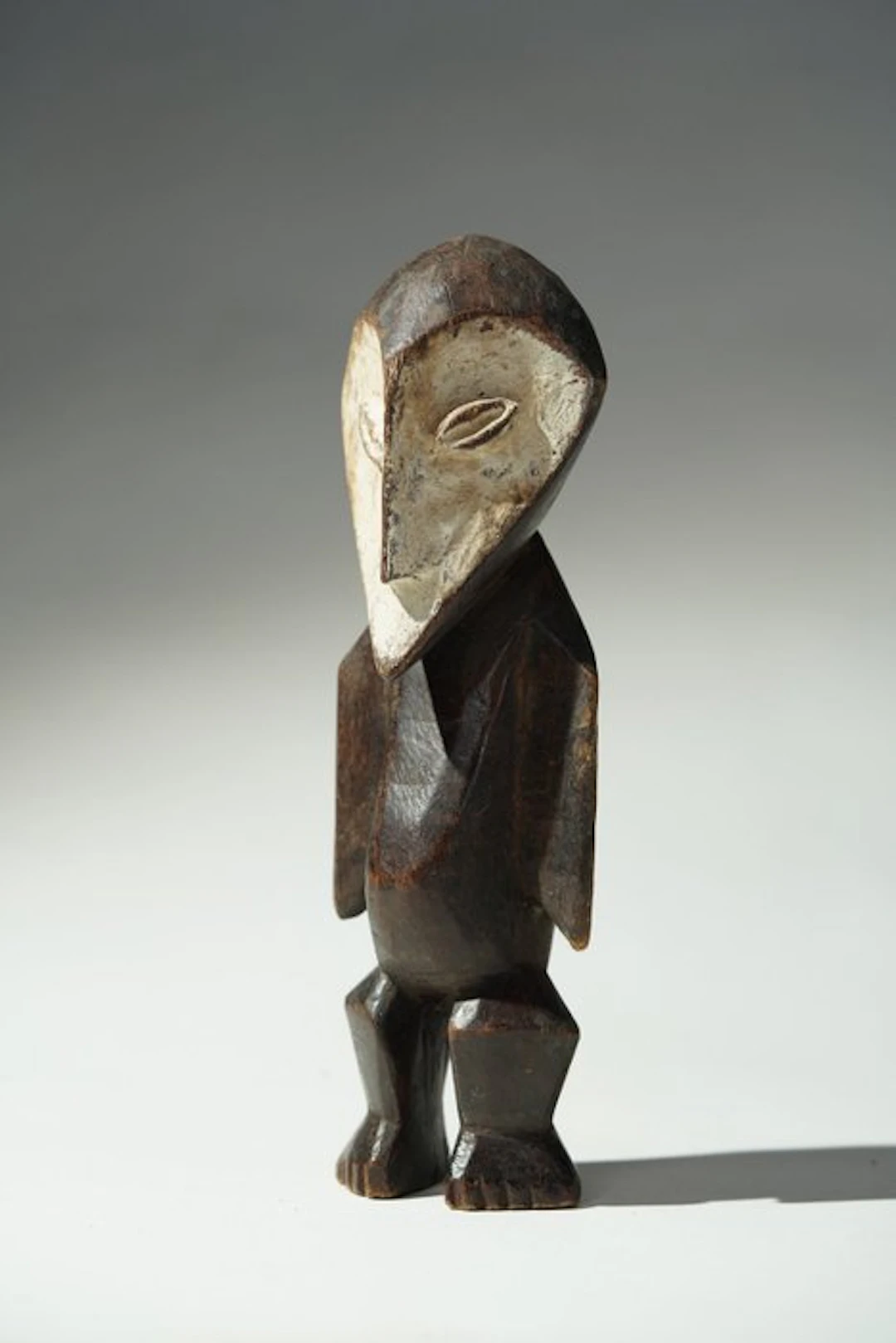
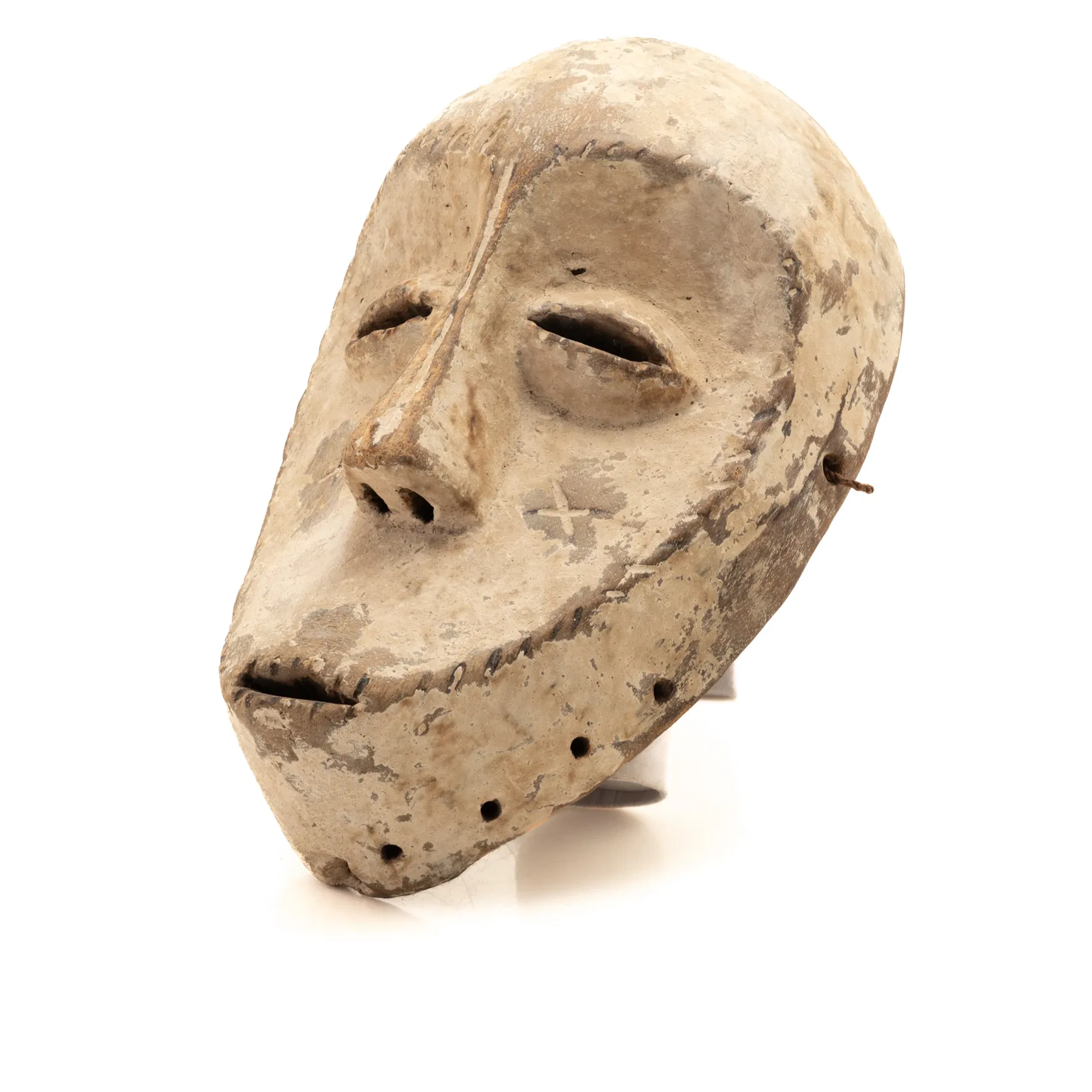
Lega Figure, Democratic Republic of the Congo Democratic Republic of the Congo, Pangi region, Lega Wood, kaolin pigment A striking anthropomorphic wooden sculpture attributed to the Lega of the Pangi region in the Democratic Republic of the Congo, according to information supplied by Eddy. The original designation “Sculpture Lega, région Pangi, Congo RDC” provides the more precise regional attribution to Pangi and places the figure within an area historically associated with Lega communities. The large head dominates the composition. Its face is conceived as an elongated heart-shaped plane terminating in a pointed chin. A pronounced central ridge divides the face vertically and simultaneously forms the nose. Narrow, deeply recessed almond-shaped openings represent the eyes. The absence of a separately articulated mouth reinforces the mask-like and highly abstract character of the face. The facial surface is covered with pale whitish pigment consistent with kaolin. This light field creates a strong contrast with the deep brown to almost black crown and body. Areas of abrasion, discoloration and irregular pigment retention emphasize the modelling of the face. The body is treated with considerable abstraction. Broad angular shoulders descend into long arms held close to the sides. The torso is compact and columnar, while the legs are separated by a pronounced opening and articulated through strongly angular knees. Broad feet provide a stable visual foundation and terminate in individually indicated toes. Among the Lega, figures, masks and other carved objects were historically associated with Bwami, an institution central to social, ethical and initiatory life. Such objects could function as visual references within teachings involving proverbs, moral concepts and appropriate social conduct. Their significance therefore depended not simply upon their form but upon the context in which they were displayed and interpreted. The pale heart-shaped face is among the most recognizable visual conventions associated with Lega sculpture. The reduction of individual physiognomic detail directs attention away from portraiture and toward an idealized image whose meaning could be activated through Bwami teachings. The present figure is notable for its economy of form. The pointed face, narrow eyes, angular shoulders, compact torso, projecting knees and broad feet establish a sequence of clearly defined geometric volumes. The contrast between dark wood and surviving pale pigment further strengthens its graphic presence. Visible wear, pigment losses, surface abrasions and variations in the wood contribute to the present appearance. Literature: Daniel P. Biebuyck, Lega Culture: Art, Initiation, and Moral Philosophy among a Central African People, University of California Press, Berkeley and Los Angeles, 1973. Daniel P. Biebuyck, La sculpture des Lega, Galerie Hélène & Philippe Leloup, Paris, 1994. Elisabeth L. Cameron, Art of the Lega, UCLA Fowler Museum of Cultural History, Los Angeles, 2001. Some of the information and photos are generated by artificial intelligence and is based on published sources from the fields of ethnography, archaeology, and art history documents. All information and photos are protected by copyright. Inv. No. MAZ28840
Estimate:£279.38
To the auctionView all items fromCatawikiorEthnographical
Estimate:
£279.38
Bring your auction to collectors worldwide!
Get listed now