



All auctions / Ethnographical / A wooden sculpture - Losso - Togo (No reserve price)

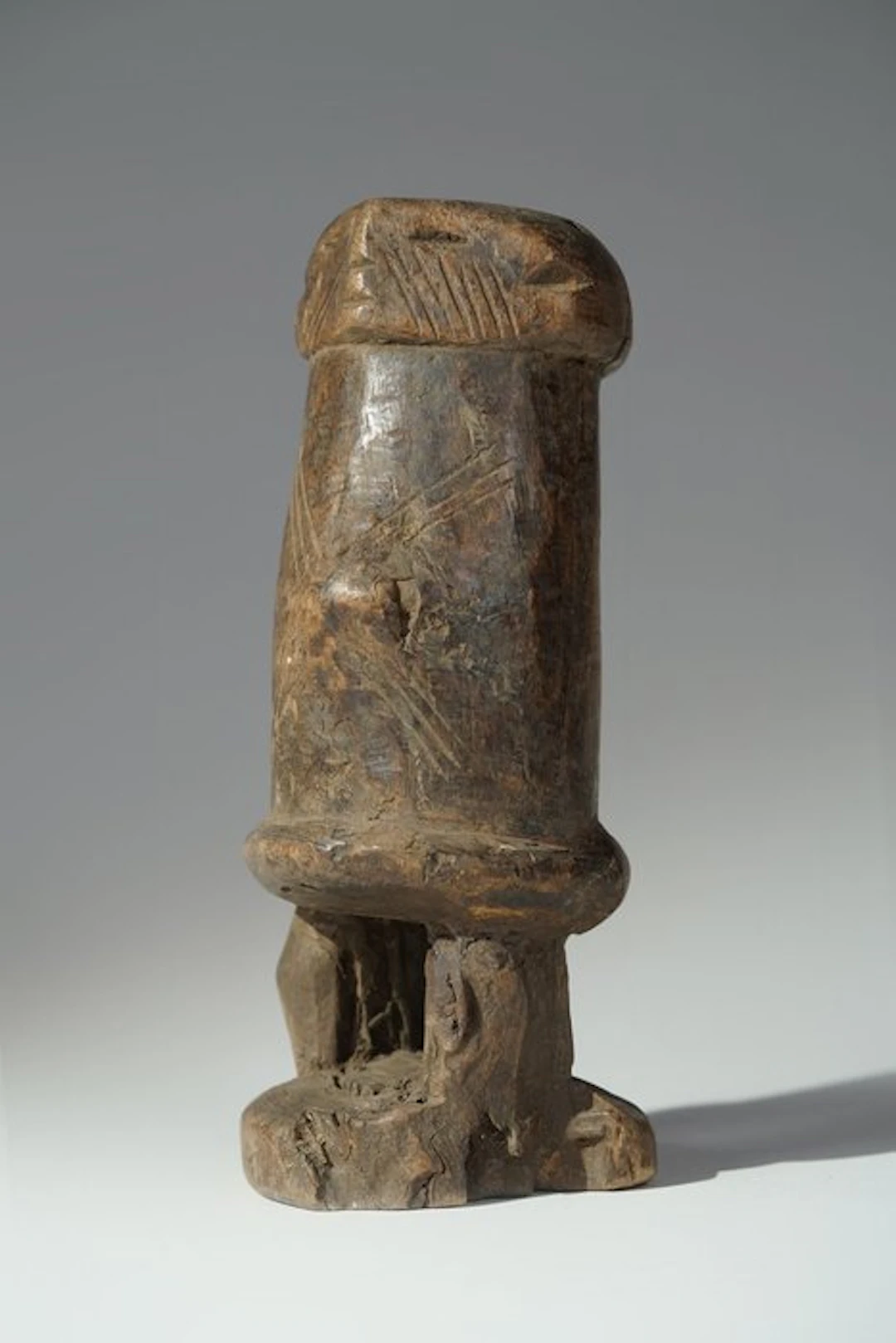
Losso Ritual Sculpture – Cylindrical Anthropomorphic Figure Losso (Nawdba), Siou Village, Niamtougou Region, Northern Togo Material: Carved wood with dark brown patina Dating: Undetermined Cultural Attribution: Losso (Nawdba), attributed Function: Possibly an ancestral, protective, or spiritually empowered figure Description This unusual wooden sculpture is distinguished by its massive cylindrical body, architectural construction, and highly abstracted anthropomorphic features. The elongated upper section is crowned by a broad, rounded horizontal projection, decorated with deeply incised diagonal lines and angular markings. Its proportions suggest a stylized head or headdress, although the precise anatomical interpretation remains uncertain. The cylindrical body displays shallow geometric incisions, including diagonal bands, intersecting lines, and irregularly distributed markings. A prominent horizontal ridge separates the upper section from the lower structure, where short, robust supports create a partially open architectural composition. The deep recess between these supports may represent an intentional opening, although considerable surface deterioration makes its original configuration difficult to reconstruct. The lower extremity terminates in an irregularly rounded base. The wood exhibits a dark brown patina, lighter areas of abrasion, longitudinal cracks, and substantial localized erosion. These characteristics contribute to the sculpture's powerful material presence but cannot independently establish its age or ritual history. Its unusual combination of cylindrical mass, incised ornament, and openwork construction creates a distinctive sculptural composition. Art-Historical Context The sculpture is attributed to the Losso, particularly the Nawdba communities inhabiting the Niamtougou and Siou areas of northern Togo. The designation Losso historically encompasses several culturally related populations, including the Nawdba and, in certain administrative classifications, neighboring Lamba communities. These groups possess distinct linguistic and social identities despite sharing aspects of their regional history and material culture. Their sculptural traditions belong to a broader northern Togolese artistic environment characterized by simplified anthropomorphic forms, compact proportions, and the frequent integration of symbolic and functional elements. The present sculpture's highly reduced anatomy and emphasis on elementary volumes correspond broadly to this regional aesthetic. However, its cylindrical construction and unusual lower opening distinguish it from more conventional standing figures. Comparative studies of Lamba and Losso sculpture demonstrate considerable stylistic diversity, making precise ethnic attribution difficult without reliable collection documentation. The object may reflect a localized sculptural tradition in which anatomical representation was subordinated to symbolic form and structural organization. Symbolism and Possible Ritual Function Among communities of northern Togo, wooden sculptures may participate in religious practices concerning ancestors, protective forces, and relationships between living families and the spiritual world. Certain regional figures have been interpreted as material representations or receptacles of ancestral and other spiritual presences, while others have been associated with protection, healing, or the commemoration of twins. The designation alua appears in discussions of related Lamba and Losso sculptures, although its application to the present object cannot be confirmed. The cylindrical body and prominent upper projection may have conveyed a deliberately simplified anthropomorphic identity, while the incised markings could represent scarification, ornamental decoration, or other culturally meaningful signs. Nevertheless, their specific symbolism remains undocumented. The pronounced opening beneath the main body raises the possibility of a functional or ritual purpose, perhaps involving placement over another object or integration into a larger installation. Such interpretations remain hypothetical. Without information concerning its original setting, the sculpture cannot confidently be classified as an ancestor figure, shrine object, or protective implement. Its possible ritual significance should therefore be considered within the wider context of northern Togolese religious traditions rather than assigned to a specific ceremony. Regional Characteristics: Siou and Niamtougou Siou lies within the historically important Nawdba-speaking area surrounding Niamtougou in northern Togo. This region forms part of the mountainous and agricultural landscape of the Kara area, where settlement patterns, lineage organization, and religious practices have developed through longstanding relationships among neighboring communities. Ethnographic research emphasizes both the similarities and distinctions between Nawdba, Lamba, and Kabyè populations, particularly regarding language, social organization, and local traditions. The designation Losso should therefore be understood as a broader historical classification rather than an entirely uniform cultural identity. The sculptural traditions of this region are notable for their formal diversity and relative independence from the more extensively documented artistic conventions of southern Togo. Wooden figures associated with ancestral remembrance, protection, and other religious concerns frequently demonstrate a preference for simplified anatomical structures and expressive geometric forms. The present object's monumental cylindrical proportions, restrained surface ornament, and unusual structural configuration may reflect a localized artistic approach, although a specific Siou workshop attribution cannot be established. The information supplied by the informant Ouro provides a valuable geographical reference, particularly because reliable documentation of individual sculptural traditions in this region remains comparatively limited. Art-Historical Appreciation The sculpture's artistic distinction lies in its powerful reduction of the human form to an arrangement of elementary geometric volumes. The broad upper projection establishes a strong horizontal accent, contrasting with the elongated cylindrical body and the open architectural structure below. The incised decoration introduces rhythmic movement across otherwise restrained surfaces, while the irregular patina and areas of erosion emphasize the material character of the wood. Particularly striking is the relationship between solid mass and negative space: the substantial upper body appears supported by a comparatively open lower construction, producing a visually compelling tension between weight and structural openness. This unusual configuration distinguishes the sculpture from more familiar anthropomorphic figures of northern Togo. Its significance resides in the combination of sculptural abstraction, regional artistic vocabulary, and possible ritual associations. Although its original function remains uncertain, the object offers an intriguing example of the formal experimentation encountered within the comparatively understudied wooden sculpture traditions of the Losso and neighboring Lamba communities. Selected Literature Amrouche, Pierre. Corps & décors: Statuaire Lamba et Losso du Togo. Paris: Éditions Berggruen, 2008. Keller, Thomas. Northern Togo Statuary. Lully, 2018. Hahn, Hans Peter. Die materielle Kultur der Konkomba, Kabyè und Lamba in Nord-Togo. Cologne: Rüdiger Köppe Verlag, 1996. Froelich, Jean-Claude, Pierre Alexandre, and Robert Cornevin. Les populations du Nord-Togo. Paris: Presses Universitaires de France, 1963. Informant: Ouro Copyright and Scientific Documentation Some of the information and photographs have been generated with the assistance of artificial intelligence and are based on published sources in ethnography, archaeology, and art history. Original texts and photographs may be protected by copyright. All rights held by the respective copyright holders are reserved. Inv. No. MAZ32294
Estimate:£175.89
To the auctionView all items fromCatawikiorEthnographical
Estimate:
£175.89


OCT 27 | 4:00 PM
Bring your auction to collectors worldwide!
Get listed nowBy subscribing, you are agreeing to the privacy policy. Unsubscribe anytime.
Barnebys HQ
Brahegatan 10
BOX 5038
114 37 Stockholm
