

OCT 17 | 10:00 PM

All auctions / Ancient Art / Ancient Egypt, Wood Upper part of the lid of a sarcophagus - 72 cm

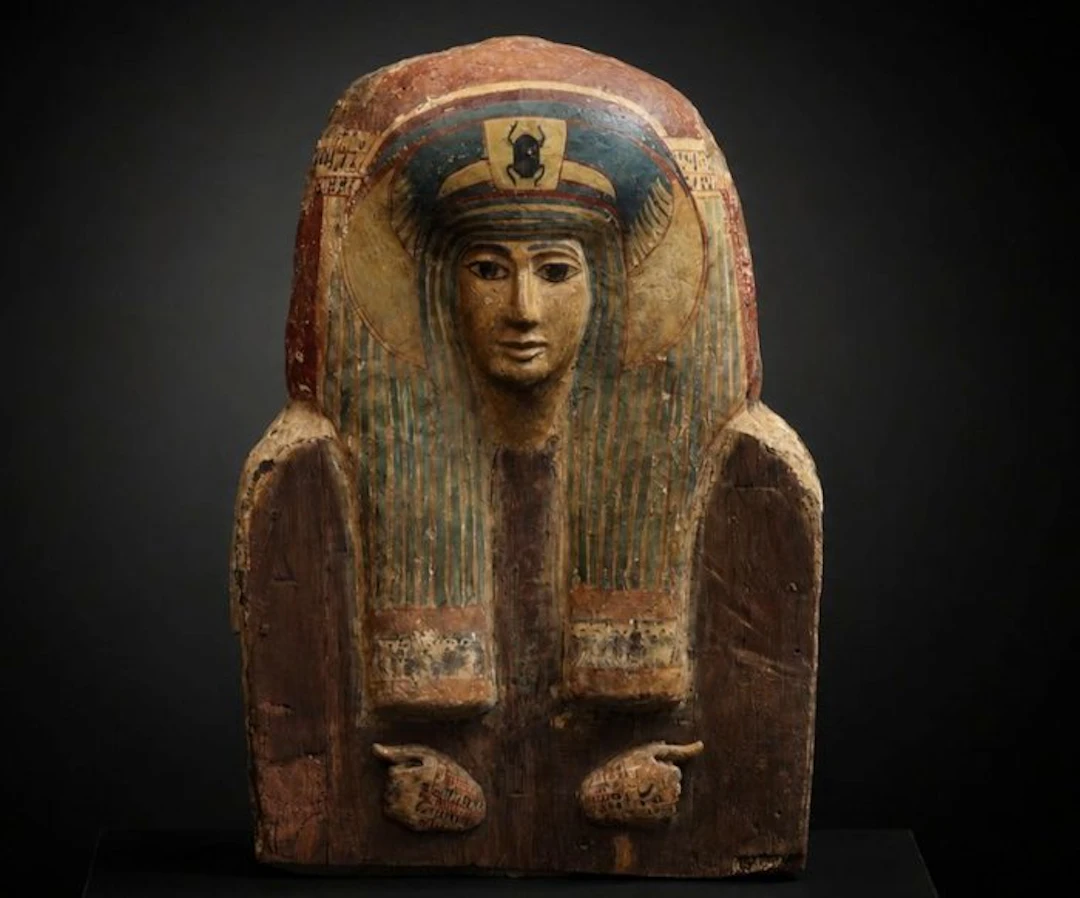
This piece is the upper part of the lid of an Egyptian anthropomorphic sarcophagus made of wood covered with a layer of plaster and decorated with polychrome. Dating from the Third Intermediate Period and probably originating from Lower Egypt, it is an excellent example of funerary production developed between the 22nd and 25th Dynasties, an era characterized by the continuity of the religious and artistic traditions of Pharaonic Egypt despite the political changes that marked the period. The lid preserves the idealized representation of the deceased, conceived not as an individual portrait but as an eternally rejuvenated image intended to guarantee survival in the Afterlife. The face has serene and symmetrical features, with large almond-shaped eyes outlined in black and carefully shaped eyebrows, elements that recall the Egyptian artistic canon and symbolize the deceased's ability to see and fully participate in eternal life. The warm coloring of the face contrasts with the blue, green, and ochre tones of the headdress, creating a visually striking and decoratively rich effect. One of the most striking elements is the vulture headdress framing the head. This iconography is traditionally associated with divine protection and the goddess Nekhbet, protector of Upper Egypt, whose symbolism was widely incorporated into funerary offerings. A dark-colored scarab appears on the forehead, a motif closely related to the god Khepri and the concepts of rebirth, regeneration, and the cyclical renewal of life. The presence of this symbol on the deceased's head reinforces the magical function of the piece, intended to ensure the individual's transformation and resurrection in the afterlife. The striated wig that falls on either side of the face follows traditional designs used in sarcophagus decoration during the Third Intermediate Period. Its long, painted vertical bands evoke the elaborate ceremonial wigs worn by the Egyptian elite and are a common feature on funerary lids of the time. At the bottom of the composition are hands depicted in relief, closed and decorated with polychrome motifs. These decorations could allude to decorated bandages, ritual gloves, or symbolic elements related to the sacred status of the deceased. The work is also notable for the survival of large areas of its original polychromy. The preserved pigments allow us to appreciate the technical sophistication of Egyptian funerary workshops, where the combination of carved wood, plaster preparation, and mineral paint resulted in objects destined to last forever. The state of preservation, described as intact with only minor restorations to the pigments, allows us to contemplate much of its decorative program and better understand the funerary aesthetics of the period. During the Third Intermediate Period, anthropomorphic sarcophagi underwent a significant evolution, incorporating complex iconographic repertoires intended to protect the deceased through visual and religious formulas. The representation of tutelary deities, scarabs, ceremonial wigs, and idealized faces formed part of a symbolic language designed to guarantee the deceased's union with the gods and their access to eternal life. Comparable pieces are held in important international collections, including the Egyptian Museum of Turin, the British Museum in London, and the Egyptian Museum in Cairo, where examples of funerary lids from the same chronological and cultural period can be found. The documented provenance of the piece, along with its verification in the Art Loss Register database and the certificate issued by Egyptologist and conservator Simone Musso, provides valuable support for its collection history and reinforces its significance within the field of collecting and studying Egyptian antiquities. For similar examples, see: J. H. Taylor, “Coffins as evidence for a North-South divide in the 22nd–25th Dynasties,” in “The Libyan Period in Egypt.” Historical and Cultural Studies into the 21st–24th Dynasties. Proceedings of a conference held at Leiden University from 25 to 27 October 2007, pp. 375–409. This item has been verified in the Art Loss Register database and comes with a confirmation letter. It is accompanied by a certificate of authenticity from Simone Musso, consultant curator of Egyptian antiquities at the Stibbert Museum in Florence, Italy, and a member of the Nuri Archaeological Expedition. Provenance: Private collection in London; acquired on the Dutch art market; Ex. Collection of Mr. Hans Kamps (1953-2023), acquired from Glenn Howard Ancient Art; Ex. Swiss collection, Ex. VA collection. -The piece includes an authenticity certificate. The Seller can prove that the lot was obtained legally. Important information. The seller guarantees that he is entitled to ship this lot. The seller will take care that any necessary permits will be arranged, this process can take between 2 and 4 weeks. IMPORTANT: Due to the new laws on the export of archaeological pieces, we have decided to NO LONGER sell outside the European territory for the following countries: SWITZERLAND & UNITED STATES of AMERICA. For other destinations out of European territory: all our items will be shipped after obtaining a definitive LICENSE EXPORTATION by the Ministry of Culture of Spain. We inform our clients that it may take between 4-8 weeks. According to Spanish legislation, items sent outside the European Union are subjected to export taxes. The taxes will be added to the invoice, at the buyer's expense. These export fees are fixed on the final auction price, and the tax rate is not applied directly to the total value of the item to be exported, but rather the different percentages by sections are applied to it: Up to 6,000 euros: 5%. / From 6.001 to 60.000 euros: 10 %. Please note that for far destination (Asia, middle east etc.. ), there will be an additional cost for the shipping.
Estimate:£30,500.02
To the auctionView all items fromCatawikiorAncient Art
Estimate:
£30,500.02
OCT 17 | 10:00 PM


Bring your auction to collectors worldwide!
Get listed nowBy subscribing, you are agreeing to the privacy policy. Unsubscribe anytime.
Barnebys HQ
Brahegatan 10
BOX 5038
114 37 Stockholm
