

OCT 17 | 10:00 PM

Bring your auction to collectors worldwide!
Get listed nowBy subscribing, you are agreeing to the privacy policy. Unsubscribe anytime.
Barnebys HQ
Brahegatan 10
BOX 5038
114 37 Stockholm
All auctions / Ancient Art / Ancient Roman Bronze Crossbow Fibula – Pröttel Type 3-4

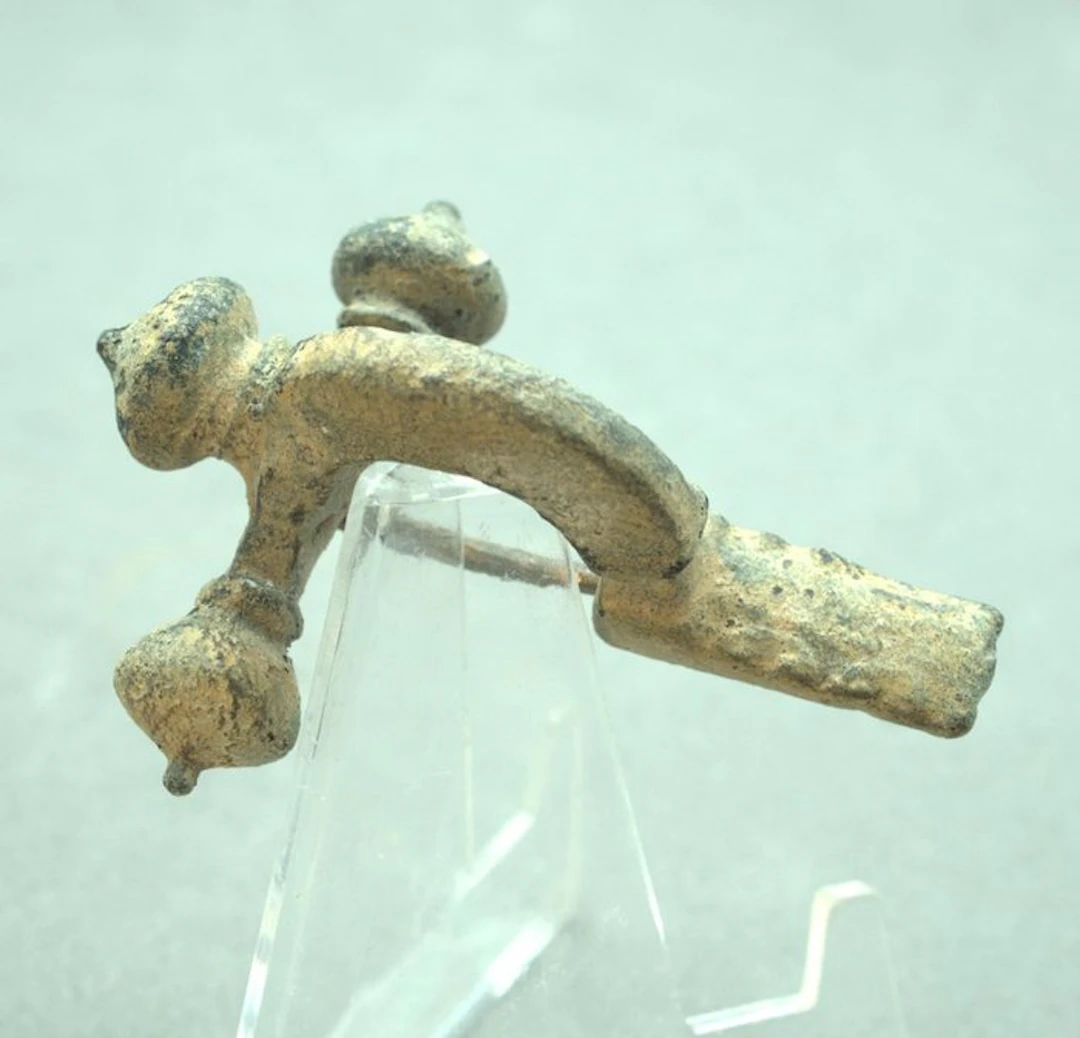
"Ancient Roman Bronze Crossbow Fibula (Zwiebelknopffibel) – Pröttel Type 3–4, Associated with Military Officers Culture / Period: Ancient Roman Date / Period: 4th–5th century A.D. Material: Bronze Dimensions: 53 mm Condition: Good condition. The pin is an ancient or old repair/replacement and remains attached. No shipping outside the European Union. Due to complex export regulations concerning cultural goods, this item cannot be shipped outside the EU. Please ensure you have a delivery address within the European Union before placing a bid. Provenance information: Object Registration ID: 866 The current owner (S.N.J. S.) purchased the Crossbow Fibula – Pröttel Type 3–4, associated with Military Officers from S.B. in Groningen. The previous owner, S.B. from Groningen (The Netherlands), stated that the object had been in his collection since 1990. According to the previous owner, the object had previously been in a private collection in The Netherlands before 1990. No further information concerning the earlier ownership history of the object was available from the previous owner. Background Information: This bronze crossbow fibula, also known as a Zwiebelknopffibel ("onion-knob fibula"), belongs to one of the most distinctive categories of dress accessories from the Late Roman Empire. The type emerged during the 3rd century A.D. and remained in widespread use throughout the 4th and early 5th centuries. Its modern name derives from the characteristic arched bow and the three prominent onion-shaped terminals, which together resemble the shape of a drawn crossbow. The present example can be attributed to Keller Type III and Pröttel Type 3–4, a well-known group dating primarily to the first half of the 4th century A.D., particularly during the reign of Constantine the Great and his successors. Characteristic features include the arched bow, onion-shaped terminals, and elongated foot. Such fibulae were produced in specialised workshops throughout the Roman Empire and reflect the highly organised craftsmanship and standardised production associated with the Late Roman state. The crossbow fibula ranks among the most recognisable symbols of authority in the Late Roman Empire. By the 4th century A.D., brooches of Keller Type III / Pröttel Type 3–4 had become closely associated with military officers, senior commanders, and imperial officials. They are regularly depicted on statues, mosaics, ivory carvings, and official portraits of generals and members of the imperial court during the reigns of Constantine the Great and his successors. Far more than a simple garment fastener, the crossbow fibula served as a visible badge of rank and office within the military and administrative hierarchy of the empire. In practical use, the fibula secured a cloak such as the chlamys or sagum, garments commonly worn by military and administrative personnel. The pin passed through several layers of fabric before locking into the catch, ensuring that the cloak remained securely fastened while simultaneously displaying the wearer's official status. Examples of this type have been discovered across a vast area of the Roman world, from Britain and Gaul to the Danubian provinces and the eastern territories of the empire. Their widespread distribution reflects the movement of military units, imperial officials, and administrators along the extensive communication networks that connected the Roman Empire. Dating to the age of Constantine I (A.D. 306–337), Constantine II, Constans, and Constantius II, this fibula belongs to a transformative period in Roman history marked by military reforms, administrative centralisation, and the emergence of a distinctly Late Roman imperial culture. The pin has been repaired or replaced in antiquity or during its long history of use, a feature commonly encountered on functional Roman brooches that reflects their continued practical use rather than immediate disposal. It provides a direct and tangible connection to the military and administrative elite of the Late Roman Empire."
Estimate:£178.13
To the auctionView all items fromCatawikiorAncient Art
Estimate:
£178.13
OCT 17 | 10:00 PM


Bring your auction to collectors worldwide!
Get listed now£127.23