



All auctions / Ancient Art / Ancient Roman

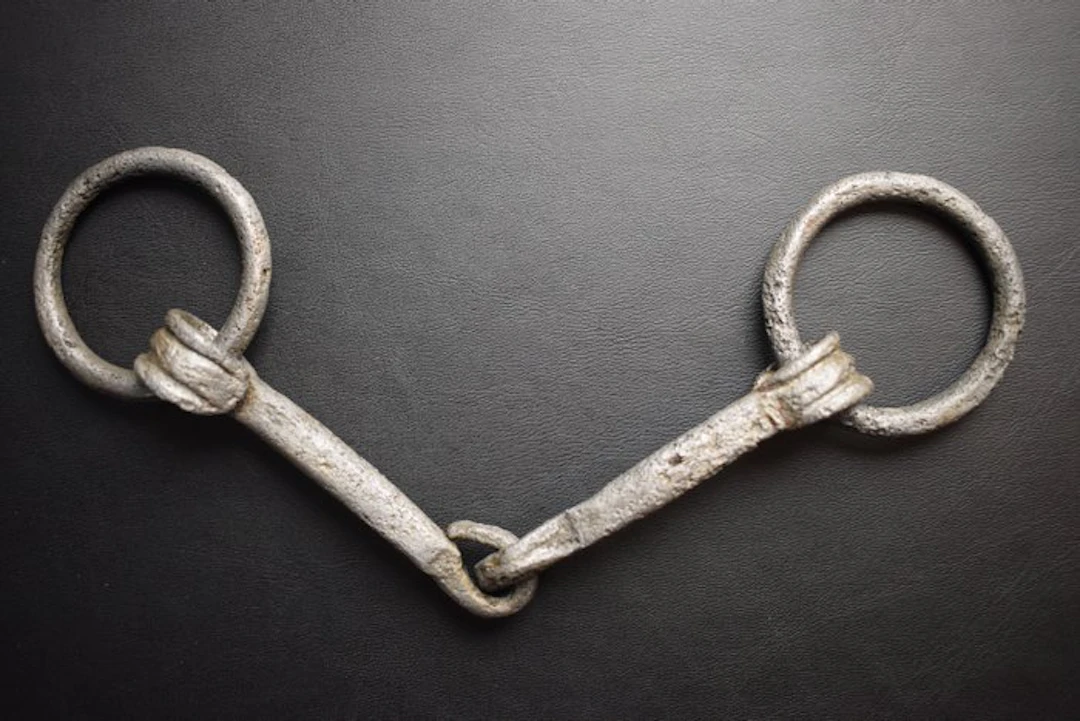
Ancient Roman Iron Cavalry Horse Snaffle Bit – Roman Military Equestrian Equipment Late Roman Republic to Early Roman Imperial Period, circa 1st century BC–1st century AD Material: Iron Weight: 115.3 g Overall dimensions: 22.0 × 4.9 cm Combined length of the articulated mouthpiece: approximately 15.0 cm Outer diameter of the large rings: approximately 4.9 cm From a Private European Collection. An impressive and highly evocative Ancient Roman iron horse snaffle bit, representing an important category of equestrian equipment closely associated with the mounted forces of the Roman world. The bit is remarkably complete, retaining its two articulated iron mouthpiece bars, central joint and both large circular side rings. Particularly attractive are the pronounced moulded and ribbed terminals immediately before the rings, giving the otherwise highly functional piece a distinctive appearance. This robust construction belongs to the long tradition of articulated snaffle bits employed for controlling riding horses. Comparable iron two-link snaffle bits are known from Roman military sites, including the important cavalry equipment from Hod Hill in Britain, where examples of this general form have been dated to the 1st century AD. Further Roman iron snaffle bits are recorded from Newstead (Trimontium), the major Roman military complex in Scotland, where they are classified as cavalry equipment. An object of Roman military horsemanship: For the Roman cavalryman, control of his horse was fundamental. Mounted soldiers had to manoeuvre rapidly, maintain formation and control their mounts while simultaneously carrying and employing their weapons. The articulated iron mouthpiece rested inside the horse's mouth, while the two substantial outer rings formed part of the connection between bit, bridle and reins. Pressure transmitted through the reins allowed the rider to communicate immediately with his mount. This makes the object considerably more than a simple piece of horse equipment: it represents the physical interface between a Roman horseman and his horse. Such equipment accompanied cavalrymen and other mounted personnel throughout the Roman world and formed an essential component of Roman military mobility. Rare survival in iron: While iron was an appropriate and widely employed material for functional Roman horse bits, complete ancient iron equestrian equipment is particularly desirable today because iron is highly vulnerable to corrosion during centuries of burial. Many archaeological horse-bit finds survive only as individual rings, fragments or heavily corroded sections. The preservation of the present example as an essentially complete articulated assembly – both rings, both mouthpiece elements and their central connection surviving together – therefore considerably enhances its archaeological character and collector appeal. Its substantial dimensions, with an overall span of approximately 22 cm and large 4.9 cm rings, together with its strong ancient surface and clearly recognisable construction, give the piece an impressive presence. A rare and highly attractive complete example of Roman iron equestrian equipment, particularly appealing to collectors of Roman military history, cavalry equipment and ancient weaponry. I prove that the lot was obtained legally , provenance statement seen by Catawiki Important information. I guarantee that I am entitled to ship this lot. I will take care that any necessary permits will be arranged. I will inform the buyer about this if this takes more than a few days.
Estimate:£335.03
To the auctionView all items fromCatawikiorAncient Art
Estimate:
£335.03

OCT 27 | 4:00 PM
Bring your auction to collectors worldwide!
Get listed nowBy subscribing, you are agreeing to the privacy policy. Unsubscribe anytime.
Barnebys HQ
Brahegatan 10
BOX 5038
114 37 Stockholm
