


OCT 8 | 3:00 PM

Bring your auction to collectors worldwide!
Get listed nowBy subscribing, you are agreeing to the privacy policy. Unsubscribe anytime.
Barnebys HQ
Brahegatan 10
BOX 5038
114 37 Stockholm
All auctions / Ethnographical / Animal themed collection - Natural History Collection / Cabinet of Curiosities

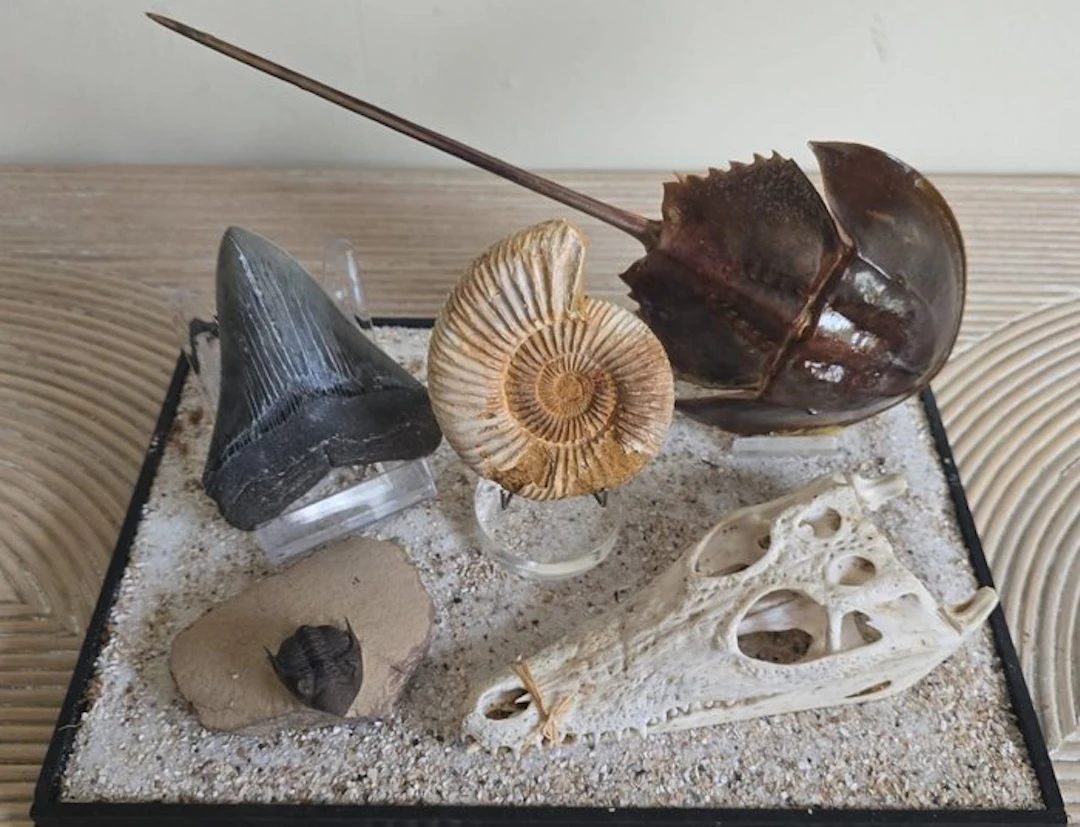
Curated Natural History Collection – 3D Metacanthina, Megalodon Tooth, Crocodile Skull, Ammonite & Horseshoe Crab – 5 Specimens From the Devonian open seas to the Megalodon era – five characterful natural history specimens that together represent hundreds of millions of years of evolution. This carefully assembled collection combines fossils and naturalia with highly diverse forms, colors and textures. The three-dimensional black trilobite, imposing Megalodon tooth and anatomical crocodile skull form the three main highlights, enriched by a sculptural ammonite and a striking horseshoe crab. Together they create a visually powerful collection for enthusiasts of paleontology, naturalia and classic Wunderkammer objects. 1. Metacanthina sp. – Exceptional 3D Devonian Trilobite – Morocco One of the absolute highlights of the collection: a strongly three-dimensionally prepared Metacanthina sp. from the Devonian, originating from the well-known fossil area Alnif – Jebel Issimour, Morocco. Matrix: 7.8 × 6.3 × 3.8 cm Reported weight: approximately 184 g The fossil is distinguished by its pronounced 3D form, finely articulated thoracic segments, long genal spines and clearly compound eyes. Especially from oblique viewing angles, the sculptural quality comes through particularly strongly: the animal seems to emerge literally from the matrix. Trilobites were among the most successful inhabitants of the Paleozoic oceans and lived hundreds of millions of years before the dinosaurs. A spectacular Devonian trilobite and one of the main display pieces of this collection. 2. Otodus megalodon – Cooper River, South Carolina, USA An imposing fossil tooth of Otodus megalodon, one of the largest marine predators that ever existed. Dimensions: circa 10 × 8 × 2 cm – almost 4 inches The tooth has a powerful triangular crown, broad heavy root, deep dark-gray to black mineralization and long portions with clearly recognizable fine serrations along both cutting edges. The side view also clearly shows how robust and three-dimensional the fossil is. Next to the tooth is the original collection label with: Carcharodon Megalodon – Cooper River – South Carolina USA – Miocene Carcharodon megalodon is the older taxonomic designation; today Otodus megalodon is usually used. Cooper River is internationally known as a find site for dark-mineralized fossil shark teeth. An impressive almost 4-inch fossil of one of the most powerful predators in the history of the oceans. 3. Crocodile Skull – SERCA Farming A striking anatomically naturalia object: a crocodile skull with lower jaw and largely preserved teeth. Dimensions: circa 16.5 × 6.5 × 4.5 cm The elongated snout, complex skull openings, natural bone structure and numerous sharp teeth make the specimen interesting from almost any viewing angle. The skull carries the original label: “Produits CITES – FARMING – N° 1522 – SERCA Sarl” Based on the known provenance information, the specimen is presumed to be attributed to a young Nile crocodile – Crocodylus niloticus – from Madagascar. The original SERCA Farming label is included and forms an important part of the well-known provenance. A particularly characterful anatomical specimen and visually one of the strongest naturalia objects in the collection. 4. Fossil Ammonite – Natural Sculptural Spiral A decorative fossil ammonite with a powerful three-dimensional spiral and deeply pronounced ribs. Dimensions: circa 8.5 × 7.5 × 2.5 cm The regularly progressing rib structure and natural cream, beige and earth tones give the fossil a distinct sculptural appearance. At the top, a portion of the outer whorl is visibly missing, as clearly shown in the photos. The characteristic spiral and main rib structures are beautifully preserved. A million-year-old natural sculpture and a nice light contrast with the dark fossils in this collection. 5. Horseshoe Crab – Degenkrab Naturalia A particularly three-dimensionally presented naturalia specimen of a horseshoe crab, complete with armored dorsal shield and exceptionally long tail spine. Dimensions: circa 28.5 × 11 × 3.5 cm The deep chestnut-brown carapace, sharp contours and long sword-like tail create a striking prehistoric silhouette. Anatomical structures and limbs are also visible on the underside. Horseshoe crabs represent a very ancient evolutionary lineage, with related forms appearing over 400 million years ago. A spectacular naturalia object with the appearance of a creature from an ancient sea. Five specimens – five chapters of natural history The collection consists of: Metacanthina sp. • Otodus megalodon • crocodile skull • ammonite • degan crab It is precisely the contrast that makes this ensemble attractive: the pitch-black and spiky Metacanthina, the monumental Megalodon tooth, the ivory-white anatomical linework of the crocodile skull, the light geometric ammonite and the chestnut-brown carapace of the degan crab. Five completely different forms of natural history, brought together in one characterful collection. Suitable as a base or expansion for a Wunderkammer, fossil collection, naturalia collection, library, office or study. The objects may show natural aging traces, preparation traces and, in the case of fossils, local restoration, consolidation or stabilization. The extensive photos therefore form an important part of the condition description. The underside plate shown in some photos is for presentation purposes only and is not included. Five distinctive specimens. Five different chapters of natural history. One carefully curated collection.
Estimate:£847.75
To the auctionView all items fromCatawikiorEthnographical
Estimate:
£847.75
OCT 8 | 3:00 PM


OCT 8 | 3:00 PM
Bring your auction to collectors worldwide!
Get listed now£1,272.37

OCT 17 | 10:00 PM