



All auctions / Ancient Art / Antieke Japanse Yosegi-zaiku houten pennenkist met...

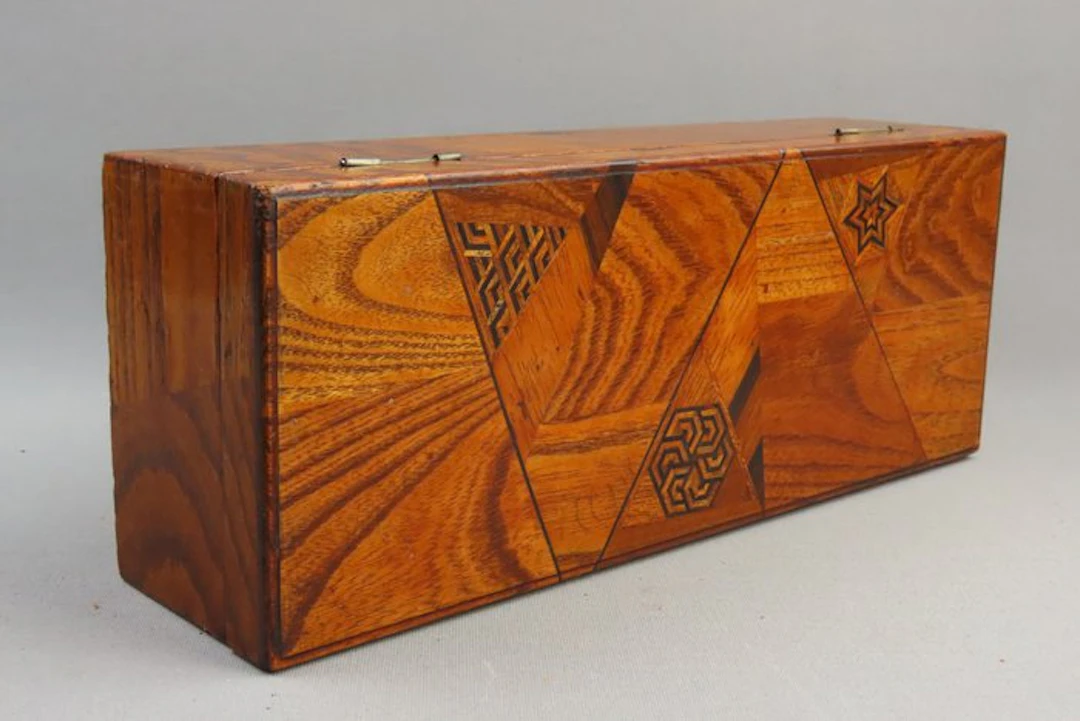
Yosegi-zaiku small box with lacquered interior. This box dates from the Meiji period (1868–1912), most likely from the late 19th century (around 1880–1900). The metal fittings are made of etched or engraved bronze/brass with a beautiful, organic cloud and floral motif (karakusa) typical of Meiji art. The central black oval part is not a keyhole but the handle of a built-in sliding mechanism or pin mechanism. This refined, hand-made metalwork is characteristic of early export pieces from the late 19th century and disappeared completely in later mass production after World War II. The hinge at the rear confirms the age: This is a so-called pen hinge (or cylinder hinge) that was hand-embedded directly into the wood. You can see that the metal is slightly irregular in shape. No modern screws or standardized factory hinges were used, indicating authentic, hand-assembled work from before the industrialization of the Yosegi workshops. The inside is fully lined with a thick, glossy layer of black Urushi lacquer (traditional Japanese tree resin lacquer). You can see at the edges and corners that the lacquer shows light wear and craquelé due to age and use. Boxes from the mid-20th century were almost always left with an unfinished interior or overlaid with cheap synthetic lacquer to save costs. On the lid of this box there are several beautiful, traditional Japanese patterns. Each pattern in this Yosegi-zaiku wood inlay has its own name and symbolic meaning. These are the three most striking geometric shapes on the lid: • The Six-pointed Star (Asanoha - 麻の葉): Top right you see a star pattern in a diamond lattice. This is the Asanoha motif, based on a stylized hemp leaf. Because the hemp plant grows extremely quickly and straight, this pattern in Japanese culture symbolizes growth, strength, and good health. Traditionally it was used to protect children from misfortune. • The Honeycomb / Turtle (Kikkou - 亀甲): In the center-bottom you see a hexagonal pattern with a geometric maze inside. This hexagonal motif is Kikkou and is inspired by the shell of a tortoise. Because the turtle in Japan is known as a creature that can live very long, this symbol stands for a long life, wisdom, and happiness. • The Tilted Maze / Lightning (Sayagata - 紗綾形): Top left you see a pattern composed of interlocking, angular lines (based on the swastika symbol, which in Buddhism has a spiritual meaning). This pattern is Sayagata and symbolizes infinity, continuity of the family, and a long, prosperous life. What makes this box especially beautiful is that the craftsman placed these three specific symbols within a larger, abstract network of large wooden triangles. By letting the grain run in different directions in each triangle, a gorgeous optical effect arises as light hits it. In good condition, the marquetry inlay is in excellent condition. We pack carefully and ship insured.
Estimate:£16.9
To the auctionView all items fromCatawikiorAncient Art
Estimate:
£16.9


OCT 23 | 8:00 AM


OCT 27 | 4:00 PM
Bring your auction to collectors worldwide!
Get listed nowBy subscribing, you are agreeing to the privacy policy. Unsubscribe anytime.
Barnebys HQ
Brahegatan 10
BOX 5038
114 37 Stockholm
