
Bring your auction to collectors worldwide!
Get listed nowBy subscribing, you are agreeing to the privacy policy. Unsubscribe anytime.
Barnebys HQ
Brahegatan 10
BOX 5038
114 37 Stockholm
All auctions / Furniture, Design & Mirrors / Boston, MA red cedar and pine desk & bookcase

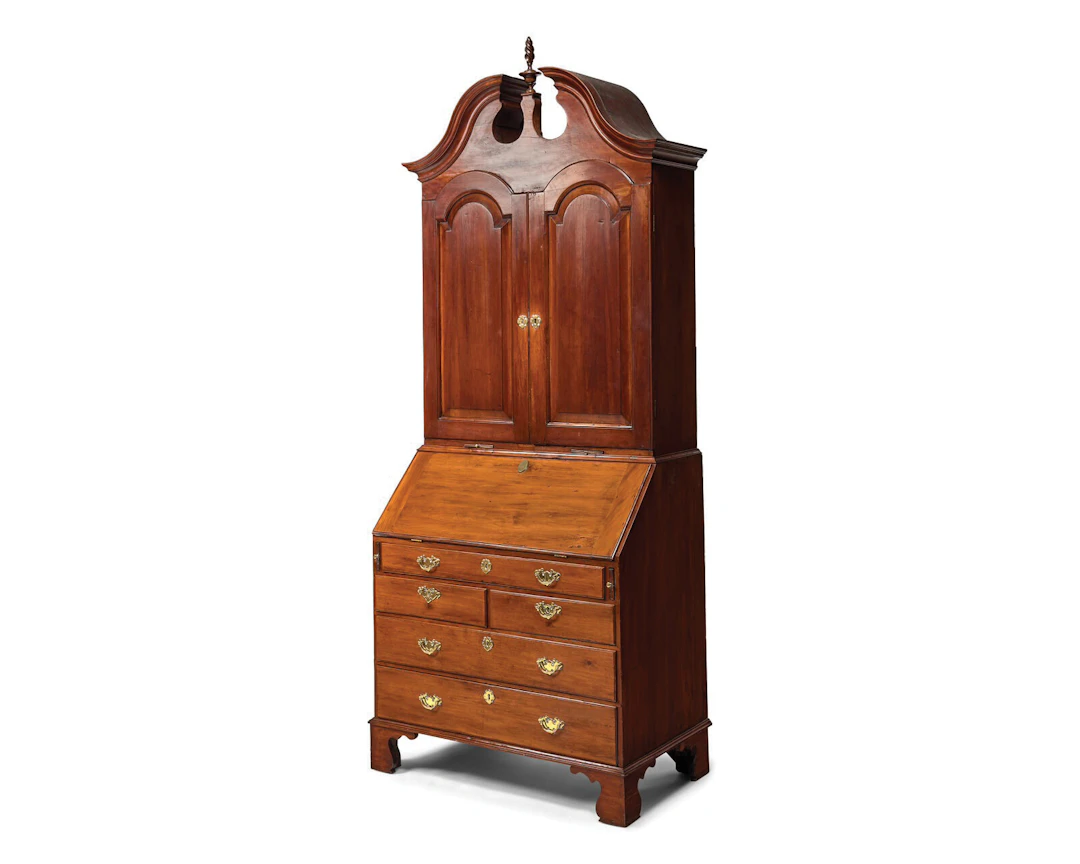
Desk and bookcase. Boston, Massachusetts, 1735-1750. Red cedar, white pine, hard (i.e., yellow or resinous) pine. 98 1/4" x 40" W x 22 1/2". This desk and bookcase is a rare piece of American furniture made of red cedar. Examples are known from listings in probate inventories and other 18th century written documentation, but few survivors have been identified. One is a Boston block-front slant-lid desk of the 1730s, illustrated in Fine American Antiques in the Stanley Weiss Collection (Providence, R.I.: Stanley Weiss, 2019), p. 45. The desk and bookcase exhibits several early features of Boston work. The arched or round- headed panels of the bookcase doors cover a fitted interior having an adjustable shelf with pigeonholes across the top and down the sides. Two side-by-side drawers are at the bottom. Particular representative of Boston work are the two half-dome niches at top, directly behind the conforming panel arches. In some other Boston work, these niches are carved or painted and gilded. Above the bookcase section, the upper case has a scrolled pediment with a corkscrew finial in the center. Depressions at each front corner show where plinths bearing other corkscrew finials were originally. Behind the scrolled pediment moldings, thin pieces of wood nailed to the front and a back board create a “roof” that remains intact. Two slides for candlesticks are at the bottom of this case. The slant-top desk similarly displays early features. Two exist in the interior: it has a central prospect door set on two iron pins at the bottom and a lock (which has been repaired) at the top center. Unlocking the door allows it to lean outward and be removed, exposing the prospect box and small drawers. This box locks by a wood spring in the center of the bottom. Removal of the bottom drawer exposes a hole that allows the user to depress the spring. Removal of the box provides access to “column drawers” that fit inside pockets behind the applied half columns flanking the prospect door. The upper of the two small drawers in the center is a replacement. The other important feature of the interior is the “amphitheater” configuration of the small drawers with pigeonholes above at each side of the prospect door. This elegant and characteristically Boston shaping occurs on a slant-lid desk signed by Richard Walker. Although information about him is scarce, the desk can be dated about 1740 by other means. (See Philip D. Zimmerman and Frank M. Levy, “An Important Block-front Desk by Richard Walker of Boston,” Antiques 147, no. 3 [March 1995]: 436-441.) Of the lower part of the desk section, it has four tiers of graduated drawers. The second tier from the top has two side-by-side drawers, another early feature. These drawers run on a full dust-board, whereas the other drawers have only drawer blades in front and side runners. The full dust-board added structural reinforcement, but in time it was omitted from most New England case furniture. The unusual drawer configuration is English in origin and occurred from time to time in different American furniture-making regions. The last early feature of this desk and bookcase lies in evidence of the original feet, the present bracket feet being replacements. The desk and bookcase originally stood on four turned ball feet. Round holes in the bottom board of the case are now plugged. Such turned feet occasionally split or were otherwise damaged. Bracket feet were easier to reconstruct—and they looked more fashionable (to the chagrin of modern collectors). All of the brass fittings (hinges, drawer pulls, escutcheons, etc.) on the desk and bookcase have been replaced, as has the box lock in the slant lid. The bookcase doors and desk lid have repairs on the inside surfaces adjacent to the replaced hinges. All of the desk drawer interiors have been coated with a red wash, probably to disguise repairs to the bottom-most drawer back. Evidence of early nailing of the drawer bottoms remains, although most early nails have been removed and replaced by modern nails, in part to compensate for shrinkage of the drawer bottom boards. Red wash has also been added to the case backboards. Red wash at the back of the molding returns inside the center of the pediment suggests some repair may have occurred in that area, although no evidence of change is apparent. The front section of the waist molding attached to the top of the desk is a replacement.
Estimate:£15,105.1
To the auctionView all items fromArader GalleriesorFurniture, Design & Mirrors
Estimate:
£15,105.1
Bring your auction to collectors worldwide!
Get listed now