


OCT 17 | 10:00 PM

All auctions / Arts & Graphics / Carlo Saraceni (1579-1620)

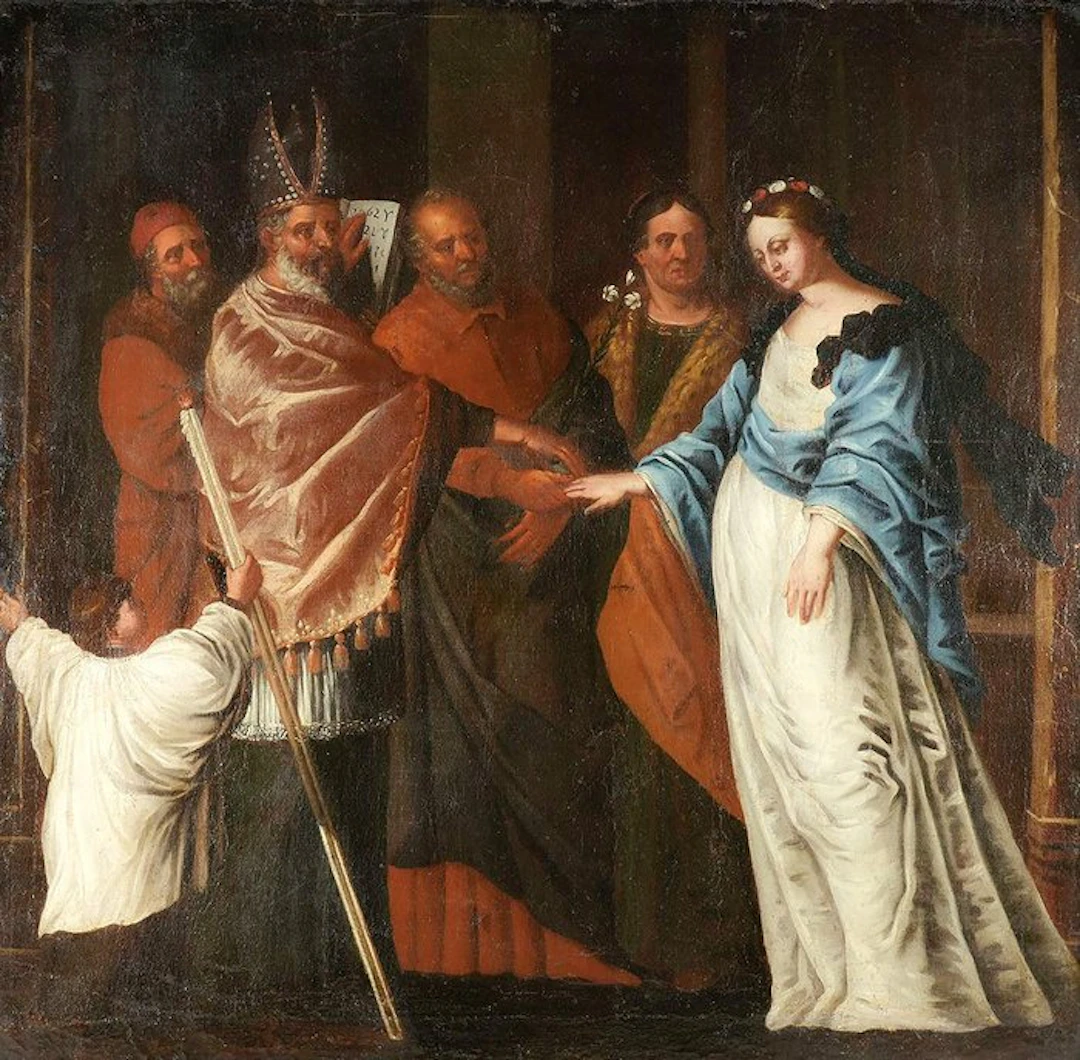
Circle of CARLO SARACENI & AIUTI (Venice, circa 1579 – 1620) The Marriage of the Virgin Mary with Saint Joseph Oil on canvas, 102 x 104 cm NOTE: Publication catalog of the Intermidiart collection works (pdf). Unmarked work. Guarantee certificate and Legitimate Provenance. Framed-less work: We present in the catalog an interesting oil on canvas of good quality, which depicts The Marriage of the Virgin Mary with Saint Joseph. The scene, set in an intimate interior with claustral atmosphere, portrays the culminating moment of the Marriage of the Virgin. At the center, the High Priest, solemnly adorned with episcopal mitre and a fringed cope, formally joins the hands of the two spouses. With his right hand he raises the Tablets of the Law, decorated with pseudo-Hebrew inscriptions. The Virgin Mary is placed on the right, caught in an attitude of devout contemplation and humility. She wears a white gown topped by a large cobalt blue mantle with dark cuffs. On her head she wears a refined garland of flowers, a symbol of purity. Saint Joseph, meanwhile, is at the center of the composition, turns his gaze toward the bride; his features are marked by a sparse beard and he wears a mantle in warm amber tones. In the lower left corner, a young acolyte kneels with his back to the viewer, pressing a large candle with both hands. The candle flame constitutes the only theatrical endogenous light source of the whole composition. The painting stands out as an interesting and valuable testimony of the international Caravaggism flourishing in Rome and spread in Northern Italy in the early decades of the seventeenth century. The work clearly diverges from the airy and monumental Renaissance disassemblies (such as the famous prototypes by Raphael and Perugino), preferring a claustral, domestic, and intensely spiritual dimension, in line with the dictates of the Counter-Reformation. The chiaroscuro layout, though clearly indebted to Caravaggio’s revolutionary style, appears here mitigated and softened. The shadow passages on the faces are not sharp, but blended and velvety. This particular “smokiness” of the tenebrism, combined with the grace of the profiles and the use of a warm, saturated palette (where blue and orange stand out), decisively orientates the attribution toward the close circle of Carlo Saraceni (Venice, circa 1579 – 1620). The Venetian master, active in Rome until 1619, was indeed the main mediator between Roman naturalism and the coloristic, plastic, and atmospheric style of Venetian origin. The most striking and characteristic element of the canvas lies in the device of the child in the foreground shielding the candle. This exceptional night-lighting effect, in which the light radiates the characters from bottom to top leaving the background in darkness, derives directly from the experiments of the German painter Adam Elsheimer (Frankfurt am Main, 1578 – Rome, 1610). Elsheimer, who in Rome was a close friend and mentor to Saraceni himself, introduced for the first time in the Caravaggesque circle the use of artificial light sources inside the painting (luminari, lanterns, braziers) to create lyrical, intimate, and almost miniature atmospheres. The foreign students of Saraceni’s workshop, first of all the Lorenese Jean Le Clerc or the mysterious "Pensionante del Saraceni", made these Elsheimerian nocturnes their trademark, reproducing them on canvases and branches destined for private, refined collection. Regarding its conservation status, the canvas is in a discreet conservational state. The paint surface presents a patina. The painting shows a widespread and homogeneous network of physiologic craquelure due to aging, structurally stable. There is a noticeable dulling of the overall chromatic readability caused by oxidation and yellowing of the old protective varnish layers, together with superficial deposits of cohesive dirt. No lifting or loss of the paint film is evident. A preliminary diagnostic investigation is recommended (UV light, IR reflectography) and a possible conservational intervention of selective cleaning to remove altered varnishes. The frame may have been replaced at the time of relining. The canvas measures 102 x 104 cm. The painting is sold without a frame, although it is enhanced by a beautiful gilded and ornate frame. Provenance: Private collection Publication: - Unpublished; - The Myths and the Territory in Sicily from a Thousand Cultures. UNPUBLISHED PANEL catalog of the paintings from the cycle “The Myths and the Territory”, Edition, Lab_04, Marsala, 2026. In case of sale outside Italian territory, the purchaser must wait for the processing times of export procedures.
Estimate:£2,372.22
To the auctionView all items fromCatawikiorArts & Graphics
Estimate:
£2,372.22

OCT 17 | 10:00 PM


Bring your auction to collectors worldwide!
Get listed nowBy subscribing, you are agreeing to the privacy policy. Unsubscribe anytime.
Barnebys HQ
Brahegatan 10
BOX 5038
114 37 Stockholm
