OCT 8 | 3:00 PM

Bring your auction to collectors worldwide!
Get listed nowBy subscribing, you are agreeing to the privacy policy. Unsubscribe anytime.
Barnebys HQ
Brahegatan 10
BOX 5038
114 37 Stockholm
All auctions / Ancient Art / Central Thailand – Mon-Dvāravatī tradition A copper alloy

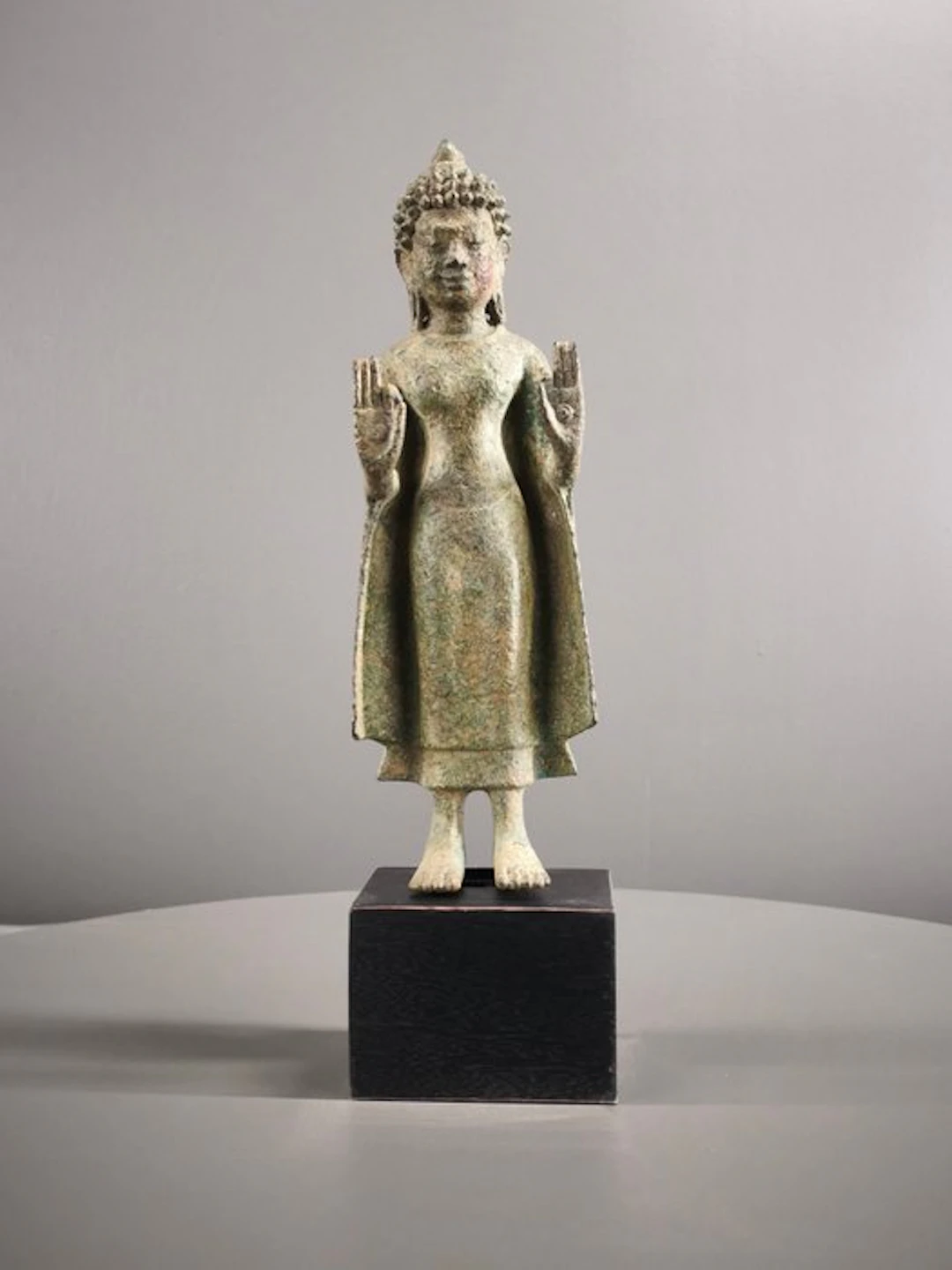
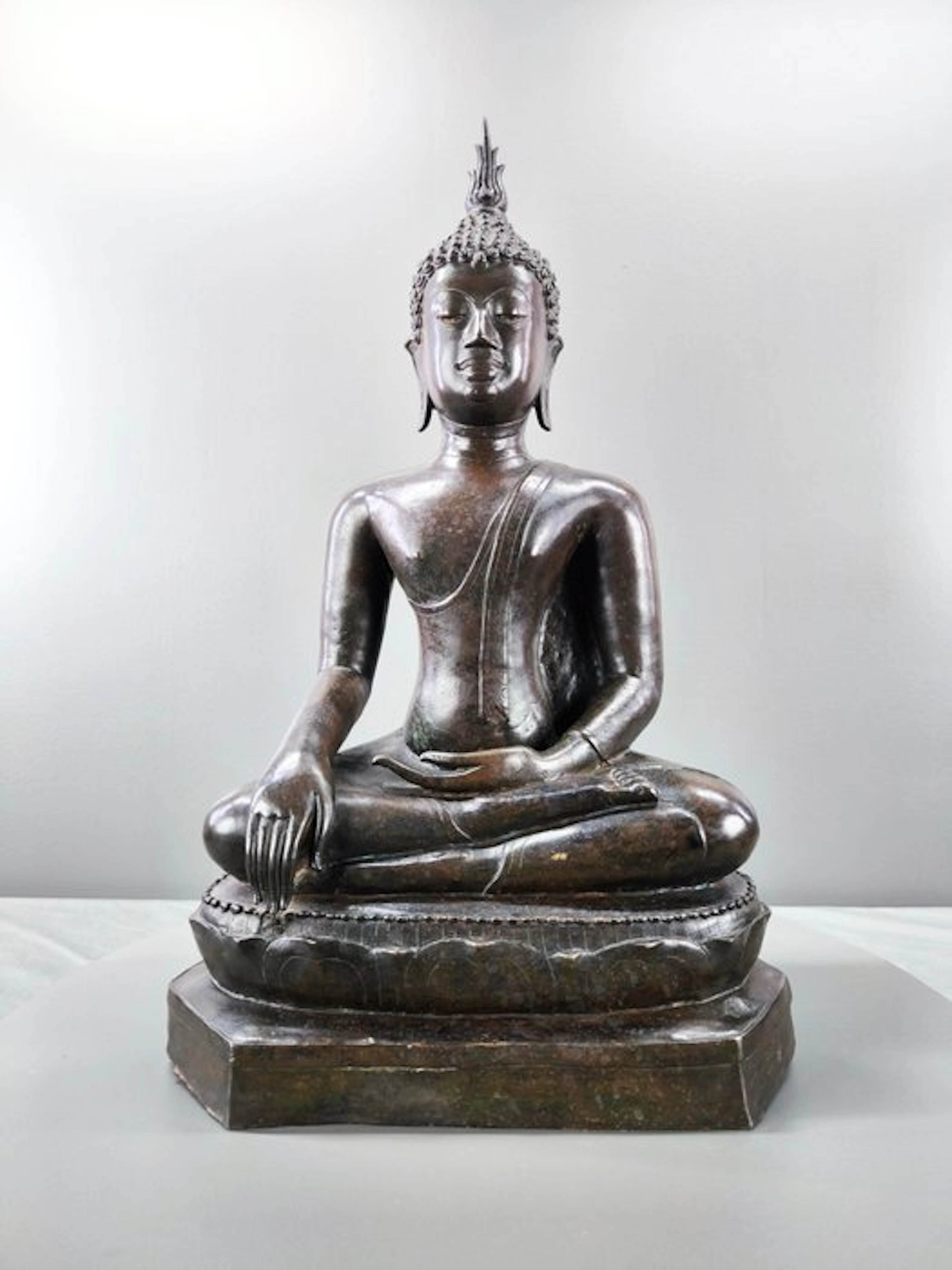
Important bronze standing Buddha Śākyamuni, central Thailand, Mon–Dvāravatī tradition, 8th–9th century. The figure stands frontally, in a calm, perfectly balanced attitude. Both arms are thrust forward and the hands raised perform simultaneously the vitarkamudrā, a gesture of teaching and exposition of Buddhist doctrine. This symmetrical use of the gesture by the two hands is one of the most distinctive iconographic features of Dvāravatī sculpture in central Thailand. The Buddha presents the essential characteristics of this tradition: a broad face with powerfully stylized features, downcast eyes, full lips, long ears with pendulous lobes, hair composed of large individualized curls and a conical uṣṇīṣa. The monastic robe, very thin and treated almost without folds, closely embraces the body before descending to above the ankles, producing that sober and almost abstract silhouette characteristic of Dvāravatī aesthetics. Murphy precisely describes for this group the heavy curls, the conical or hemispherical uṣṇīṣa, the highly stylized and diaphanous robe, and the double vitarkamudrā. Both palms bear circular markings associated with the Buddha’s auspicious signs. Under the feet remains also an element of the casting system, an interesting testimony to cire perdue (lost-wax) sculpture making. The bronze retains an attractive and complex ancient patina, mixing greens, reddish-brown, and whitish mineral deposits. Corrosion and incrustations develop differently in exposed and protected areas, notably at the hair, hands, robe, and under the feet. Macroscopic examination revealed no features suggesting artificial recent patination; overall, it is compatible with a long sojourn buried in a ground environment. The sculpture is remarkably complete for its age: head, two arms, two hands and their mudrās, clothing, legs and feet are preserved. Old wear, corrosion, casting irregularities, and small abrasions on reliefs are present and coherent with the work’s age. No structural damage or major restoration is visible. Provenance: former private collection Jean Dumoulin, Belgium; acquired in Bangkok in the mid-1990s. A signed provenance declaration accompanies the piece. Dimensions: H. 26.5 cm without base; 27.2 cm with base. Weight: 847 g without base; 1,086 g with base. Modern base included. The attribution and dating are based on stylistic, iconographic, technical and macroscopic examination of the work, and its comparison with scientific literature and museum corpora relating to Dvāravatī art. No instrumental analyses (XRF, radiography, metallography) have been performed, as these investigations would be disproportionate to the commercial positioning of the piece. A certificate of authenticity and detailed attribution accompanies the sculpture. video link: https://www.dropbox.com/scl/fo/8uaw6pt2fer33p3w99xka/AHU3quflI_F7aVzutz0-9a4?rlkey=yr1c4enpwpy2i99t7zybnir59&dl=0
Estimate:£2,210.55
To the auctionView all items fromCatawikiorAncient Art
Estimate:
£2,210.55
OCT 8 | 3:00 PM


OCT 8 | 3:00 PM

Bring your auction to collectors worldwide!
Get listed now