



All auctions / Arts & Graphics / École fauviste française (XX) - La Fenêtre sur la Méditerranée - NO RESERVE

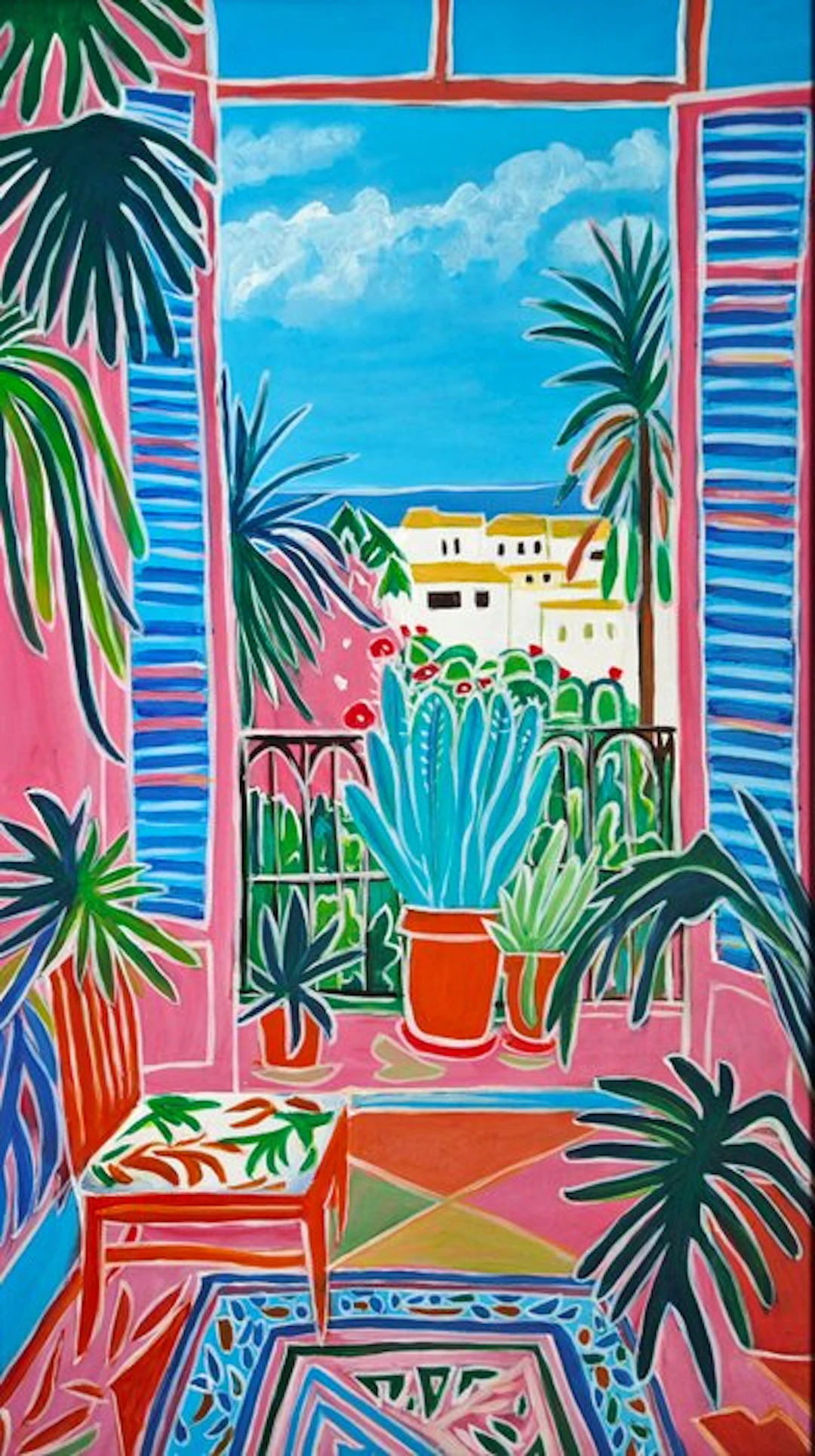
An attractive and luminous oil painting belonging to the French Fauvist school of the 20th century, representing a colorful Mediterranean interior open to a coastal landscape, through a composition of great chromatic vitality and a strong influence from French avant-gardes. The work stands out for its extraordinary richness of color, the simplification of forms, the predominance of expressive outlines, and a free, decorative interpretation of space, features closely related to the pictorial language of Fauvism and its later derivatives. The composition shows a Mediterranean-inspired room, richly decorated with plants and ornamental elements, which opens through a window or balcony to a landscape of white houses, vegetation and an intense blue sky. The artist builds the scene by combining turquoise and ultramarine blues, intense pinks, reds, emerald greens, yellows and oranges, arranged on chromatic surfaces of great intensity. The result is a painting of cheerful character, luminous and deeply Mediterranean, in which color becomes the true protagonist. The work presents important stylistic affinities with the chromatic investigations of Henri Matisse, Raoul Dufy and André Derain, as well as with the decorative tradition of French modern painting. These references should be understood exclusively as stylistic relationships, not implying attribution to any of these artists. The painting is framed, with a white-aged finish moldings that harmonize especially well with its luminous and decorative character. Description of the work The composition represents a Mediterranean interior viewed from a frontal perspective, in which architectural elements, furniture and vegetation integrate into a richly ornamental whole. In the central area there is a wide opening to the exterior, framed by blue shutters and reddish-pink profiles. Through this opening one contemplates a coastal landscape of white houses, warm roofs and abundant vegetation. The sky, depicted in an extraordinarily luminous turquoise blue, occupies a large part of the upper area. Above it are distributed white clouds with soft outlines, introducing a sense of amplitude and depth. On the horizon a dark blue stripe is discernible, suggesting the presence of the sea. The background buildings are depicted with simplified geometric shapes, white façades, yellow roofs and small dark openings. The architecture evokes coastal Mediterranean towns, though there are not enough elements to identify a specific location. In the foreground, a series of tropical and Mediterranean plants occupy different zones of the composition. Their elongated, pointed leaves are distributed through stylized shapes and contrasts of intense greens, blues and dark tones. In the center stands a large blue-tinged plant in a pot of orange-red color. Around it appear other pots, ornamental plants and vegetative masses that enrich the scene. At the bottom there are elements of furniture, decorative surfaces and a rug with geometric motifs. The pinks, reds and blues of these elements establish an intense chromatic dialogue with the exterior landscape. The entire composition conveys a sense of light, vegetation, warmth and vitality. Fauvism and the liberation of color The work presents characteristics directly related to the pictorial language developed by French Fauvism in the early 20th century. Fauvism was one of the first great artistic revolutions of European modernity. Its principal representatives, among them Henri Matisse, André Derain, Maurice de Vlaminck, Raoul Dufy and Albert Marquet, developed a painting based on the free and intense use of color. In contrast to naturalistic representation, Fauvist artists defended the autonomy of color as a means of expression. Tones could be intensified, modified or combined independently of their real appearance. Painting ceased to depend exclusively on faithful reproduction of nature to become a personal and emotional interpretation of the visible world. In the present work, this principle is particularly evident. Colors appear used with expressive freedom that surpasses naturalistic description. Walls show pink and reddish tones, plants combine greens and intense blues, and the sky acquires an almost ornamental luminosity. Overall harmony does not depend on strictly realistic reproduction, but on the relationships between the different chromatic fields. This expressive use of color is one of the most characteristic aspects of painting. Influences of Henri Matisse One of the most evident stylistic references in the composition lies in the painting of Henri Matisse (1869-1954), a fundamental figure of Fauvism and the artistic renewal of the 20th century. Matisse developed a pictorial language based on simplification of forms, chromatic intensity and the integration of decorative elements within the composition. His interiors, especially those that include open windows, vegetation, ornamental fabrics and views to the exterior, constitute one of the most recognizable contributions of his career. In numerous works, the French artist used the window as an element that allowed establishing relations between domestic space and the landscape. Interior and exterior ceased to function as independent realms to be integrated into a single chromatic structure. The present painting shares certain characteristics with this conception. The window occupies a central position and visually organizes the entire composition. Interior elements, plants and the exterior landscape relate through a continuity of colors and forms. Perspective appears simplified and subordinate to decorative harmony. The intense pinks, blues and greens also evoke the importance Matisse gave to chromatic relationships. The presence of vegetal motifs, decorative fabrics and ornamental surfaces reinforces these affinities. This is not a reproduction of a specific model, but a composition that participates in a visual sensitivity related to the Matissean tradition. Affinities with Raoul Dufy The painting also presents affinities with the artistic language of Raoul Dufy (1877-1953). Dufy developed a painting characterized by its luminosity, drawing freedom and an especially joyful interpretation of Mediterranean landscape and life. His compositions frequently incorporate intense colors, simplified architectures, ornamental vegetation and scenes bathed in light. In the present work, the representation of the coastal landscape with white houses, blue sky and abundant vegetation recalls this Mediterranean sensibility. The use of expressive outlines and the distribution of colors across relatively flat surfaces also allow establishing certain stylistic relationships. The scene conveys a sense of spontaneity and vitality that finds general parallels with certain manifestations of 20th-century French decorative painting. The influence of André Derain and expressive color The use of intense chromatic contrasts allows relating the work to the principles developed by André Derain (1880-1954) during his Fauvist period. Derain experimented with pure and contrasted color combinations, especially in his Mediterranean landscapes. His painting helped establish a new conception of color, understood as an expressive resource independent of the natural appearance of objects. In the present composition, intense blues, saturated pinks and deep greens combine to generate a vibrant atmosphere. The artist gives priority to the chromatic effect of the whole. Contrasts between warm and cool tones organize the scene visually and reinforce its luminosity. These features allow placing the painting within a figurative tradition deeply influenced by the Fauvist chromatic investigations. The Mediterranean as a source of inspiration Light and Mediterranean landscapes played a fundamental role in the development of French modern painting. During the late 19th century and the first decades of the 20th, numerous artists found in the south of France a setting particularly suitable for color experimentation. The intensity of the light, the contrast between the sea’s blue and the warm tones of architecture, as well as the abundance of vegetation, favored the development of new pictorial solutions. Localities such as Collioure, Saint-Tropez, Nice and other towns along the Mediterranean coast gained special importance within these explorations. In the present painting, the artist recreates an atmosphere that evokes this visual universe. White houses, bright sky, blue shutters and ornamental vegetation recall an idealized interpretation of Mediterranean life. The scene conveys a sense of well-being, serenity and brightness. The landscape is not conceived solely as a geographical representation, but as a chromatic and emotional experience. The dialogue between interior and exterior One of the most interesting compositional aspects of the painting is the relationship between interior space and exterior landscape. The window constitutes the main organizing axis of the scene. Through it, the viewer contemplates a luminous landscape of white houses and blue sky. However, the interior possesses chromatic and ornamental richness as intense as the exterior. The plants in the foreground seem to extend the landscape’s vegetation. The blues of the shutters relate to those of the sky and sea. The pinks of the walls contrast with the greens of the plants and the whites of the architecture. In this way, the artist builds a visual continuity between both spaces. The window ceases to be only an architectural element and becomes the center of a composition organized by chromatic relationships. This conception is especially characteristic of modern decorative painting. The treatment of perspective The work presents a deliberately simplified perspective. Although it is possible to recognize the different spatial planes, the artist does not seek a strictly academic representation of depth. Interior elements are organized through relatively flat surfaces. Shutters, plants and furniture are distributed across a structure of vertical, horizontal and diagonal lines. The background architecture is represented by simple geometric forms. The layering of elements allows suggesting depth without recourse to detailed volumetric modeling. This spatial simplification reinforces the decorative character of the painting. The composition thus acquires a quality akin to a tapestry or ornamental surface, in which each element participates in the overall balance. The protagonism of vegetation Vegetation constitutes one of the most important elements of the composition. Plants are distributed across different planes and present an extraordinary variety of shapes and colors. Elongated leaves, sharp profiles and dark vegetal masses create a visual rhythm that runs through the entire painting. In the central zone stands a blue-toned plant in an orange-red pot. Its presence introduces an especially intense chromatic contrast. Leaves are depicted with simplified strokes and clearly defined outlines. The artist does not seek a meticulous botanical description, but an ornamental interpretation of natural forms. Vegetation functions as a unifying element between domestic space and exterior landscape. At the same time, it adds dynamism and vitality to the composition. Color as the main expressive element The color palette is undoubtedly one of the painting’s greatest attractions. Intense blues, turquoises, pinks, reds, greens and yellows predominate, distributed through contrasts of high vibrancy. The blue sky constitutes one of the main luminous surfaces. The shutters show different shades of blue, combined with reddish profiles. The walls and interior architectural elements are dominated by intense pinks. The plants introduce emerald greens, deep blues and dark tones. Red and orange pots provide points of warm intensity. The white houses of the landscape function as zones of visual rest within an extraordinarily colorful composition. The artist uses color autonomously, giving priority to its expressive and decorative capacity. The overall harmony arises from the balance between warm and cool contrasts. The result is a vibrant, luminous scene with high visual appeal. Drawing and simplification of forms The painting presents a synthetic drawing, based on clearly defined contours. Plants are built with elongated leaves and angular profiles. Shutters are organized by vertical and horizontal lines. The background houses are reduced to essential geometric volumes. The interior decorative elements are represented by simplified shapes and flat color combinations. The artist gives greater importance to visual rhythm and surface organization than to detailed object description. This formal simplification is a fundamental characteristic of modern pictorial currents related to Fauvism. The decorative dimension of the painting The work shows a marked decorative vocation. The abundance of vegetal motifs, chromatic intensity and the integration of different compositional elements recall the importance that many modern artists attributed to the decorative arts. In particular, 20th-century French painting developed a close relationship between pictorial creation and interior design. The representation of windows, fabrics, furniture and plants allowed exploring new possibilities for chromatic organization. In this work, the interior appears conceived as a visual set in which each element contributes to the overall balance. The geometric motifs of the floor and furniture relate to the lines of the shutters. The plants introduce organic shapes that contrast with the architectural structure. The exterior landscape provides depth and luminosity. The result is a composition of great ornamental richness, in which color and form combine to create an atmosphere of Mediterranean vitality. Frame and presentation The painting is framed with a white-aged finish molding, with areas of wear of decorative appearance that reveal darker tones. The framing has a rustic and Mediterranean aesthetic that harmonizes especially well with the luminous character of the composition. The whiteness of the frame provides a balanced contrast with the painting’s intense colors, helping to highlight the chromatic richness of the whole. Its presentation is particularly suitable for spaces decorated with wooden furniture, natural materials and Mediterranean-inspired environments. The frame is offered as a gift to the buyer, with no commercial value, and is not part of the painting’s economic valuation. It is recommended to examine the photographs carefully to assess the condition of the frame and its conservation state. Condition of conservation The work is framed. The conservation state should be assessed from the provided photographs. It is not possible to determine solely from the images the existence or absence of restorations, retouchings or previous interventions. The photographs are an integral part of the description. Artistic and collecting interest The work constitutes an attractive interpretation of a Mediterranean interior through a pictorial language clearly inspired by Fauvism. Its main interest lies in the chromatic intensity, the simplification of forms and the integration of the exterior landscape within an ornamental composition. The stylistic affinities with the investigations of Henri Matisse, Raoul Dufy and André Derain allow relating it to the tradition of French modern painting. The free use of color, the representation of ornamental plants and the simplified perspective reinforce its Fauvist character. The composition also stands out for its luminosity, vitality and its ability to evoke the warm atmosphere of the Mediterranean. It is a work particularly attractive to collectors of Fauvist painting, French modern art, Mediterranean landscapes, decorative interiors and 20th-century figurative painting. Characteristics of the work Scope: French Fauvist school. Era: 20th century. Technique: Oil. Theme: Mediterranean interior with sea views. Genre: Landscape and interior. Style: Fauvism, with influences from French decorative painting and the avant-gardes of the 20th century. Stylistic influences: Henri Matisse, Raoul Dufy and André Derain. Presentation: Framed. Shipping The work will be carefully and professionally packed, using suitable protective materials to ensure its safety during transport. Shippings outside the European Union may be subject to taxes, duties, import fees, clearance costs and customs procedures. Any such charges will be the sole responsibility of the buyer and are not included in the hammer price or shipping costs. Furthermore, shipments to islands, insular territories, or remote or hard-to-reach areas by transport companies may incur additional charges. Any surcharge applied by the transport company for this reason must be borne by the buyer. It is recommended to consult in advance the applicable customs conditions and potential transport supplements for the destination.
Estimate:£335.03
To the auctionView all items fromCatawikiorArts & Graphics
Estimate:
£335.03
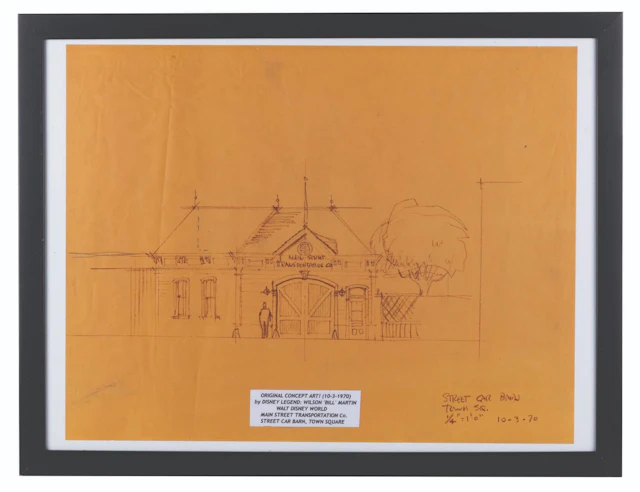
A Bill Martin Main Street Car Barn Original Concept Drawing.
10/10/2026
£169.95
Est: £301.87
A Bill Martin Main Street Car Barn Original Concept Drawing.
10/10/2026
£169.95
Est: £302.04


OCT 27 | 4:00 PM
Bring your auction to collectors worldwide!
Get listed nowBy subscribing, you are agreeing to the privacy policy. Unsubscribe anytime.
Barnebys HQ
Brahegatan 10
BOX 5038
114 37 Stockholm
