



All auctions / Ancient Art / Europe – Late Bronze Age Bronze Chisel with Fan-Shaped...

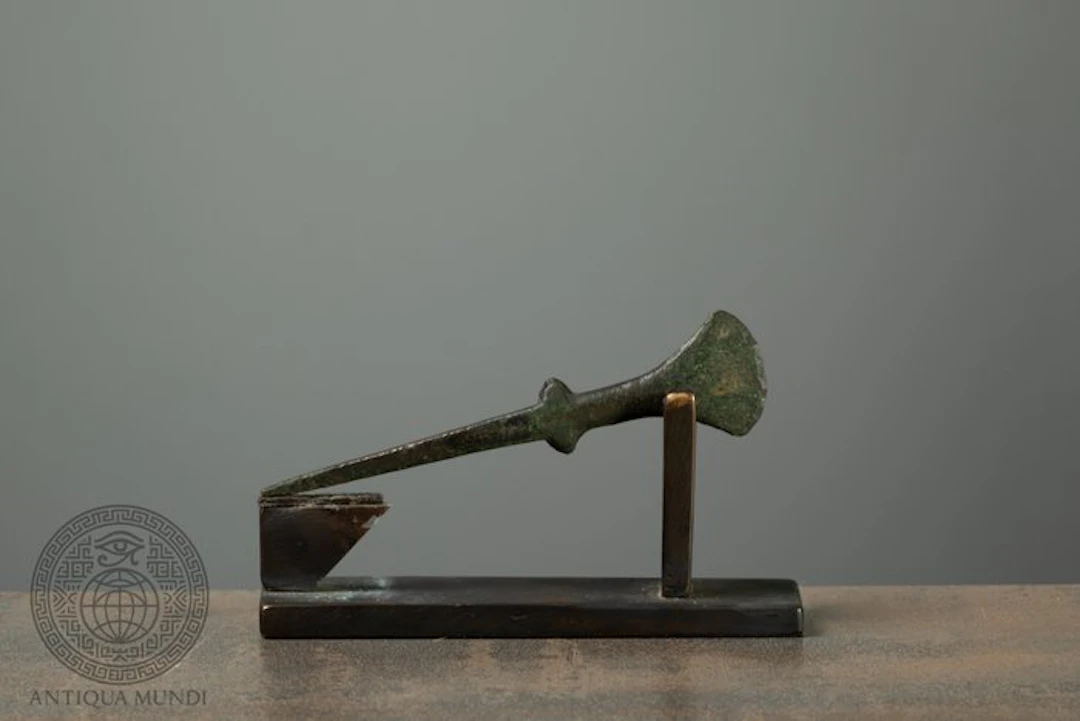
A finely cast Late Bronze Age bronze chisel with a distinctive fan-shaped cutting edge, pronounced collar and elongated tapering tang, attributed to the European Late Bronze Age. Measuring approximately 13 cm in length, the tool displays a carefully balanced construction, combining a slender pointed tang with a broad, curved working edge. The long, narrow tang tapers gradually towards a pointed end and was originally intended for insertion into a handle, most probably made of wood. At the transition between the tang and the working section is a prominent moulded collar, projecting distinctly on either side of the shaft. This pronounced feature creates a clear structural division between the handle attachment and the working portion of the tool. Above the collar, the body continues into a short, slightly widening neck before expanding into the characteristic fan-shaped blade. The cutting edge forms a broad, gently curved outline, approaching a semicircular profile. Its slightly convex surfaces taper smoothly towards the narrower neck, giving the tool an elegant and clearly defined silhouette. The bronze retains an attractive dark green to brown patina, with lighter green oxidation and mineral deposits in places. Typology and Dating Bronze chisels with narrow tangs and broadened cutting edges formed part of the metalworking and woodworking tool repertoire of prehistoric Europe. During the Late Bronze Age, a variety of tanged chisels were produced, including examples with pronounced collars and expanded cutting edges. The present chisel displays characteristics associated with this broader European Late Bronze Age tool tradition. A particularly relevant typological comparison is preserved in the British Museum, London, under inventory number 1998,0901.160. This museum example is catalogued as a cast copper alloy tanged chisel, with collar and belongs to the Salisbury Hoard, discovered at Netherhampton, Wiltshire, England. The British Museum dates the comparative example to the Ewart Park phase of the Late Bronze Age, circa 1140–800 BC. The general construction, including the elongated tang and pronounced collar, provides a useful parallel for the present object. On typological grounds, a Late Bronze Age attribution, possibly within the broad chronological horizon of circa 1140–800 BC, appears plausible. However, the comparison does not establish a British origin or a definite association with the Ewart Park cultural phase. Without a documented archaeological find context, the precise production region remains uncertain. Function Tanged bronze chisels were practical tools used primarily for working wood and other relatively soft materials. The pointed tang was inserted into a wooden or other organic handle, allowing the tool to be held and controlled during use. The pronounced collar may have served as a stop, helping to limit the depth to which the metal tang could penetrate the handle. The broad, fan-shaped cutting edge would have provided a comparatively wide working surface, suitable for controlled cutting, shaping or finishing operations. The combination of functional design and carefully developed casting demonstrates the technical capabilities of Late Bronze Age bronze workers. Surface and Patina The bronze displays a varied dark green to brown patina, with areas of lighter green oxidation and darker surface discolouration. Small mineral accretions and age-related surface irregularities are visible throughout. The patinated surface emphasises the distinctive shape of the expanded blade, projecting collar and slender tang. Condition Good condition considering its considerable age. The chisel is preserved with its fan-shaped cutting edge, pronounced collar and elongated pointed tang. The cutting edge displays some wear, minor irregularities and small areas of edge damage. The tang shows surface wear and age-related irregularities. Oxidation, corrosion deposits, surface discolouration and mineral accretions are present across the bronze. Please examine all photographs carefully, as they form an integral part of the condition description. The modern display stand is used solely for presentation and is not included in the sale. Comparative Reference British Museum, London Inventory number: 1998,0901.160 Object: Cast copper alloy tanged chisel, with collar Period: Late Bronze Age, Ewart Park phase, circa 1140–800 BC Findspot: Netherhampton, Wiltshire, England – Salisbury Hoard Literature: Stead, I. M. (1998), The Salisbury Hoard. Provenance Formerly in the Madeleine & Erich Dammann Collection, Germany. Acquired during the collectors’ extensive travels between 1950 and 1970. The collection is documented in Germany by 1970 through historical photographs of the family residence and subsequently remained in continuous family ownership. The objects were acquired privately during the collectors’ travels. As was customary for private purchases made at local markets during the 1950s and 1960s, purchase receipts or invoices were generally neither issued nor requested. Historical photographs and biographical documentation relating to the Dammann Collection are available and support the long-standing provenance of the collection.
Estimate:£355.97
To the auctionView all items fromCatawikiorAncient Art
Estimate:
£355.97


OCT 27 | 4:00 PM
Bring your auction to collectors worldwide!
Get listed nowBy subscribing, you are agreeing to the privacy policy. Unsubscribe anytime.
Barnebys HQ
Brahegatan 10
BOX 5038
114 37 Stockholm
