
Bring your auction to collectors worldwide!
Get listed nowBy subscribing, you are agreeing to the privacy policy. Unsubscribe anytime.
Barnebys HQ
Brahegatan 10
BOX 5038
114 37 Stockholm
All auctions / Miscellaneous / European School (c.1800) - The Education of the Virgin

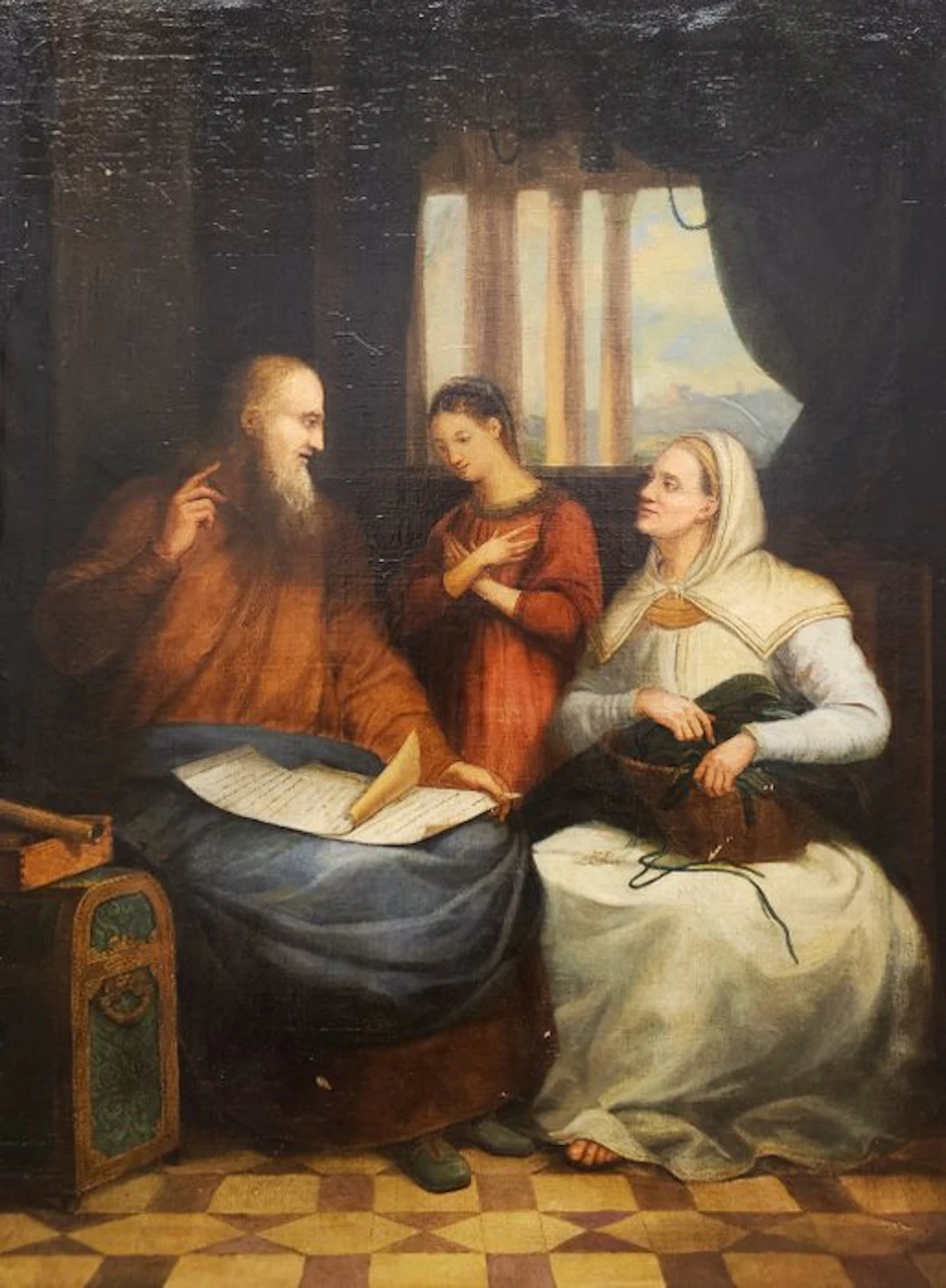
1. Technical Sheet Author: European School, unidentified author Period: First half of the 19th century Approximate dating: c. 1800–1830 Title: The Education of the Virgin Technique: Oil on canvas Dimensions of the work: 96 × 71 cm Dimensions with frame: 105 × 82 cm Support: Relined canvas Frame: Gilded frame from a later period or contemporary to the historical setting of the work Signature: No visible signature in the photographs examined Condition: Condition in keeping with its age. The work has been relined and shows widespread craquelure, small losses, and ancient interventions compatible with its material history. 2. Description Important religious painting of the European school from the first half of the 19th century, representing an episode traditionally identified as The Education of the Virgin. The scene presents a solemn, intimate domestic interior. On the left appears St. Joachim, depicted as an elderly man with a long beard, seated before an open manuscript or text on his knees and addressing the young Mary with a didactic gesture. In the center, the young Virgin listens to the teaching with her hands crossed over her chest and her head slightly inclined, expressing reverence, obedience and devotion. On the right, Santa Ana appears seated and accompanied by textile work, a traditional element linked to the female domestic sphere. Her gaze is directed toward the other figures, psychologically integrating her into the episode. The whole combines religiosity, familial intimacy, and spiritual instruction, turning the sacred episode into an accessible and humane scene. 3. Stylistic and compositional analysis From a stylistic point of view, the work responds to a clearly academic figurative culture, but incorporates several elements that allow situating it within the historicist and spiritualist revival developed during the early decades of the 19th century. The construction of the figures starts from a precise and carefully delineated drawing. The contours remain visible and the treatment of the surfaces deliberately seeks a clean, polished finish, with an almost imperceptible brushwork in the flesh tones and in much of the clothing. This finish is compatible with academic painting and with certain approaches close to Italian and French Purism and the Nazarenes, whose artists claimed clarity of narrative, spirituality, and certain formal solutions of Italian painting before the fully developed Baroque. The composition is organized by a perfectly legible triangular scheme. St. Joachim, Mary and Santa Ana constitute three psychological and spatial vertices linked by looks and gestures. The use of the geometric pavement is especially significant, introducing a strong perspectival structure in the lower area and deliberately emphasizing the archaizing character of the image. Depth is also constructed through the central window, which opens the domestic scene to an exterior landscape. 4. Psychological dimension One of the most successful aspects of the painting is the psychological relationship established among the three figures. St. Joachim appears in an active attitude. His raised hand and the open document clearly identify the act of transmitting knowledge. Opposite him, the Virgin adopts a completely different position: she stands upright, contemplative and silent, with her hands crossed over her chest. The gesture avoids excessive theatricality and conveys attention and acceptance. Santa Ana introduces a third emotional dimension. She does not intervene directly but follows the conversation while holding on her knees the elements of her domestic labor. Thus the painter constructs an image of education, family and spirituality, more intimate than spectacular, moving away from the rhetoric typical of much Baroque religious painting. 5. Authorship, school and dating There is currently no signature that would allow establishing a specific authorship. From its formal characteristics, the work can be related to European academic painting of the first half of the 19th century, in a context where late Neoclassicism, religious historicism, and currents of recovery of the early Renaissance converge. The relationship with the Nazarene and Purist world should be understood essentially in stylistic terms: defined contours, restrained expressiveness, orderly composition, contained spirituality, and a desire to recover a certain formal simplicity prior to the Baroque. The Nazarene movement itself already emerges in the first decades of the 19th century, so these features advise placing the painting preferably in the first third or the first half of the 19th century, rather than in the late 18th century. In the absence of historical documentation or additional technical analysis, it seems prudent to maintain the attribution as: European School, first half of the 19th century. 6. Iconography and other points of interest The theme of The Education of the Virgin derives from Christian traditions related to Mary’s childhood, extensively developed in apocryphal literature and Western iconography. The simultaneous presence of St. Joachim and Santa Ana transforms the educational episode into a complete family scene. The unfurled manuscript constitutes the main narrative attribute of the episode. In turn, Santa Ana’s textile work introduces a domestic element linked to the traditional education of the young Mary. In the lower left corner there is also an object decorated with green and gold tones, possibly related to books, documents, or devotional elements, which reinforces the cultured nature of the scene. The background architectural setting is also of particular interest. Through the window one can discern constructions and elements with a classical appearance. Its presence can be interpreted as a historicist and symbolic device. In the 19th-century Christian tradition, ancient ruins could be used as allusion to the world before Christianity, although in this work such reading should be considered interpretive and not demonstrably documented. The work has been relined, a common historical intervention intended to reinforce an old canvas. The verso preserves widespread craquelure, consistent with the age of the pictorial layer. 7. Shipping and conditions The work will be shipped by a professional specialized company, using high-protection packaging, a bespoke crate, and foam protections to ensure maximum security during transport. We offer international shipments worldwide. Due to its dimensions, weight, and characteristics, certain distant destinations, large-format shipments, or shipments outside the European Union may incur additional transport, packaging, customs, or import costs, which will be borne by the purchaser. The frame is included as a gift with the work and will not be subject to claims.
Estimate:£1,892.21
To the auctionView all items fromCatawikiorMiscellaneous
Estimate:
£1,892.21

Bring your auction to collectors worldwide!
Get listed now