






All auctions / Ethnographical / Extra Large Polished Cleoniceras Ammonite with Intricate...

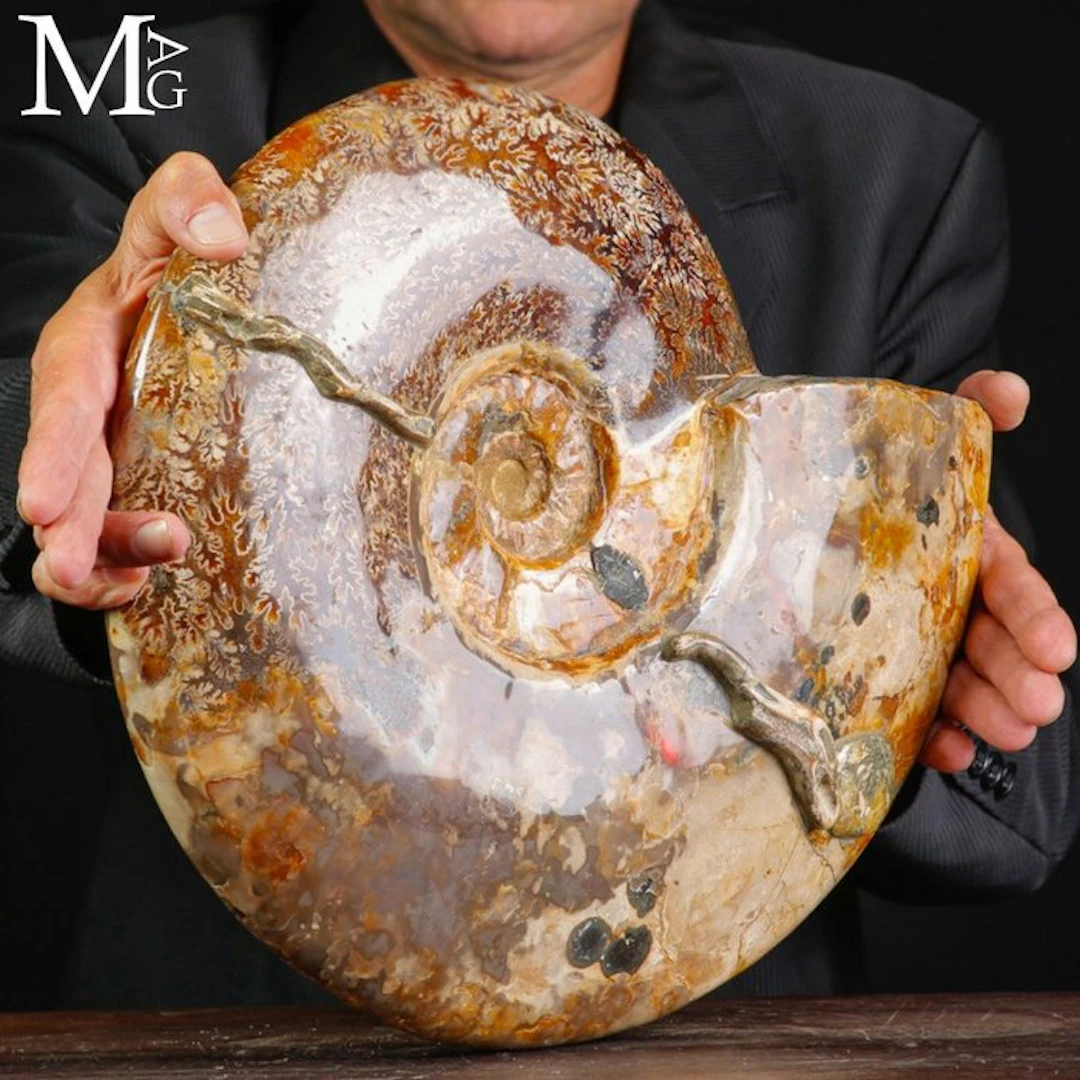
A masterpiece of the Cretaceous with unique inlays — This exceptional specimen is a large fossil ammonite of the genus Cleoniceras, sectioned and polished to reveal its complex internal anatomy. Coming from Lower Cretaceous deposits in Madagascar, the fossil presents itself as a natural sculpture of imposing dimensions, whose geological history has been boldly reinterpreted through a contemporary artistic intervention. The most distinctive feature, in fact, is the sculptural inlays in metal that follow and consolidate the natural fracture lines, transforming a paleontological find into a one-of-a-kind work of art. Direct observation of the piece reveals a mirror-polished surface that highlights the logarithmic spiral of the shell. The color palette is rich and warm, dominated by amber, brown, and cream tones, with darker mineral inclusions speckling the composition. The internal chambers of the ammonite, or septa, were completely filled with crystalline calcite during the fossilization process, creating a translucent mosaic that captures and reflects light. Particularly fascinating are the sutural lines, the complex junctions between one chamber and another, which draw on the surface dendritic patterns resembling ferns or corals, a testament to the biological perfection of this ancient cephalopod. What makes this specimen an object of design as well as a fossil for collection is the original metalwork. An artist created sculptural casts, probably in a bronze or brass alloy, that insinuate themselves along the ancient cracks of the fossil. This intervention not only serves a structural function of consolidation but establishes an aesthetic dialogue between the petrified organic matter, millions of years old, and human creativity. The flowing, organic shapes of the polished metal almost appear as a natural continuation of the sutural lines, blending perfectly into the whole and giving the piece a contemporary and sophisticated aura. The history of this ammonite begins about 110 million years ago, during the Lower Cretaceous, when the seas of Madagascar were inhabited by these marine predators. After its death, the animal settled on the ocean floor and was quickly buried by sediments, a process that protected its shell from destruction. Over millions of years, groundwater rich in minerals, mainly calcium carbonate, percolated through the shell, filling the empty chambers and gradually replacing the original aragonitic structure. This slow mineralization process allowed the conservation of extraordinarily fine anatomical details, such as the delicate sutural lines. For its monumental size, the quality of preservation, and the exceptional artistic intervention, this specimen sits at the boundary between natural history and contemporary art. It is not only a scientific artifact of great interest to the paleontologist or fossil collector but also a striking decorative object with strong visual impact. Its presence can define a space, whether a professional studio, a library, an art gallery, or a luxury interior. It is a piece for a modern Wunderkammer, a fragment of deep time transformed into a sculpture that invites contemplation and dialogue.
Estimate:£2,680.28
To the auctionView all items fromCatawikiorEthnographical
Estimate:
£2,680.28

OCT 27 | 4:00 PM
Bring your auction to collectors worldwide!
Get listed nowBy subscribing, you are agreeing to the privacy policy. Unsubscribe anytime.
Barnebys HQ
Brahegatan 10
BOX 5038
114 37 Stockholm
