


OCT 8 | 3:00 PM

Bring your auction to collectors worldwide!
Get listed nowBy subscribing, you are agreeing to the privacy policy. Unsubscribe anytime.
Barnebys HQ
Brahegatan 10
BOX 5038
114 37 Stockholm
All auctions / Books, Maps & Manuscripts / F. Bartolomeo Ovmo Piacentino - Somma Armilla - 1584

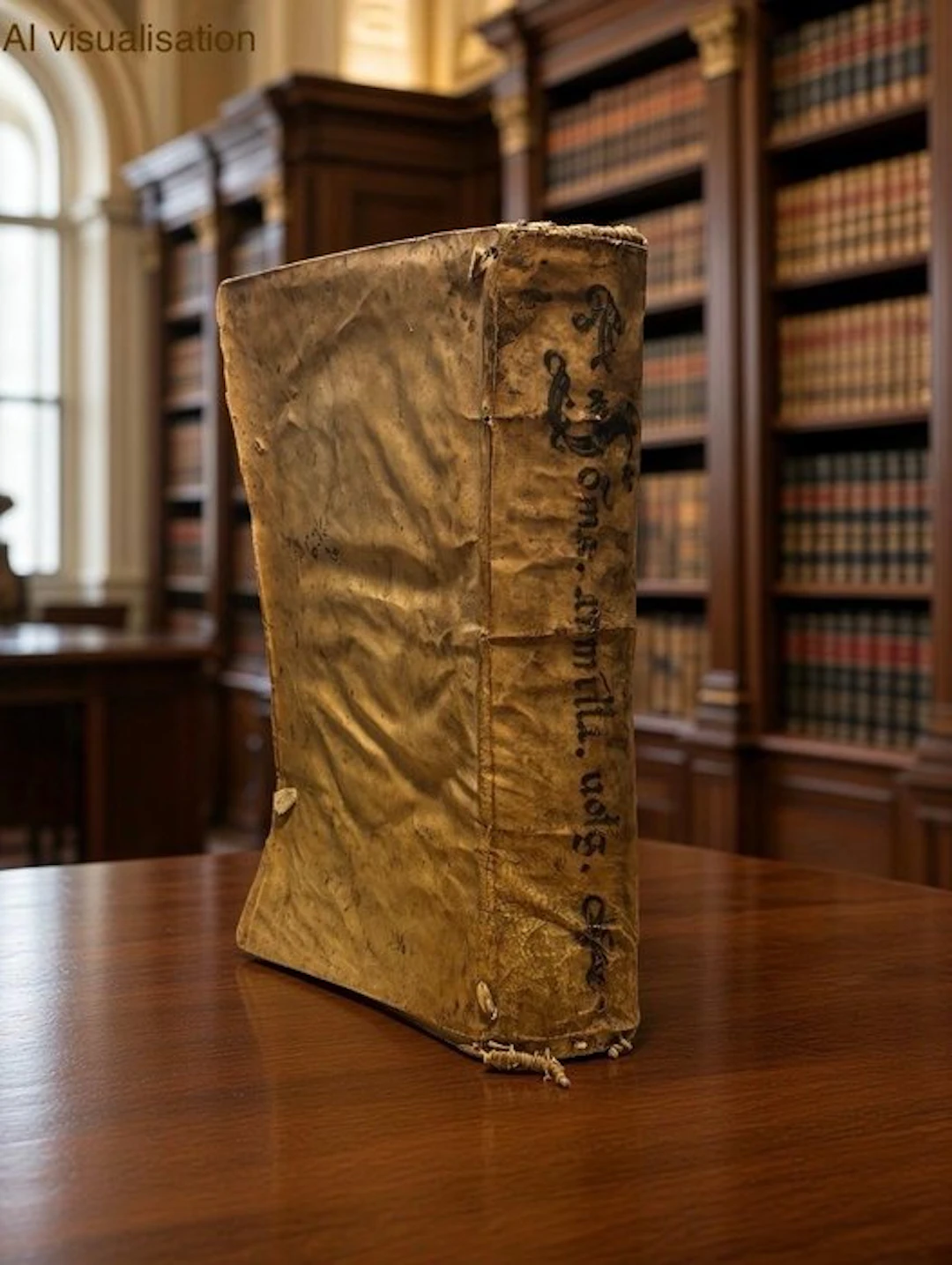
BARTOLOMEO FUMO Summa armilla of the Rev. Father F. Bartolomeo Fumo, Piacentine, theologian of the Order of Preachers, and inquisitor against heretics… Venice, at Domenico Nicolini, 1584 An important Cinquecent work on theological, moral and canonical topics, belonging to the long editorial fortune of the Summa armilla, the work of the Dominican from Piacenza Bartolomeo Fumo (d. 1555), theologian, preacher and inquisitor, active in Piacenza and Crema. His figure sits fully within the religious climate of sixteenth-century Italy, marked by the need to discipline ecclesiastical life and pastoral practice and, after the Protestant Reformation, by the growing demand to define with precision the doctrine and conduct of the faithful. The Summa armilla, also known in the Latin form Summa aurea armilla, constitutes a vast manual for the care of souls, in which are collected and organized the main cases of conscience, that is, the moral, legal and religious situations that could arise in the practice of confession and in the administration of penance. The work draws on the tradition of canon law and moral theology and addresses questions concerning sin, confession, penance, the obligations of the faithful and of the ministers of the Church, providing the confessor with a highly practical instrument for the solution of conscience cases. The historical significance of the work is particularly relevant if placed in the context of the Catholic Reformation and the Council of Trent. The Summa armilla belongs, in fact, to that body of books intended to provide the clergy with systematic tools for exercising the pastoral function. Its editorial fortune, lasting for decades through numerous reprintings, testifies to the persistence of demand for this kind of religious manuals in post-Tridentine Italy. Copies of the work are also found in the libraries of religious institutions already by the end of the 16th century, confirming its concrete dissemination in ecclesiastical circles. Of particular interest is the translation into the vernacular, carried out by the Dominican Remigio Nannini and Giovanni Maria Tarsia. The choice of the vernacular is a significant element: a work originally tied to Latin theological and canonical culture is made more accessible to Italian pastoral practice. Remigio Nannini was in turn an important figure of 16th-century Dominican culture and dedicated himself extensively to producing and translating religious texts for dissemination in Italian. His version of the Summa armilla was first published in 1581, and underwent subsequent reprintings, including the one offered here of 1584. Especially eloquent is the frontispiece itself, which declares the work intended not only for “Confessors, & Penitents,” but also for notaries, lawyers and those who have to deal with civil and criminal matters. This indication allows us to grasp the breadth of the work’s ambition: the Summa armilla is not presented solely as a devotional text, but as a practical repertoire capable of intersecting moral theology, canon law and judicial practice. The printer: Domenico Nicolini The edition is printed in Venice by Domenico Nicolini, belonging to the celebrated family of printers originating from Sabbio Chiese, in the Brescia territory, one of the most important print dynasties active in sixteenth-century Venice. Domenico Nicolini represents a prominent figure in the Venetian book production of the second half of the Cinquecento. His activity fits into the family tradition of the Nicolini from Sabbio, printers settled in Venice as early as the first decades of the century and protagonists of a highly diverse production. Domenico remained active in Venice from the mid-sixteenth century to the early seventeenth century, and his workshop produced over 250 titles, operating in the heart of the city, in the parish of San Zulian, between Rialto and San Marco. His production includes religious, theological, literary and scientific works, thus fully located within the great Venetian Renaissance book industry. The presence of Nicolini’s name on the frontispiece of this Summa armilla thus binds the copy not only to the history of moral theology, but also to the history of the great Venetian publishing in the Cinquecento. The volume also presents on the frontispiece the refined woodcut printer’s mark, set in an ornamental frame, a characteristic element of Renaissance typography culture and an integral part of the editorial identity of the workshop. Importance of the edition This 1584 edition belongs to the mature phase of the work’s Cinquecento fortune. The Summa armilla had already become a consolidated instrument for the training and activity of confessors and continued to be reprinted precisely while the Catholic Church proceeded with the systematic application of the principles of the Tridentine Reform. Its antiquarian interest lies therefore in the convergence of several elements: the figure of an important Dominican theologian and inquisitor of the XVI century; the history of confession and moral theology; the diffusion of religious culture in the vernacular; the relationship between morality, canon law and judicial practice; and the book production of Renaissance Venice, one of Europe’s major centers of printing. An exemplar that, through the printed book, documents a fundamental moment in the religious and cultural history of 16th-century Italy: the transition from Latin-language specialized theological culture to the progressive diffusion of pastoral tools in the vernacular, within the framework of the deep reorganization of the Catholic Church following the Protestant Reformation and the Council of Trent. Venice, Domenico Nicolini, 1584. 4to. Cinquecentina. Text in the vernacular. Condition and Collation: Excellent state of preservation with minor imperfections due to nearly half a millennium passing, such as slight browning of some sheets and part of the binding somewhat fragile but overall an excellent exemplar. Collation (8 pp); 390 pp Shipping: rapid express with DHL which will allow you to receive it in only 24 working hours throughout Europe and in only 48 working hours for non-EU countries
Estimate:£169.7
To the auctionView all items fromCatawikiorBooks, Maps & Manuscripts
Estimate:
£169.7
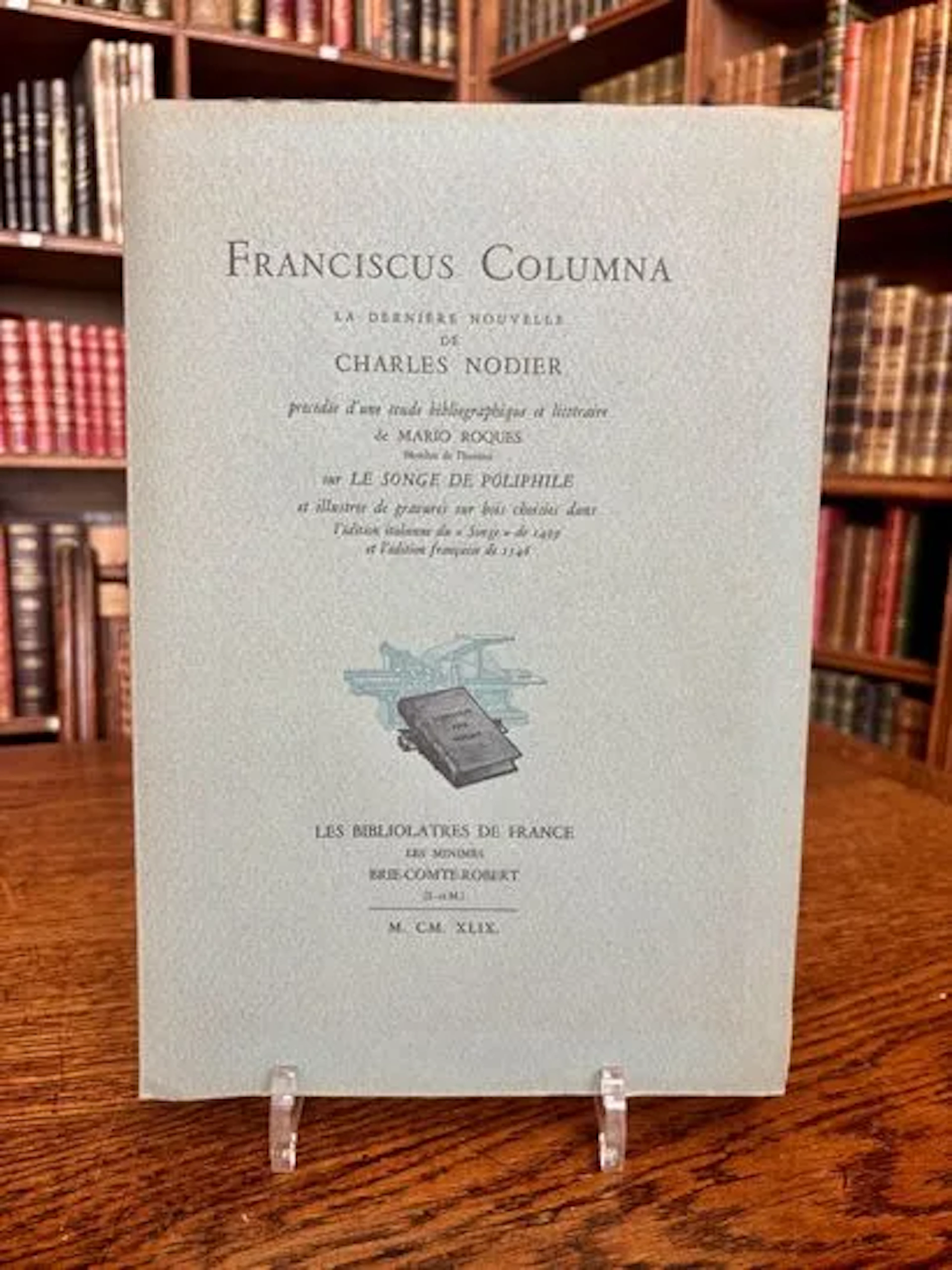
NODIER (Charles). FRANCISCUS COLUMNA. Charles Nodier’s lates - Lot 216
10/04/2026

£4.24
Est: £34
OCT 8 | 3:00 PM


OCT 8 | 3:00 PM
Bring your auction to collectors worldwide!
Get listed now£3.39
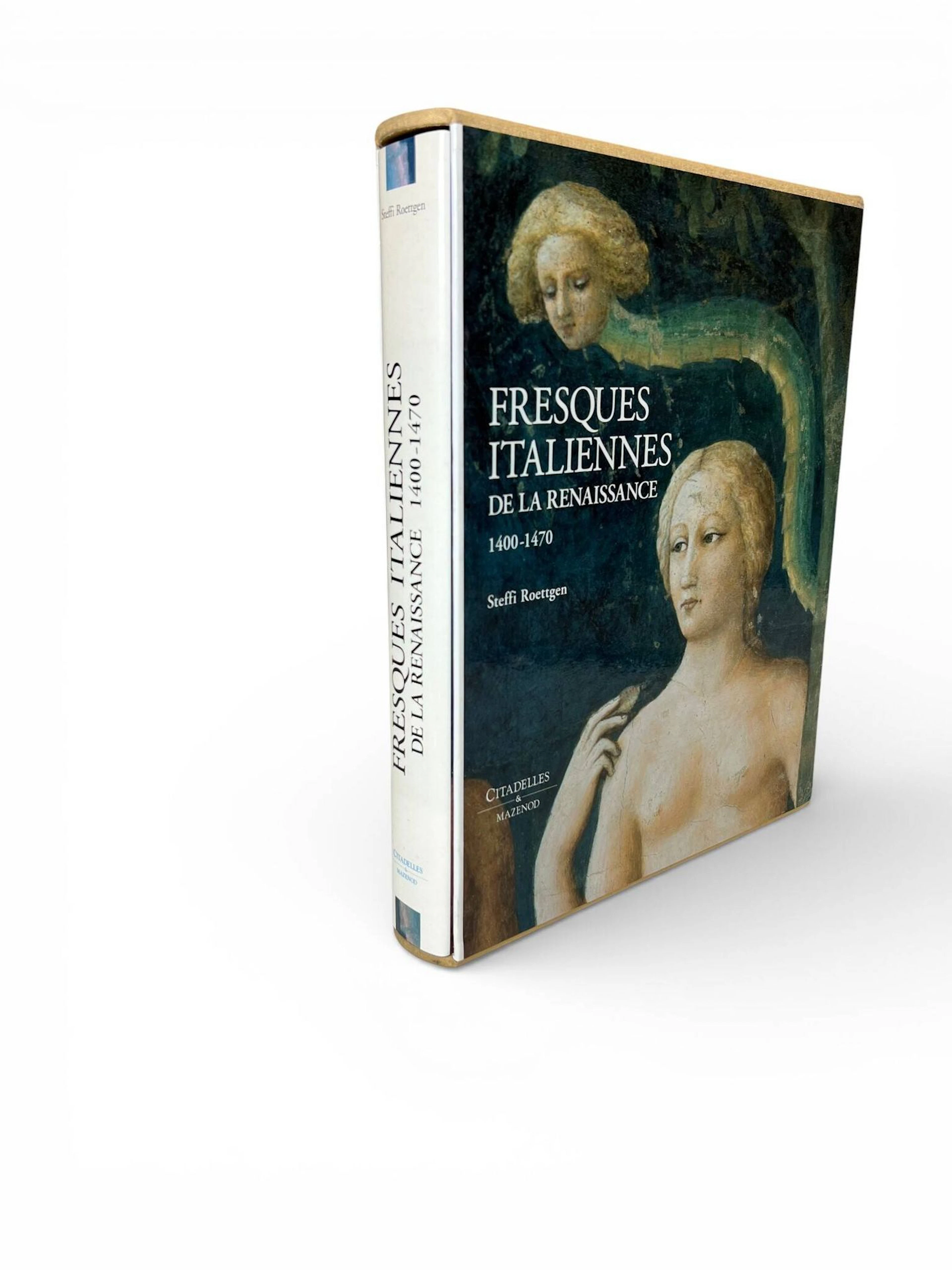
CITADELLES & MAZENOD - Italian Renaissance frescoes 1400 - Lot 396
09/10/2026

£60.03
Est: £59.89

OCT 17 | 10:00 PM