




All auctions / Ethnographical / Fossil skull - Thylacosmilus atrox - Museum-Grade Replica - 37 cm - 26 cm

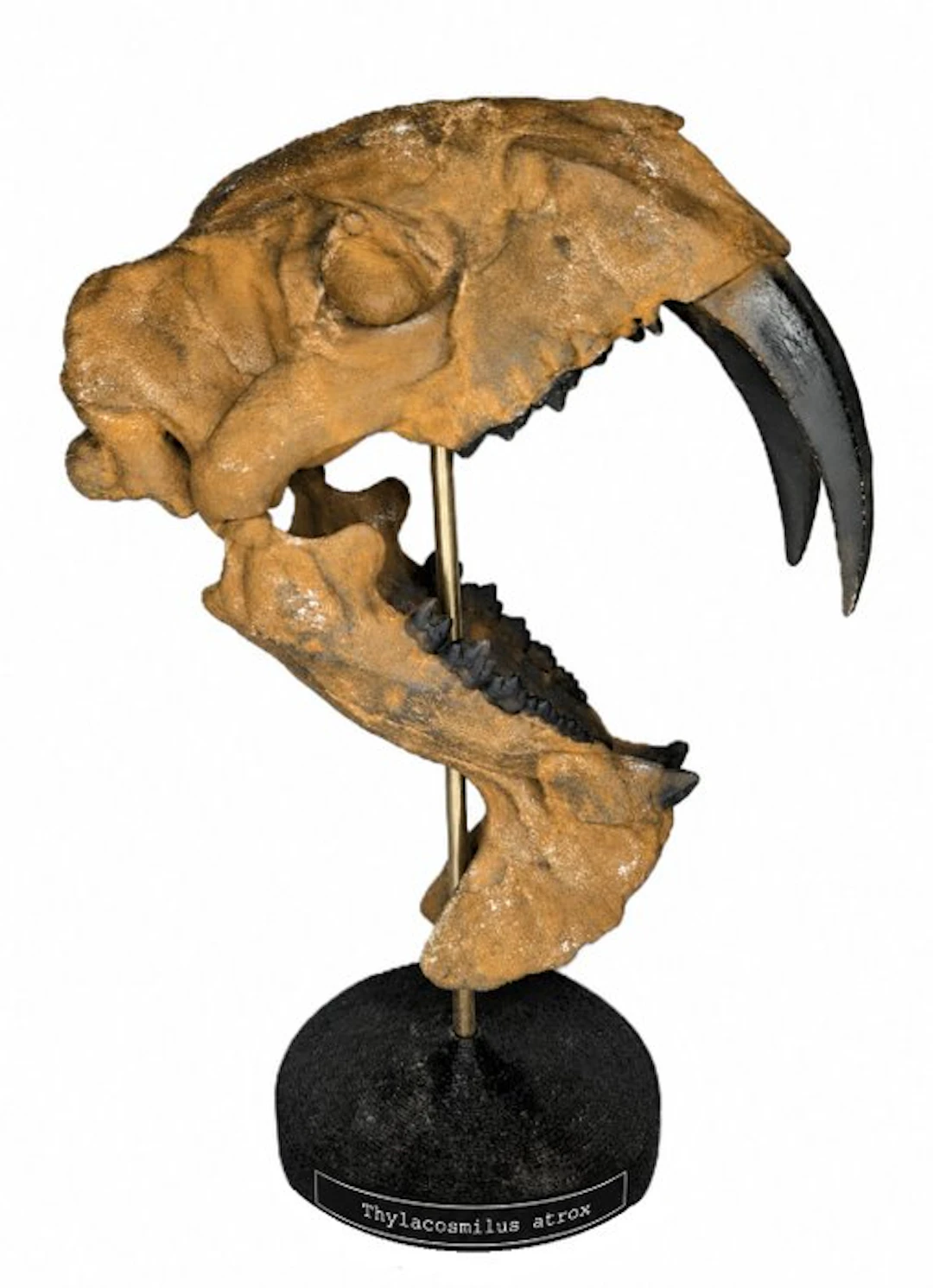
Why does it look real? Because it is real stone! Ossatorum Aeterna is a company specializing in the creation of ultra-realistic replicas of dinosaur skeletons and other extinct or endangered animals. Using an innovative mineral-coating technique, our creations achieve an authentic, museum-quality appearance. This unique approach was born from a simple observation: painted replicas often lack realism, while traditional molds, although more faithful, provide limited detail and restrict the creation of fine anatomical features. Our hybrid technique combines the best of both worlds, accurately capturing anatomical complexity while giving a lifelike mineral texture reminiscent of natural fossils. The result is arguably among the most realistic replicas currently available for discerning collectors and enthusiasts. Item for Sale: real size replica Skull of Thylacosmilus atrox Overall Dimensions (with base): • Length: 37 cm • Height: 26 cm • Depth: 20 cm Discover a museum-quality, ultra-realistic replica of the Thylacosmilus atrox skull, crafted for collectors, paleo-artists, and enthusiasts fascinated by the extraordinary predators of prehistoric South America. About Thylacosmilus atrox Thylacosmilus atrox was an extinct predatory mammal that lived approximately 9 to 3 million years ago, during the Late Miocene and Pliocene epochs, in what is now South America. Its fossils have been discovered primarily in Argentina, where it inhabited ancient environments that supported a diverse community of mammals and other terrestrial animals. Thylacosmilus is particularly famous for its exceptionally long, saber-like upper canine teeth, which extended far below the lower jaw. These impressive teeth give the animal its distinctive appearance and have earned it comparisons with the famous saber-toothed cats of the Northern Hemisphere. However, Thylacosmilus was not a true cat. It belonged to the sparassodonts, an extinct group of predatory mammals related more closely to marsupials than to modern placental carnivores. Its skull displays a remarkable combination of specialized anatomical features, including elongated upper canine teeth, deep protective flanges along the lower jaw, powerful jaw muscles, and a distinctive cranial structure adapted to accommodate its enormous canines. Unlike the saber teeth of Smilodon, which were exposed when the mouth was closed, the upper canines of Thylacosmilus were protected by bony extensions of the lower jaw. Thylacosmilus was a medium-sized predator with a robust body and powerful forelimbs. Although its precise body size varied according to estimates, it was a formidable member of South America's prehistoric mammalian fauna. Its specialized dentition and skull anatomy suggest that it relied on a highly adapted feeding strategy, although the precise mechanics of its hunting and feeding behavior remain subjects of scientific discussion. One of the most fascinating aspects of Thylacosmilus is that its saber-like teeth continued growing throughout its life. This unusual characteristic differs from the condition in many other saber-toothed predators and raises important questions about how the animal maintained and used its specialized canines. Its lower jaw flanges provided additional protection for these teeth, making its skull one of the most unusual examples of mammalian cranial specialization. Despite its resemblance to saber-toothed cats, Thylacosmilus evolved its distinctive canines independently. This is an example of convergent evolution, in which unrelated groups develop similar anatomical adaptations in response to comparable ecological pressures. Its evolutionary history demonstrates the remarkable diversity of predatory mammals that developed in South America during its long period of geographic isolation. The species is known from fossil skulls, jaws, teeth, and other skeletal remains that have helped paleontologists reconstruct its anatomy and investigate its ecological role. Its unusual cranial features continue to attract scientific interest, particularly regarding the function of its enormous canines and the differences between sparassodont predators and saber-toothed placental mammals. Thylacosmilus atrox occupies a significant place in paleontology as one of the most distinctive predatory mammals of prehistoric South America. Its extraordinary skull, protective jaw flanges, and elongated saber-like teeth make it an exceptional subject for anyone interested in mammalian evolution and the diversity of extinct predators. Key Features (Superior Craftsmanship) Weight and Stability With the base included, the skull weighs 250 g. Its solid construction ensures a stable and secure display suitable for shelves, desks, studios, or museum cases. Mineralized Hyper-Realistic Finish This piece has undergone a multi-step artisanal process, including a hand-applied mineral coating that replicates fossilized bone, subtle surface irregularities, micro-abrasion patterns, and the fine sedimentary textures characteristic of genuine fossil specimens. For an enhanced museum-like presentation, we recommend a well-positioned lighting setup. The interplay of light with the mineral layers emphasizes the elongated upper canines, protective lower jaw flanges, pronounced cheekbones, and distinctive contours of the skull, enhancing depth and realism. Exceptional Detail Surface structures are reproduced with remarkable precision, faithfully capturing the characteristic cranial morphology of Thylacosmilus atrox, including its enormous saber-like upper canines, deep mandibular flanges, robust skull structure, and specialized jaw anatomy. The overall design highlights the unusual evolutionary adaptations that make this extinct predator one of the most remarkable mammals of prehistoric South America. Museum-Grade Mounting The skull is mounted on a modern black plastic base. This museum-style sculpture is designed to stand out in any natural history collection, from private studios to professional exhibition environments. Material Polymer coated with Ossatorum Aeterna’s hand-applied mineral coating, crafted from carefully selected rocks chosen for their natural coloration and finely ground to achieve an authentically fossilized texture. Scientific Accuracy Based on established paleontological research and anatomical references for Thylacosmilus atrox, this replica is intended to reproduce the characteristic cranial morphology of the species. Particular attention is given to its elongated upper canines, protective lower jaw flanges, distinctive cranial proportions, and specialized dental anatomy, resulting in a scientifically inspired representation suitable for collectors and enthusiasts.
Estimate:£150.76
To the auctionView all items fromCatawikiorEthnographical
Estimate:
£150.76


OCT 27 | 4:00 PM
Bring your auction to collectors worldwide!
Get listed nowBy subscribing, you are agreeing to the privacy policy. Unsubscribe anytime.
Barnebys HQ
Brahegatan 10
BOX 5038
114 37 Stockholm
