




All auctions / Books, Maps & Manuscripts / Giasone del Maino; Giovanni Crispo de’ Monti - Post...

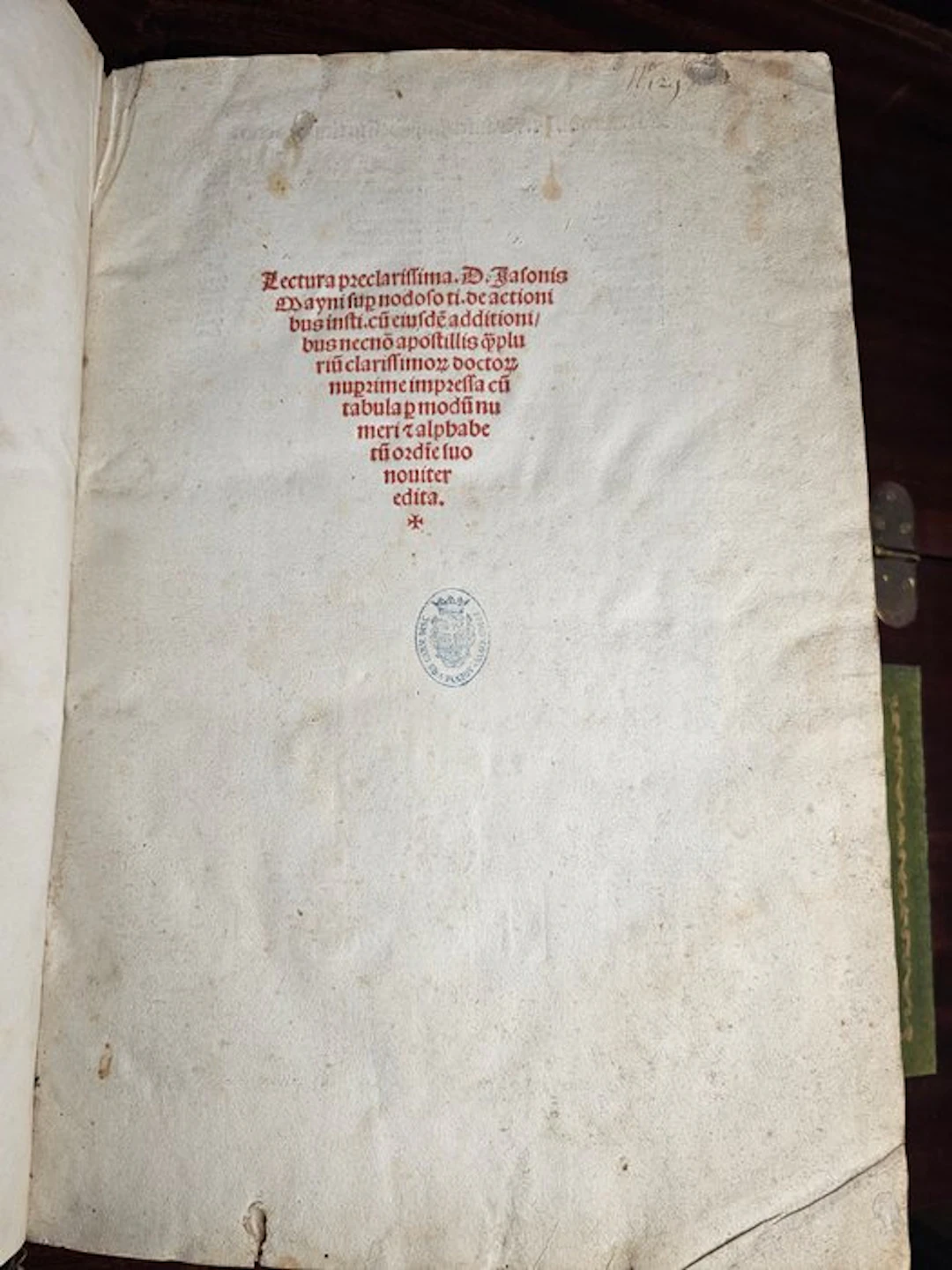
Giasone del Maino – Reading on the super-title De actionibus Institutionum, 1517 – With Giovanni Crispo de’ Monti, Termini omnium actionum cum arbore, 1519 – Large 42.5 × 29 cm folio with a woodcut tree Volume of notable dimensions, 42.5 × 29 cm, uniting two legal works printed in Lyon by Jean de Jonvelle: the commentary by Giasone del Maino on the title De actionibus of the Justinian Institutes, of 1517, followed by the Termini omnium actionum cum arbore by Giovanni Crispo de’ Monti, of 1519. The large folio format constitutes a feature of particular interest for this volume of the post-incunabula period. The dimensions give the book a striking presence and highlight the Gothic two-column composition, the wide margins and especially the large woodcut tree of legal actions on a full page. The volume combines an extensive doctrinal exposition with an illustrated reference for consultation. Frontispiece of the commentary printed in red, ornamental initials and elaborate apparatuses for study. BIBLIOGRAPHICAL DATA First work Giasone del Maino, indicated in the volume as Iason Maynus. Lectura super titulo De actionibus Institutionum, with additions and annotations. Lyon, Jean de Jonvelle, July 13, 1517. The colophon bears the formula “tertio idus Julii” and recalls the intervention of Benedetto Vadi da Fossombrone. Copy: 96 leaves, [15] leaves of index and a blank leaf. Second work Giovanni Crispo de’ Monti, indicated as Joannes Crispus de Montibus. Termini omnium actionum cum arbore, newly collected for the jurist in both rights, lord Joannes Crispus de Montibus Aquilanus citizen. Lyon, Jean de Jonvelle, 1519. Copy: 18 unnumbered leaves, with a full-page woodcut showing the tree of actions, plate and commentary. Two works bound together. Folio format. Binding dimensions: 42.5 × 29 cm. Text in Latin. BOUNDARY AND CONDITION OF THE EXAMPLE Binding in full ivory-colored parchment, four raised spine nerves and a leather label with title and gold fillets, partially worn. Binding probably seventeenth-century. Boards restored. The parchment shows stains, abrasions, wear and tears, with an external hinge cracked. Missing backing at the foot of the spine, with underlying structure exposed and loose threads. Abrasions and gaps of the label. Pages with stains and damp halos, also marginal, creases at the corners and small holes or gaps, especially in the initial leaves. Wide margins. Manuscript ownership note and blue oval stamp on the frontispiece. THE CONTENT: THE ACTIONS IN ROMAN LAW The Lectura by Giasone del Maino comments on the title De actionibus of Justinian’s Institutes, dedicated to the tools by which a legal claim can be asserted in court. It is a central topic in the training of a jurist: identifying a right goes hand in hand with the question of its protection. Distinguishing the actions, understanding their prerequisites, and determining to which situations they apply constitute an essential part of legal reasoning. The commentary develops the subject through explanations, distinctions, questions and comparisons among interpretations. The rubrics, including In personam, Item Serviana and Sed istae, follow sections of the Justinian text, enlarging the discussion by references to other sources and to doctrine. The book documents how Roman law was studied and revised within the tradition of common law: the ancient text becomes the foundation of a complex analysis built through cases, objections, solutions and opinions of jurists. GIASONE DEL MAINO AND THE LEGAL CULTURE OF HIS TIME Giasone del Maino, who lived between 1435 and 1519, was a distinguished jurist and lecturer, active at the universities of Pavia, Padua and Pisa. His commentaries on the Corpus iuris civilis enjoyed wide diffusion; among his pupils was Andrea Alciato. His work belongs to the tradition of the Commentators, characterized by examination of Roman sources through comparison with earlier doctrine and with the needs of practice. This approach is recognizable also in the page layout: numbered passages, quotations, distinctions and marginal references accompany the reasoning. The typographic composition reflects a method of study based on linking texts and interpretations. The 1517 edition dates to the final years of the author’s life and testifies to the printed dissemination of his teaching. ADDITIONS AND TOOLS FOR CONSULTATION The frontispiece announces additions by the same Giasone and annotations by other scholars. The colophon also mentions Benedetto Vadi da Fossombrone, named likewise in the conclusion of the table. The commentary is accompanied by tools that facilitate its use. The initial plate lists the sections commented on and indicates the corresponding leaves; the alphabetical index allows the search of topics and specific questions. These apparatuses make evident the volume’s intended use for study and consultation: the reader can follow the exposition or directly access the problem that interests them. THE TERMINI OMNIUM ACTIONUM AND THE WOODEN TREE Following the commentary is Giovanni Crispo de’ Monti’s work, described in the title as a doctor in both rights and a citizen of Aquila. The main figurative element is a large full-page woodcut tree. From a central trunk with roots, numerous branches develop, to which circular medallions bearing designations of actions and numerical references are connected. The tree structure visually organizes the repertoire and allows the individual entries to be located, pairing the written discussion with a succinct representation of the subject. The diagram shows how a juridical classification could be translated into an image designed to aid consultation and memory. The large format of the volume allows the composition to unfold across the page, making the whole trunk, branches and medallions particularly striking. The presence of the two works in the same volume connects complementary modes of transmitting knowledge: the extended commentary, with discussion of issues, and the schematic repertoire, with the visual arrangement of the actions. FORMAT AND TYPOGRAPHIC CHARACTERISTICS With its 42.5 cm height and 29 cm width, the volume presents substantial dimensions, to be considered alongside its antiquity and specialist purpose. The broad page surface accommodates the text in two columns, marginal annotations and consultation tools. Thus the format contributes both to the book’s material presence and to the readability of its complex organization. The Lectura’s frontispiece is printed in red, with the title arranged in progressively decreasing lines. The text is set in Gothic type, with running titles, folio numbers, gathering signatures and ornamental initials. Annotations and marginal references accompany the exposition. The density of the text, the use of abbreviations and the organization of cross-references convey the appearance of a legal scholarly book from the early sixteenth century. The woodcut tree adds a significant figurative element and an example of the use of images in organizing knowledge. COLLECTORIAL INTEREST The volume’s interest lies in the joining of two works devoted to the same subject, printed two years apart in the same printing center, and presented in a large folio. For a history of law collection, the Giasone del Maino commentary documents the method of the Commentators and the transmission of Roman-law doctrines through printing. For the collector of early sixteenth-century books, the red frontispiece, Gothic composition, initials, and consultation apparatus are significant, preserving a strong continuity with the book-trade tradition of the fifteenth century. The 42.5 × 29 cm dimensions reinforce the volume’s visual impact, especially showcasing the tree of actions: a graphic representation that translates a complex subject into a network of branches, medallions and references. The volume is of interest both for its legal content and for the material form in which that content is presented: an example of the relationship between doctrine, study tools and didactic illustration in the early sixteenth century.
Estimate:£1,172.62
To the auctionView all items fromCatawikiorBooks, Maps & Manuscripts
Estimate:
£1,172.62


OCT 27 | 4:00 PM
Bring your auction to collectors worldwide!
Get listed nowBy subscribing, you are agreeing to the privacy policy. Unsubscribe anytime.
Barnebys HQ
Brahegatan 10
BOX 5038
114 37 Stockholm
