





OCT 17 | 10:00 PM

All auctions / Arts & Graphics / Guido Guidi (1901-1998) - Fiori

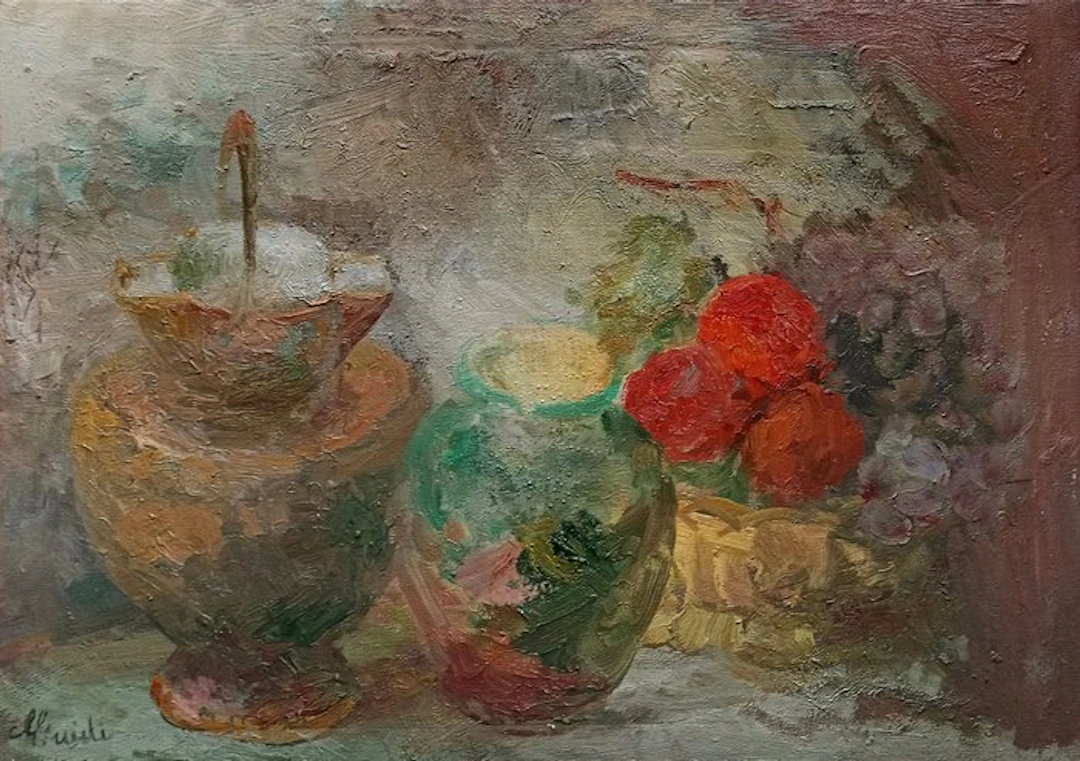
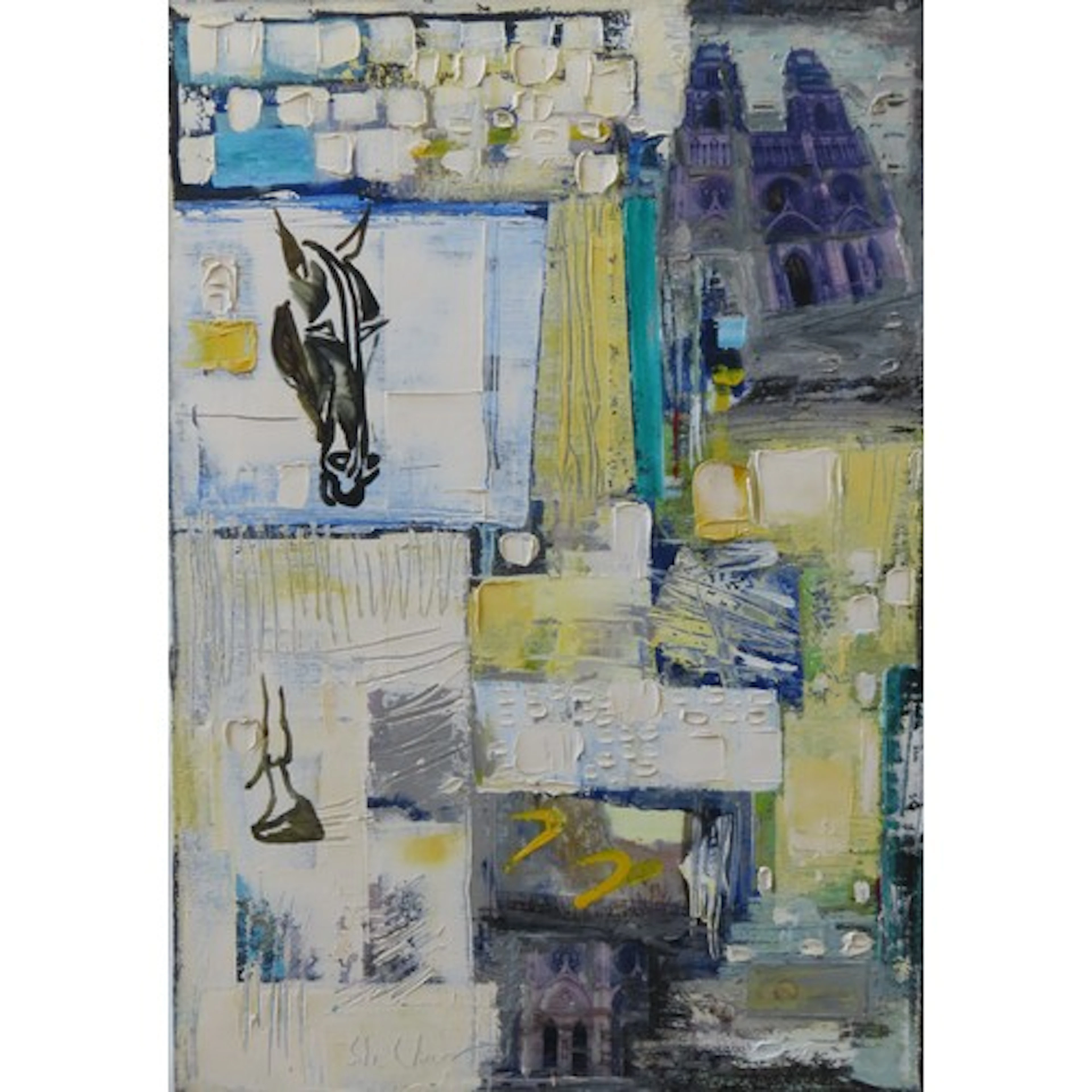
An important work by the Livornese painter Guido Guidi, characterized by a refined pictorial quality and a materic brushstroke of color. The composition, dedicated to still life, presents a harmonious balance between objects, shapes, and chromatic tones, with particular attention to tonal relationships; of notable interest is the treatment of the background, obtained through a rich stratification of painting matter, which gives the surface a pronounced tactile effect and contributes to the depth of the scene. The palette, played on warm, earthy tones paired with greener and redder hues that are more intense, reveals a wise search for chromatic harmony; the work testifies to the solid mastery of oil painting and to the compositional sensibility of Maestro Guidi. DESCRIPTION Old original painting by the painter Guido Guidi (Livorno 1901-1998) Complete with legally compliant stamped and signed certification Condition: the front painting surface is well preserved; the back of the canvas shows some traces and small superficial alterations compatible with dating (see photos); no particular issues evident, the painting does not require restoration and is classified in good condition. Technique: oil on canvas Title or subject: "Composition with Jugs and Fruit - Still Life" 1960/1970 Dimensions of the painting: 50 x 70 cm - frame not included The painting will be cleaned with a protective varnish "DAMAR" to give new life and brightness to oil colors Provenance and archiving: Modì Arte - Livorno (Italy) Shipping via Fedex, UPS, TNT, SDA express from Italy with tracking number NOTE: it is important for us to inform you that our after-sales customer service is always active and at your service for assistance or simple information Wikipedia: https://it.wikipedia.org/wiki/Guido_Guidi_(pittore) BIOGRAPHY Guido Guidi (1901-1998) was born in Livorno, a city generally considered a link between the great Macchiaioli and the subsequent generations. From childhood he showed a certain predisposition for drawing, through which he developed his observations on forms and colors, also showing manual skill. After completing elementary studies, in 1912 he enrolled at the Institute of Arts and Crafts, which he attended only briefly, being soon recalled to work as a cobbler due to his family's severe economic conditions. Following this experience, he decided to open his own workshop in 1916, in the midst of World War I, and, in fact, he was called to arms with the III Cavalry Regiment in Ferrara already in 1919. Despite efforts to improve his and his family's economic conditions, he continued to cultivate his passion for drawing through life studies. Even the war events did not dampen his desire to experiment, and in those years there remained scenes of military life, which later returned in his painting, testifying to how intensely the artist lived this period and how certain events remained impressed in his memory. In 1924 he first exhibited his paintings publicly in a group show titled Cenacolo degli Illustri near Florence, while in 1927, the year of his marriage, he exhibited at the Bottega d'Arte in Livorno with his first solo show and for a while aligned his art with his brother-in-law Galliano Masini, a renowned tenor, who as enlightened patron purchased his entire production, thus easing the artist’s psychological sufferings. Unfortunately, despite some exhibition successes and recognitions, such as the purchase of one of his paintings by the Royal Household in 1936, the artist was never free from a certain mental illness, also due to the end of the alliance with Masini, which forced him into frequent hospitalizations in Volterra and Pisa. This condition of economic and especially inner instability led him to distance himself from painting, coinciding with World War II. He resumed his activity with enthusiasm at the end of the forties and 1955 marked his great return with a show for the Rome Popular Art Review, followed by another show at the Bottega d'Arte in Livorno in 1956, repeated in 1959. In 1961 he was also present in Florence at the Galleria Cancelli as a member of the Labronico Group. After several years spent practically in isolation, in close contact only with his palette, the artist soon found himself in the running among the most important Italian gallery owners and collectors who, struck by his very personal way of painting, swamped his studio. Thus began for Guidi a period of intense exhibition activity, which led him to visit all the major Italian cities, through the main postwar art events in Italy. A recurring stop for the artist was Livorno, where, in 1966, he held a retrospective organized by the Municipality at the House of Culture, which established him among the leading Livornese painters of the twentieth century, giving definitive recognition to his art. In the seventies his participation continued, both in large international events, such as the European Contemporary Art Biennale held in Athens in 1972, and in the most important Italian galleries. In 1984, further confirming the popularity and success obtained, a monograph was published by Matteoni Editori of Lucca, edited by Piero Caprile, Elio Mercuri and Adolfo Tucci. His last shows took place at the Galleria Athena in Livorno in 1996 and at the Giardino dell'Arte in Montenero in 1997. Guidi passed away in 1998 and his memory was immediately celebrated through a series of retrospectives dedicated to the person and the artist. Guidi’s art arises from a personal, spontaneous need rooted in his interior life. He belongs to that group of self-taught artists who grew up on the margins, but this should not be seen as something limiting for the artist; on the contrary, if he had not lived such an experience, his art would surely have developed differently and perhaps would not have been free from external conditioning as it was. He knew how to give free rein to his interiority, to his own feelings, without using languages already used by others. Guidi builds forms and figures through quick, almost sketchy brushstrokes, smoothing the contours of the subjects depicted. The color, always bright and vivid, dominates, but never manages to erase the portrayed figures. His painting is spontaneous, free, it does not follow a predetermined evolutionary path, it draws inspiration from daily life; forms and situations are recognizable to everyone. Through his canvases he is able to draw the viewer into a space that seems to transport them into an almost dreamlike dimension, perhaps precisely thanks to his brushwork, his colors, the diffused luminosity, which remains linked to contexts and spaces that are typical of the reality known and recognizable to all, but here appear in an unexpected dimension.
Estimate:£169.23
To the auctionView all items fromCatawikiorArts & Graphics
Estimate:
£169.23
OCT 17 | 10:00 PM


Bring your auction to collectors worldwide!
Get listed nowBy subscribing, you are agreeing to the privacy policy. Unsubscribe anytime.
Barnebys HQ
Brahegatan 10
BOX 5038
114 37 Stockholm
