


OCT 8 | 3:00 PM

Bring your auction to collectors worldwide!
Get listed nowBy subscribing, you are agreeing to the privacy policy. Unsubscribe anytime.
Barnebys HQ
Brahegatan 10
BOX 5038
114 37 Stockholm
All auctions / Photographs / JOSE AMADOR (1897–1965) - Imagén inédita e impactante del...

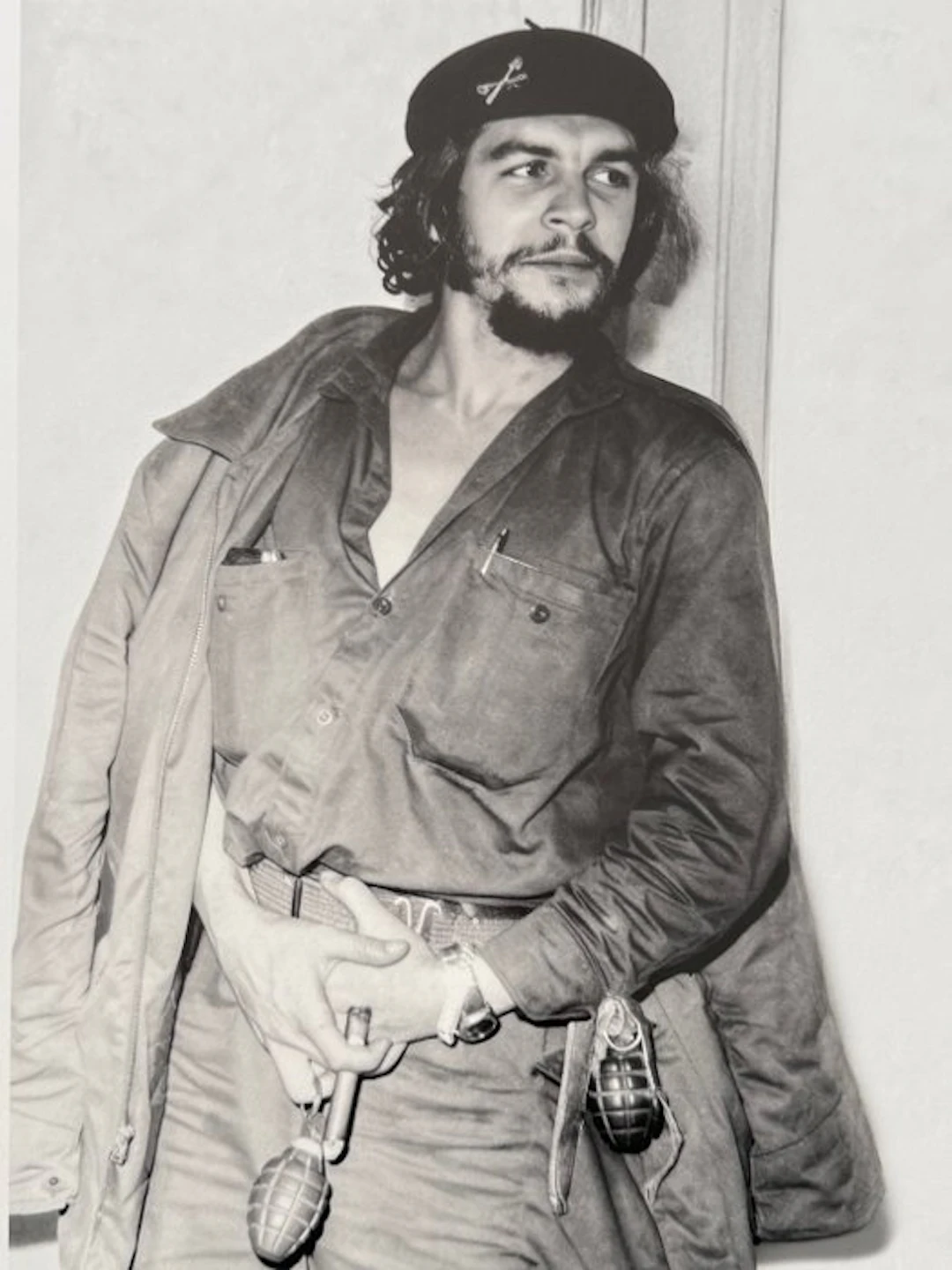
Striking and until now unpublished image of Che Guevara, captured in the heat of the Cuban Revolution, probably after one of the decisive battles of Santa Clara, in 1959. In this powerful composition, the Che appears standing, facing forward, radiating confidence and charisma. He wears his classic revolutionary beret, with the jacket hanging casually over his right shoulder, while he grips his belt firmly. Between his fingers, a half-lit cigar, and hanging from a finger, a hand grenade, a visual symbol of the tension and intensity of the historical moment Cuba lived through. On his belt you can make out another hand grenade and a combat machete, details that reinforce the authenticity and drama of the instant. His sideways, serene and smiling gaze seems to anticipate victory, depicting a human Che, triumphant and aware of the symbolic weight of his role in history. The visual force of this photograph resides not only in its historical value but also in its impeccable composition, in which spontaneity and documentary aesthetics fuse with a unique naturalness. An image that had never before seen the light of public, coming from the archives of the legendary Cuban photographer Amador Vales, a pioneer of photojournalism on the island and a direct witness to the great events of his century. Works of this nature, due to their rarity, context and visual power, are considered authentic top-order historical documents, sought after by collectors and museums around the world interested in Latin American photography and revolutionary iconography. JOSE AMADOR (1897–1965) Pioneer of Cuban photojournalism Childhood and training JOSE AMADOR was born in the Canary Islands in 1897. After the Cuban–Spanish-American War, his parents emigrated to Cuba and settled in Havana. From a young age he showed artistic leanings and, at only 16, in 1913, decided to leave school to join the Bohemia magazine, where he began as an assistant to the art director, Antonio Rodríguez Morey. He recognized his talent and encouraged him to study photography and engraving at the workshops of the newspaper La Discusión, under the tutelage of the renowned master Federico Gibert. Thanks to his dedication, Amador progressed from apprentice to photojournalist. In 1917, at just 20 years old, he became the first photographer of Bohemia magazine, marking the start of a career of more than half a century tied to Cuba’s visual history. Bohemia and the birth of Cuban photojournalism During his early years at Bohemia, Vales witnessed the magazine’s evolution into a modern, popular medium. In 1927, when Miguel Ángel Quevedo Lastra took the helm, Bohemia modernized its format and gave prominence to imagery. Amador, as the sole fixed photographer, became an essential figure in this process, bringing a fresh and bold perspective that blended technique and artistic sensitivity. At the same time, he opened his own photographic studio on Belascoaín Street, near San Rafael, where he did portraits, IDs and postcards. He also collaborated with his former master Federico Gibert in organizing the photographic department of the El País newspaper between 1924 and 1927. In those years, photojournalism began to consolidate in Cuba. Until then, illustrated magazines depended on images provided by newspaper photographers, who worked independently. Vales was part of the first generation to professionalize the craft within an editorial staff, paving the way for modern photojournalism on the island. The reporter of hard times Amador’s talent and bravery became especially notable during the turbulent years of Gerardo Machado’s dictatorship. Bohemia openly supported popular causes, and Amador risked his life covering student protests and police repression. He gained a reputation for being fearless: colleagues said that, being deaf, he did not hear the gunshots and kept photographing under fire, concentrating solely on getting the best image. Professor and photographer Rafael Pegudo Gallardo recalled: “Vales always stood out for his audacity photographing shootouts and the brutal abuses of the Machado regime’s police… When Machado fell, on August 12, 1933, I happened to be with him in the shootout in front of the Prado pharmacy. We both captured the moment when the people lifted the chief of ‘la Porra’ onto the bronze lion of the Prado. Bohemia published Amador’s photo, which was better, and it circulated worldwide.” During his career, Vales also documented natural disasters such as the 1926 cyclone, capturing emblematic images of Parque Maceo before the Havana waterfront. His work was always characterized by immediacy, technical precision and deep humanity. In the forties, Bohemia publicly highlighted his bravery. In a note dated January 13, 1946, it read: “In the days of tangles in the Havana streets, Amador was the photographer who carried the best images for his newspaper. No one like him to throw himself into a tumult and push forward in front of the shots of weapons cut off.” His deafness, which could have been a disadvantage, became his best shield: Amador did not hear danger, only saw history. Final years and legacy Throughout his career, Amador witnessed military coups, gangster eras and revolutions. In January 1959, already a veteran, he took up his camera again to portray Fidel Castro’s triumphant arrival in Havana and the first steps of the new revolutionary government. On August 25, 1965, Bohemia published a moving obituary note: “At 68 years old, the comrade Amador passed away, who for more than fifty years, since 1913, was photojournalist of Bohemia and other Havana publications. A true soldier of the news, through Amador’s camera more than half a century of Cuba’s history marched by… In his balanced concept of discipline and camaraderie, Amador was a true forward-thinking worker, as well as an exponent of generous humanity. His passing constitutes an irreparable loss for national journalism and a mourning for Bohemia.” His images became direct testimony of the country’s historical progress, from cyclones to revolutions, through the daily life of a nation in transformation. Value and relevance Amador is remembered today as the first professional photographer of Bohemia magazine and one of the founding figures of Cuban photojournalism. His work, marked by bravery, sensitivity and social commitment, represents an essential chapter in the history of Latin American photography. His photographs come from the author’s personal and protected archive, and are considered pieces of great historical and documentary value, sought after by collectors and institutions that recognize in his work the pioneering gaze of someone who photographed Cuba’s history from within. Note: The image of the photographer Amador that appears last in the description is not included with the photograph for sale.
Estimate:£339.1
To the auctionView all items fromCatawikiorPhotographs
Estimate:
£339.1
OCT 8 | 3:00 PM


OCT 8 | 3:00 PM
Bring your auction to collectors worldwide!
Get listed now£1,530.38

OCT 17 | 10:00 PM