

OCT 17 | 10:00 PM

All auctions / Ancient Art / KAWANISHI HIDE · Kobe · Nihon Jozoku-sen 1946 ·...

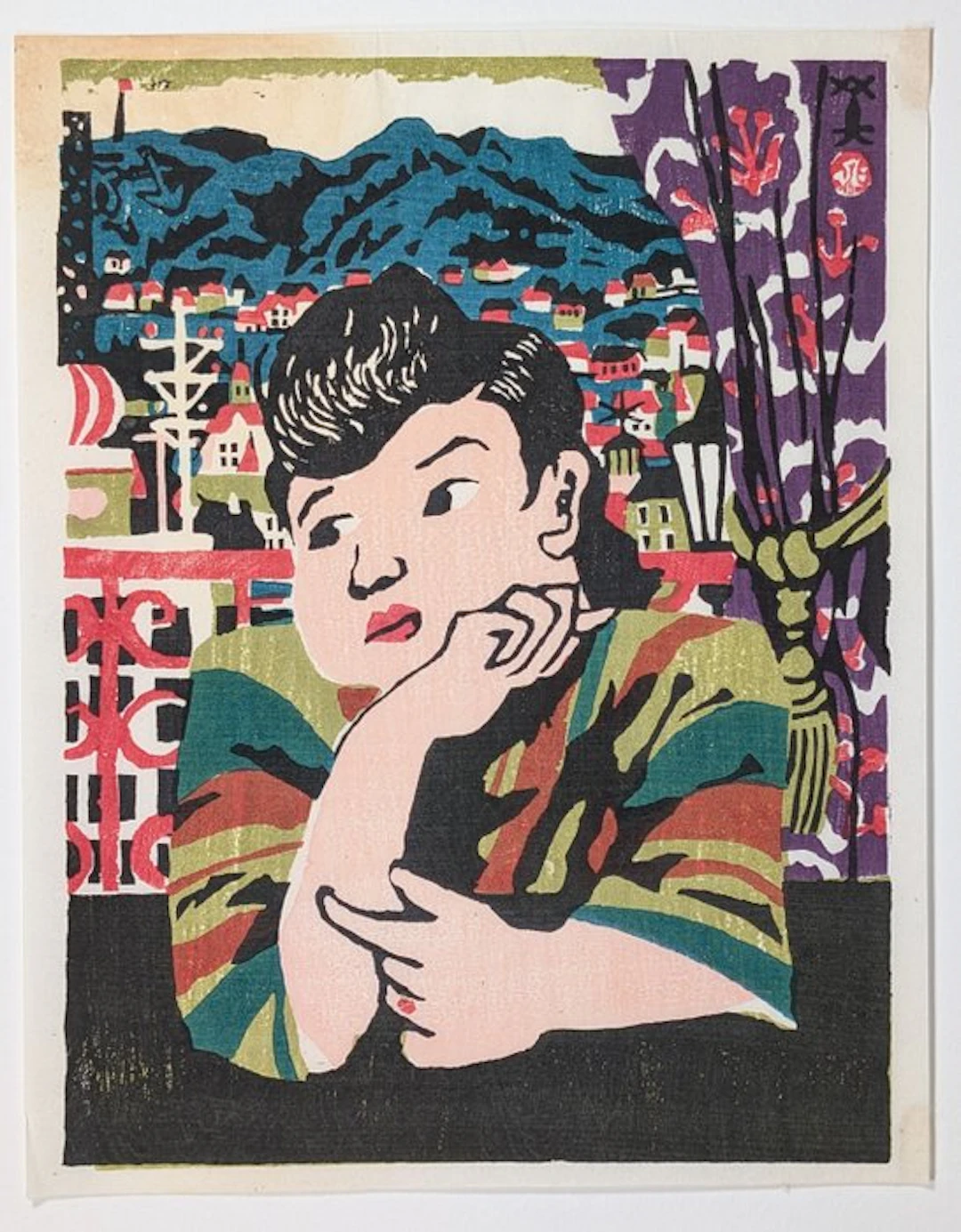
Artist: Kawanishi Hide (川西英, 1894–1965), born Kobe Title: 港の女 (Minato no Onna) — Woman of the Port (Kobe). The portfolio's own English title is "A Bar-Girl of Port Town". Series: Nihon Jozoku-sen 日本女俗選, A Selection of Woman's Customs in Japan. The portfolio was issued as a collection of self-carved works by members of the Japan Print Association (日本版画協会同人自刻作品集). Publisher: Fugaku Honsha (富岳本社), Takamizawa edition Date: 1946 (Shōwa 21) Movement: Sōsaku-hanga (創作版画), the creative print movement Signature: 英 and ひで, printed in the block at upper right Format: Image approx. 24 × 18 cm (9.4 × 7 in.) Technique: Colour woodcut on washi Collections: The Miyagi Museum of Art holds an impression of this design Condition: Excellent! Why Sōsaku Hanga Deserves Your Attention The creative print movement grew out of a specific objection. In the traditional system — ukiyo-e in the Edo period, shin-hanga in the twentieth century — a print was made by a chain of specialists: the artist supplied a design, a carver cut the blocks, a printer pulled the impressions, and a publisher commissioned and financed the whole thing and decided what was made. The sōsaku-hanga artists held that the finished sheet under such a system is not fully the artist's: it is the collective product of many participants, filtered through a carver's habits, a printer's judgement and a publisher's commercial calculation, and what reaches the paper is inevitably something other than what the artist saw. Their answer was jiga, jikoku, jizuri — self-drawn, self-carved, self-printed. The artist takes the knife to the block and pulls the impressions personally, so that every decision from first line to final colour belongs to one person. About the Print Kawanishi Hide is the artist of Kobe. He was born in 1894, the seventh son of a shipping and grain wholesaler, and spent his entire life in the port city, which became his lifelong subject. He taught himself woodblock printing after seeing the work of Yamamoto Kanae and Takehisa Yumeji. He was first accepted at the Sōsaku Hanga Kyōkai exhibition in 1923, joined the Japan Print Association in 1932, and joined the Kokugakai in 1935. His One Hundred Views of Kobe, carved between 1933 and 1936 and published in 1937, remains his best-known work. It records an international harbour city of foreign settlements, ships and shopfronts that has no parallel elsewhere in Japanese printmaking. The Nihon Jozoku-sen portfolio assigned each artist a region and a type of woman. Maekawa took Kyoto, Onchi Tokyo, and Sekino and Saitō the north. Kawanishi, inevitably, was given Kobe. He contributed only this one sheet, which makes Woman of the Port his single statement in the set. The Japanese title is neutral, while the portfolio's English caption, "A Bar-Girl of Port Town", is more direct. The English caption is a reminder that the set appeared in 1946, in occupied Japan, with an English-reading audience clearly in mind. Kobe was then rebuilding from wartime bombing, and its harbour and the women who worked around it were part of the new postwar city. Kawanishi received the Hyōgo Prefecture Culture Prize in 1949 and remained the central figure of Kansai printmaking until his death in 1965.
Estimate:£152.3
To the auctionView all items fromCatawikiorAncient Art
Estimate:
£152.3
OCT 17 | 10:00 PM


Bring your auction to collectors worldwide!
Get listed nowBy subscribing, you are agreeing to the privacy policy. Unsubscribe anytime.
Barnebys HQ
Brahegatan 10
BOX 5038
114 37 Stockholm
