



All auctions / Ancient Art / KUNISADA • a Tattooed Outlaw • Suikoden • 1862 • auth

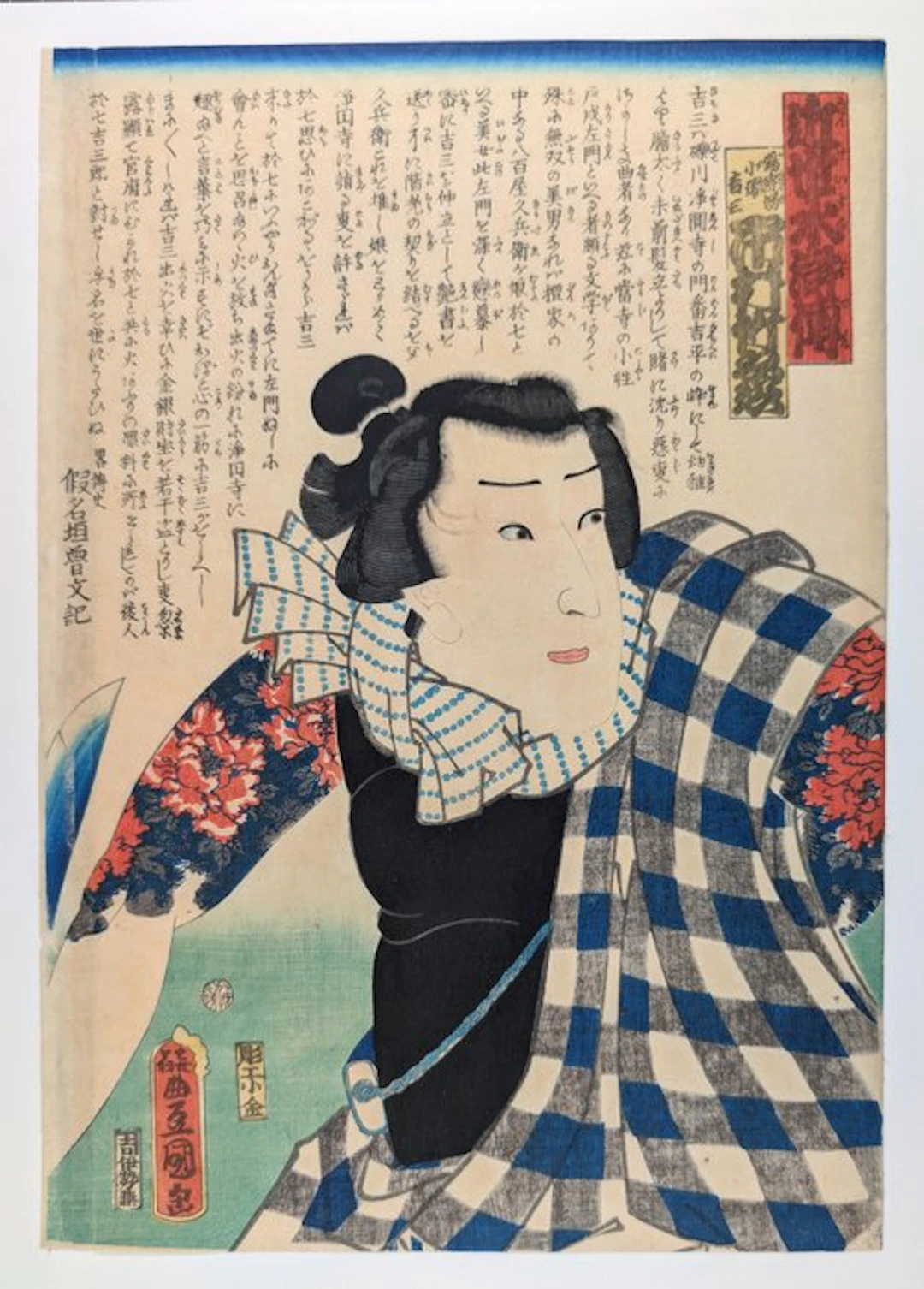
Artist: Utagawa Kunisada (歌川国貞), known as Toyokuni III (三代豊国), 1786–1865 Series: Kinsei Suikoden (近世水滸伝) — "A Modern Water Margin," a set of 36 designs with a title page Role & Actor: Yukanba Kozō Kichisa (湯灌場子僧吉三) — "Kichisa, the corpse-washhouse acolyte" — played by Ichimura Takenojō V (五代目市村竹之丞, 1812–1851) Text: Narrative panel by the gesaku author Kanagaki Robun (仮名垣魯文, 1829–1894) Publisher & Carver: Iseya Kanekichi (伊勢屋兼吉); block-carver Horikō Ko-Kin (彫工小金) Date: 1862 (Bunkyū 2), year of the Dog — with aratame censor seal Technique: Woodblock print (mokuhanga) — nishiki-e (polychrome) Format: Ōban tate-e — approx. 25 × 36 cm (9⅞ × 14⅛ in.) Signature: Kiō Toyokuni ga (喜翁豊国画) — "Toyokuni, aged 77" — in a red toshidama cartouche CONDITION A strong, crisp impression with fresh, well-saturated colour — the deep indigo of the bold ichimatsu check, the vermilion of the peony tattoos, the dense black of the robe and hair, and the soft green ground all read with full strength. Fine detail is well held in the hair and the dotted kanoko collar. The paper is a good condition. The left margin, weakened by an old album fold, has been professionally reinforced from the reverse with a strip of kōzo-fibre washi; this is confined to the margin and does not intrude on the image. Minor, even toning consistent with age. A sound, attractive impression overall. The Scene — A Beautiful Youth in Outlaw's Skin Kunisada frames the figure close and large against a plain ground, the upper third of the sheet given over to a dense block of text. A handsome young man turns his head with a cool, level gaze, his black kimono slipped from both shoulders to bare the arms — and the arms are tattooed, wreathed in vivid red peonies and foliage in the manner of the Suikoden braves. A great length of bold blue-and-white ichimatsu (chequer) cloth is swept up over one shoulder; a finely dotted blue-and-white kanoko-shibori collar frames the throat; a blade just edges into the frame at the left. A narrow band of indigo bokashi seals the top of the sheet, a wash of green the foot. The portrait turns on a deliberate contradiction. The face is that of a soft, almost androgynous youth — the beautiful temple page of legend — while the body has been given the inked skin and bared shoulders of a hardened tough. That tension is the whole point of the design: a famously delicate romantic figure recast as one of the tattooed desperadoes of a "modern" outlaw saga. The long passage of text at the upper right is no decorative filler but a written biography, supplied for every sheet in this series by the popular author Kanagaki Robun, telling the reader exactly who this young man is and how he came to such a pass. Kichisa, Oshichi, and a Fire that Burned Down Edo Robun's text reaches back to one of the most famous true tragedies of the Edo period — the story of Yaoya Oshichi, "Oshichi the greengrocer's daughter." When fire drove her family to take refuge in a temple, the teenage Oshichi fell helplessly in love with a beautiful young acolyte there — the youth Kichisaburō, the "Kichisa" of this print. Parted from him once the city was rebuilt, and desperate to engineer another night under the temple's roof at his side, she set fire to her own home. The blaze spread; arson was a capital crime; and Oshichi was caught and put to death by burning, still only in her teens. Immortalised by the writer Ihara Saikaku and replayed for centuries on the kabuki and puppet stages, hers became a byword for love carried to a reckless, fatal extreme. Here the lover Kichisa is carried past the familiar romance into a darker, invented afterlife — reborn for this series as Yukanba Kozō Kichisa, "Kichisa, the acolyte of the corpse-washing house," the lowliest of temple stations and a fitting cover for an outlaw. It is exactly the kind of free, sensational re-imagining the Edo public relished: a beloved tragic figure dragged into the criminal underworld and given the tattoos to match. The Series — A "Modern Water Margin" for a Restless Age The Kinsei Suikoden ("A Modern Water Margin") of 1862 is one of the most distinctive series of Kunisada's last years. Where Kuniyoshi's celebrated Suikoden had drawn the 108 bandit-heroes of the Chinese novel, Kunisada turned the idea homeward: a gallery of thirty-six famous kabuki actors, each portrayed as a tattooed outlaw or gallant of the recent Japanese underworld, with a prose life by Kanagaki Robun attached to every sheet. The conceit was pointed. Produced in the turbulent final years of the Tokugawa order, when shogunal authority was visibly failing, these glamorous tattooed lawbreakers — men who lived by their own code outside official rule — carried an obvious appeal for an Edo audience growing impatient with its masters. The series doubled as a roll-call of the great actors of the era, the living shown alongside legends of the recent past. The figure here, Ichimura Takenojō V (1812–1851), was a leading man and the manager (zamoto) of the Ichimura-za, remembered for a lavish, larger-than-life manner on and off the stage; he had died a decade before the print was made, and Kunisada's image stands as a commemoration of him in a signature guise.
Estimate:£209.29
To the auctionView all items fromCatawikiorAncient Art
Estimate:
£209.29


OCT 27 | 4:00 PM
Bring your auction to collectors worldwide!
Get listed nowBy subscribing, you are agreeing to the privacy policy. Unsubscribe anytime.
Barnebys HQ
Brahegatan 10
BOX 5038
114 37 Stockholm
