


All auctions / Ancient Art / Kuniyoshi Suikoden • Daredevil Third Brother • 1845 •...

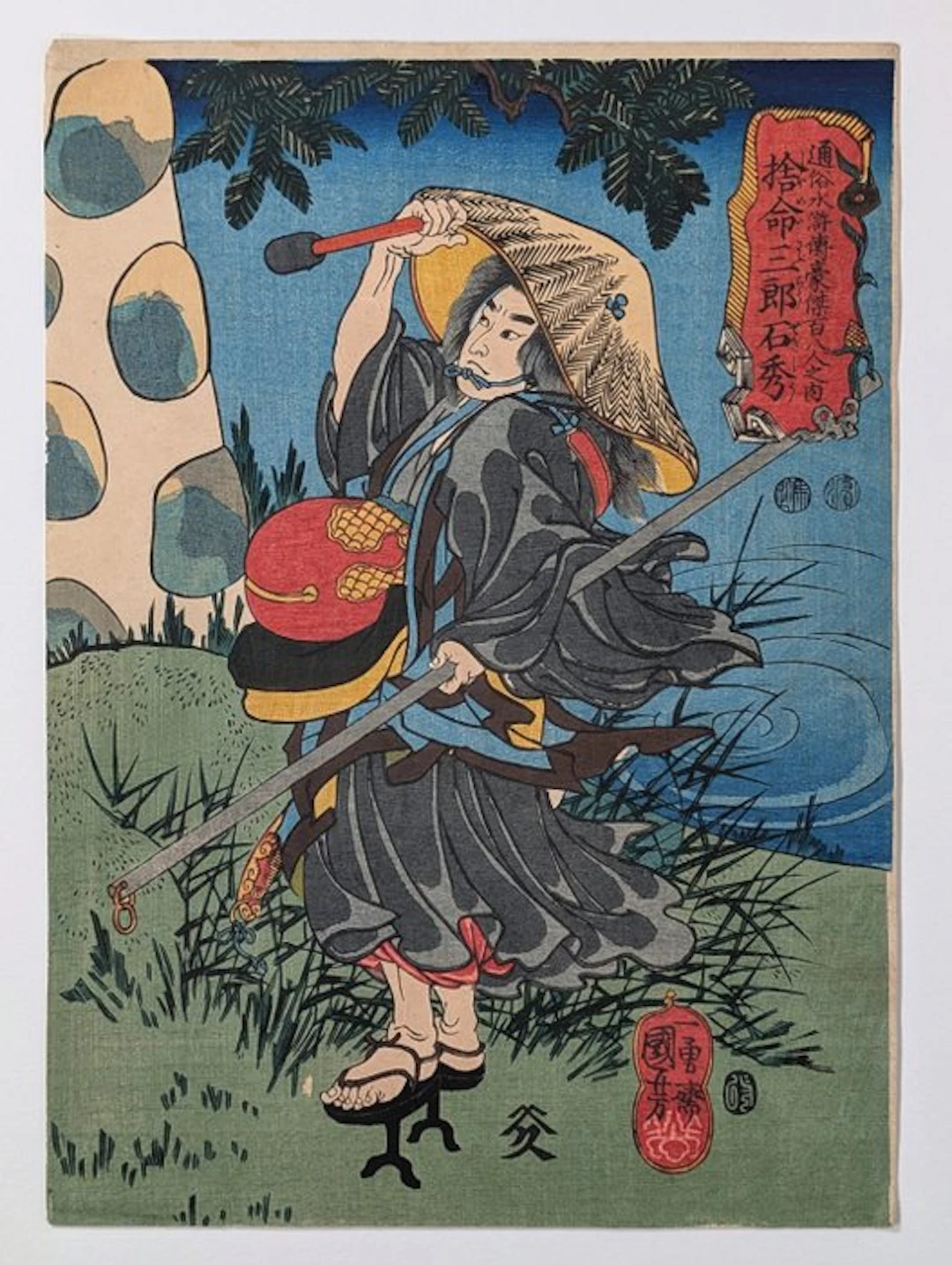
** The print that inspired Dragon Bull ** 歌川国芳 — UTAGAWA KUNIYOSHI (1798–1861) Shameisaburō Sekishū (捨命三郎石秀) — "Daredevil Third Brother" Shi Xiu From: 108 Heroes of the Popular Suikoden (通俗水滸傳濠傑百八人之内) — Chūban Series Technique: Woodblock print (mokuhanga), polychrome (nishiki-e) on Japanese washi Date: c. 1845 Publisher: Yamamoto-ya Heikichi (山本屋平吉) Format: Chūban tate-e (approx. 25 × 18 cm / 10 × 7 in.) Impression & Colours: Excellent. The impression is strong and sharp throughout, with crisp keyblock lines and fine detail preserved in the weave pattern of the straw hat, the fish-mouth carving of the mokugyo, and the layered folds of the dark kimono. Colours are vibrant and well-balanced: a rich Prussian blue in the sky and stream, saturated greens in the grassy foreground, warm ochre and buff tones in the hat, and vivid vermillion in the toshidama seal and interior accents of the robe. The bokashi gradation in the blue sky is smoothly applied and beautifully preserved. Paper: Very good. The paper is firm, intact, and without tears, holes, or losses. See British Museum: https://www.britishmuseum.org/collection/object/A_2008-3037-10222 The Scene — Shi Xiu: The Daredevil Who Risked Everything Kuniyoshi depicts Shi Xiu (Japanese: Shameisaburō Sekishū) as a wandering figure in disguise — striding through tall grasses beside a stream, his face half-hidden beneath a broad straw hat, carrying a Buddhist mokugyo drum and a long stick. The scene captures him in the guise of a wandering monk or mendicant, a clever disguise he adopts in the novel to carry out one of his most daring exploits. In the Chinese classic Water Margin (Shuihu Zhuan), Shi Xiu is ranked 33rd among the 108 Stars of Destiny and nicknamed "Daredevil Third Brother" (捨命三郎) for his fearless, impulsive courage. Originally from Jiankang (present-day Nanjing), Shi Xiu was a martial arts expert who could not stand to see injustice. After rescuing Yang Xiong — the chief prison warden of Jizhou — from a gang of thugs, the two became sworn brothers. When Shi Xiu later uncovered Yang's wife's adultery with a corrupt monk, he was falsely accused by the woman and cast out. Undeterred, Shi Xiu killed the monk, exposed the affair, and helped Yang exact justice. The pair fled to the outlaw stronghold at Liangshan Marsh. His most legendary feat came later: when the hero Lu Junyi was about to be executed in Daming Prefecture, Shi Xiu single-handedly stormed the execution ground and rescued him — an act of suicidal bravery that epitomises his nickname and cemented his place among the most beloved figures of the Suikoden. The Series — Kuniyoshi's Later Suikoden: Where Ukiyo-e Becomes Proto-Manga This print belongs to Kuniyoshi's second Suikoden series (Robinson S47) — the lesser-known but artistically remarkable chūban-format set published by Yamamoto-ya Heikichi between c. 1845 and 1853. While his first, larger ōban Suikoden series of 1827–1830 made Kuniyoshi famous overnight and earned him the nickname "Warrior Kuniyoshi" (武者の国芳), this later chūban series represents a mature, evolved artist revisiting his most celebrated subject with two decades of additional mastery. And here is what makes this series so fascinating for the modern eye: these prints look startlingly like early manga panels. Compare the visual language. Kuniyoshi's earlier 1827 Suikoden prints are grounded in the classical ukiyo-e tradition: muscular, heavily tattooed heroes fill the entire sheet, surrounded by dramatic water, flames, or swirling clouds. They are magnificent — but they belong unmistakably to their era. The later chūban series, by contrast, shows something different: figures placed within narrative landscapes, set against atmospheric backgrounds with streaming grasses and flowing water, their clothing caught in dynamic movement, their poses frozen in mid-action. The compositions are tighter, more cinematic. The figures have been given a sense of narrative motion — they are going somewhere, doing something, caught in a moment of a story unfolding. This is the visual DNA that leads directly to manga and anime. When Akira Toriyama drew Goku striding through a landscape with his nyoibō staff in the early chapters of Dragon Ball — itself inspired by the Chinese novel Journey to the West, another classic of the same literary tradition as the Water Margin — he was, knowingly or not, channelling a visual language that Kuniyoshi had pioneered 140 years earlier. The dynamic diagonal compositions, the wind-swept fabrics, the expressive faces, the way action is implied through posture rather than shown through explicit violence: all of these are Kuniyoshi inventions that passed through generations of Japanese visual storytelling. Utagawa Kuniyoshi — The Father of the Japanese Action Hero Utagawa Kuniyoshi (1798–1861) is one of the great masters of the ukiyo-e tradition and the undisputed pioneer of the warrior print (musha-e) genre. Born in Edo (present-day Tokyo) as the son of a silk dyer, he trained under Utagawa Toyokuni I and initially struggled to establish himself. His fortunes changed dramatically in 1827 when the publisher Kagaya Kichibei commissioned him to illustrate the heroes of the Chinese novel Water Margin. The resulting series — the 108 Heroes of the Popular Suikoden — was an enormous commercial success that launched Kuniyoshi's career and ignited a nationwide craze for warrior imagery and full-body tattoos. Over the following decades, Kuniyoshi became one of the most prolific and inventive artists of the late Edo period, producing thousands of designs across every genre: warriors, actors, beauties, landscapes, cats, satirical prints, and historical narratives. He was a beloved teacher who trained an entire generation of major artists, most notably Tsukioka Yoshitoshi — the last great master of ukiyo-e. Kuniyoshi's legacy extends far beyond the world of traditional prints. Art historians have increasingly recognised him as a forerunner of manga and anime: his dynamic compositions, exaggerated expressions, and narrative visual storytelling laid the foundation for Japan's modern pop-culture visual tradition. His work is held in the collections of the British Museum, the Museum of Fine Arts in Boston, the Art Institute of Chicago, the Victoria and Albert Museum, and major institutions worldwide.
Estimate:£753.83
To the auctionView all items fromCatawikiorAncient Art
Estimate:
£753.83
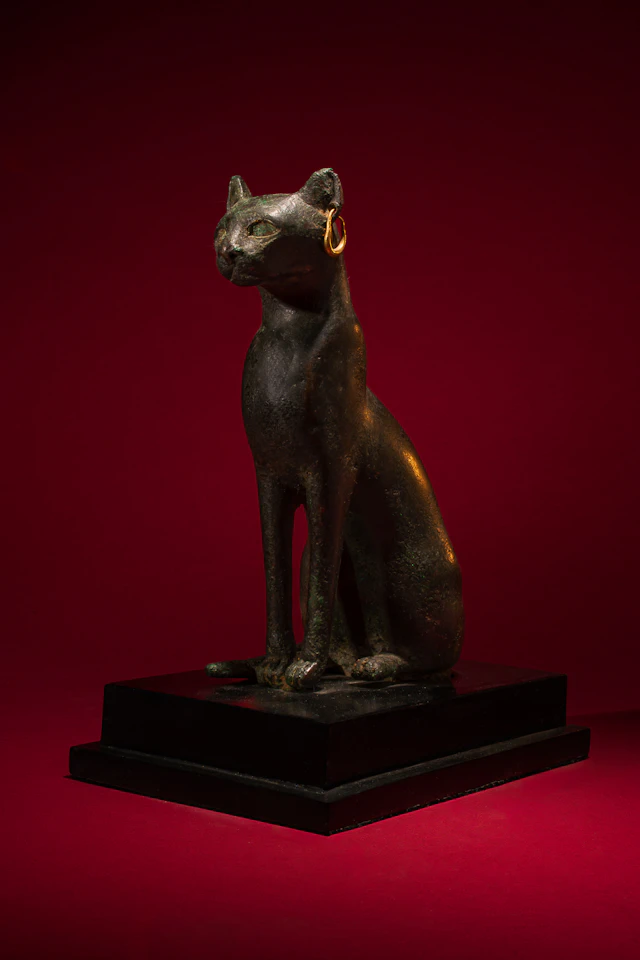
RARE EGYPTIAN BRONZE CAT STATUETTE WITH GOLD EARRINGS - LARGE SIZE
06/21/2026

£22,000
Est: £20,000
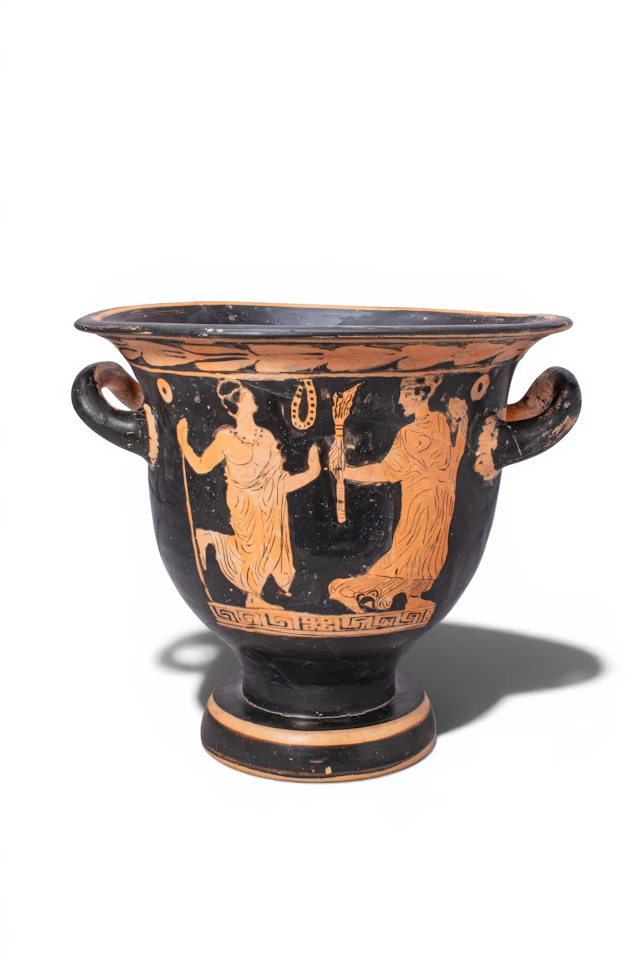
APULIAN RED-FIGURE BELL KRATER WITH KOMASTOS AND MAENAD - TL TESTED
06/21/2026
£2,600
Est: £2,000


OCT 27 | 4:00 PM
Bring your auction to collectors worldwide!
Get listed nowBy subscribing, you are agreeing to the privacy policy. Unsubscribe anytime.
Barnebys HQ
Brahegatan 10
BOX 5038
114 37 Stockholm
