


Bring your auction to collectors worldwide!
Get listed nowBy subscribing, you are agreeing to the privacy policy. Unsubscribe anytime.
Barnebys HQ
Brahegatan 10
BOX 5038
114 37 Stockholm
All auctions / Arts & Graphics / λ QUENTIN BELL (ENGLISH, 1910-1996), A TILED TABLE, CIRCA 1985
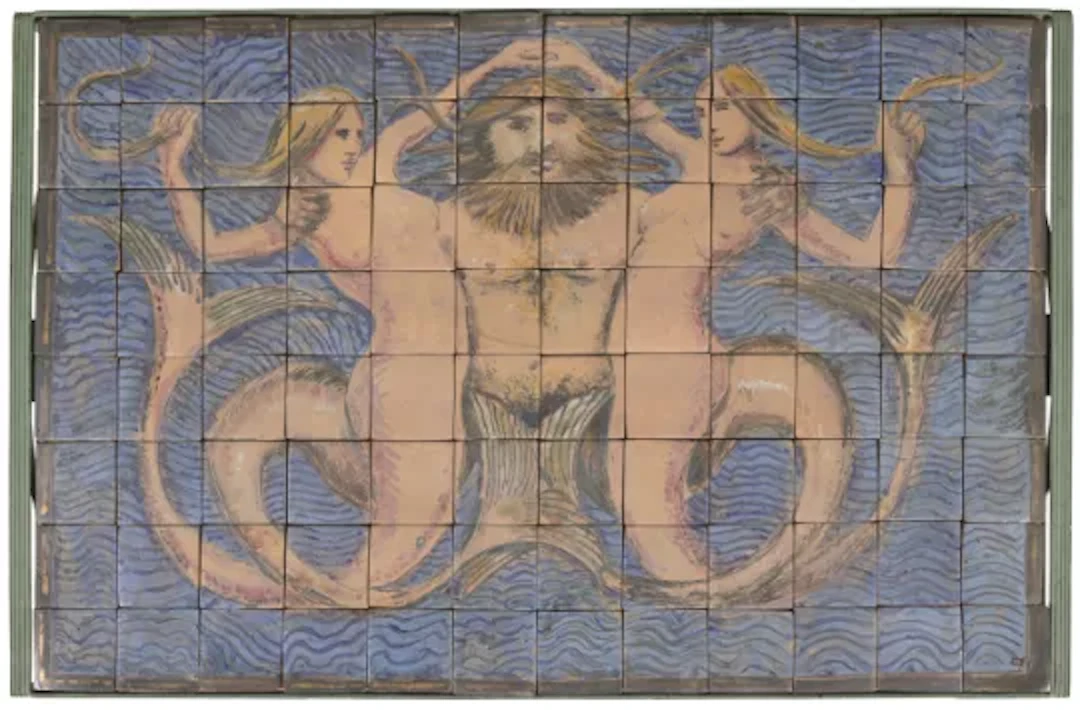
λ QUENTIN BELL (ENGLISH, 1910-1996) A TILED TABLE, CIRCA 1985 Polychrome pottery tiles, depicting a central merman flanked by two mermaids, the patinated metal table frame with bowed stretchers Tiles: 10cm x 10cm Table: 73cm high, 128cm wide, 83cm deep Making tiled tables was something of a family tradition for Quentin Bell. His mother, Vanessa Bell, and her partner, Duncan Grant, had experimented extensively with painted and decorated furniture through the Omega Workshops and later produced tiled tables for private commissions, establishing a precedent that Bell would revisit in his own work. Examples of Bell’s tiled tables survive in public collections, including at Monk’s House in Rodmell, the former home of his aunt Virginia Woolf and now in the care of the National Trust, and in the Garden Room at Charleston, his family home, which has been open to the public since the 1980s. As was typical of his practice, Bell appears to have made the tiles for this table himself, working in association with the Fulham Pottery. The numbers inscribed on their reverse helped him to reassemble the composition once the individual tiles had been completed. The design relates closely to a private commission undertaken in 1983, for which Bell created a tiled bathroom scheme populated by interlocking merfolk. Mermen and mermaids recur throughout Bell’s work, appearing particularly frequently in his ceramics of the late 1970s and 1980s. Their presence reflects, in part, his longstanding interest in the mythology and iconography of the classical world, but they also offered rich decorative possibilities. In Bell’s hands, such figures could be lyrical and bawdy, humorous and tender, while lending themselves to the expressive use of line, pattern and colour. His niece, Henrietta Garnett, recalled that the imagined behaviour and habits of merfolk were a favourite subject of conversation with her uncle. This table was probably made after the 1983 bathroom commission and appears to represent Bell returning to a motif that continued to hold his imagination. Related compositions of entwined merfolk, including arrangements centred upon a merman flanked by two mermaids, can be found on decorated plates from the same period. These figures belong to a much broader cast of mythological and fantastical characters that populated Bell’s ceramics, whether painted onto plates or modelled in terracotta. The central merman here has something of Silenus about him: corpulent, cheerful and mischievous. Yet he is rendered with a certain benevolence, lacking the more lecherous or unruly qualities traditionally associated with that figure. Bell more commonly favoured abstract arrangements of shape and colour for his tiled tables, making the present example particularly unusual for its sustained figurative imagery. The composition nevertheless retains his strong feeling for pattern. The rhythmic forms of the background suggest the movement of water, while the sweeping hair and curling tails of the mermaids extend this aquatic rhythm across the surface. Their interlocking bodies create a continuous curvilinear movement, binding figure and ornament into a single decorative scheme. The table also demonstrates Bell’s characteristically direct approach to ceramic decoration. The design appears to have been incised into the surface of the handmade clay tiles with a pen or other pointed implement, a technique he particularly favoured for the strong graphic line it produced. Colour and glaze were subsequently applied, while the exposed outer edges of the tiles were finished in gold and probably refired at a relatively low temperature. This table is an exceptionally fine and rare example of Quentin Bell’s work in this form. Its figurative subject matter sets it apart from the more abstract tiled tables he produced, bringing together several of the qualities that distinguish his ceramics of the period: a fascination with classical mythology, a playful and distinctly personal humour, and an instinctive understanding of the relationship between figure, pattern and colour. We are grateful to Matthew Holliday, curator of the upcoming Quentin Bell exhibition at Charleston (19 September 2026- March 2027), for their assistance in cataloguing this lot. Condition Report Disclaimer, λ, λ QUENTIN BELL (ENGLISH, 1910-1996) A TILED TABLE, CIRCA 1985 Polychrome pottery tiles, depicting a central merman flanked by two mermaids, the patinated metal table frame with bowed stretchers Tiles: 10cm x 10cm Table: 73cm high, 128cm wide, 83cm deep Making tiled tables was something of a family tradition for Quentin Bell. His mother, Vanessa Bell, and her partner, Duncan Grant, had experimented extensively with painted and decorated furniture through the Omega Workshops and later produced tiled tables for private commissions, establishing a precedent that Bell would revisit in his own work. Examples of Bell’s tiled tables survive in public collections, including at Monk’s House in Rodmell, the former home of his aunt Virginia Woolf and now in the care of the National Trust, and in the Garden Room at Charleston, his family home, which has been open to the public since the 1980s. As was typical of his practice, Bell appears to have made the tiles for this table himself, working in association with the Fulham Pottery. The numbers inscribed on their reverse helped him to reassemble the composition once the individual tiles had been completed. The design relates closely to a private commission undertaken in 1983, for which Bell created a tiled bathroom scheme populated by interlocking merfolk. Mermen and mermaids recur throughout Bell’s work, appearing particularly frequently in his ceramics of the late 1970s and 1980s. Their presence reflects, in part, his longstanding interest in the mythology and iconography of the classical world, but they also offered rich decorative possibilities. In Bell’s hands, such figures could be lyrical and bawdy, humorous and tender, while lending themselves to the expressive use of line, pattern and colour. His niece, Henrietta Garnett, recalled that the imagined behaviour and habits of merfolk were a favourite subject of conversation with her uncle. This table was probably made after the 1983 bathroom commission and appears to represent Bell returning to a motif that continued to hold his imagination. Related compositions of entwined merfolk, including arrangements centred upon a merman flanked by two mermaids, can be found on decorated plates from the same period. These figures belong to a much broader cast of mythological and fantastical characters that populated Bell’s ceramics, whether painted onto plates or modelled in terracotta. The central merman here has something of Silenus about him: corpulent, cheerful and mischievous. Yet he is rendered with a certain benevolence, lacking the more lecherous or unruly qualities traditionally associated with that figure. Bell more commonly favoured abstract arrangements of shape and colour for his tiled tables, making the present example particularly unusual for its sustained figurative imagery. The composition nevertheless retains his strong feeling for pattern. The rhythmic forms of the background suggest the movement of water, while the sweeping hair and curling tails of the mermaids extend this aquatic rhythm across the surface. Their interlocking bodies create a continuous curvilinear movement, binding figure and ornament into a single decorative scheme. The table also demonstrates Bell’s characteristically direct approach to ceramic decoration. The design appears to have been incised into the surface of the handmade clay tiles with a pen or other pointed implement, a technique he particularly favoured for the strong graphic line it produced. Colour and glaze were subsequently applied, while the exposed outer edges of the tiles were finished in gold and probably refired at a relatively low temperature. This table is an exceptionally fine and rare example of Quentin Bell’s work in this form. Its figurative subject matter sets it apart from the more abstract tiled tables he produced, bringing together several of the qualities that distinguish his ceramics of the period: a fascination with classical mythology, a playful and distinctly personal humour, and an instinctive understanding of the relationship between figure, pattern and colour. We are grateful to Matthew Holliday, curator of the upcoming Quentin Bell exhibition at Charleston (19 September 2026- March 2027), for their assistance in cataloguing this lot. QUENTIN BELL (ENGLISH, 1910-1996), Quentin Bell, Condition Report Disclaimer
Estimate:£4,000
To the auctionView all items fromDreweattsorArts & Graphics
Estimate:
£4,000
Bring your auction to collectors worldwide!
Get listed now
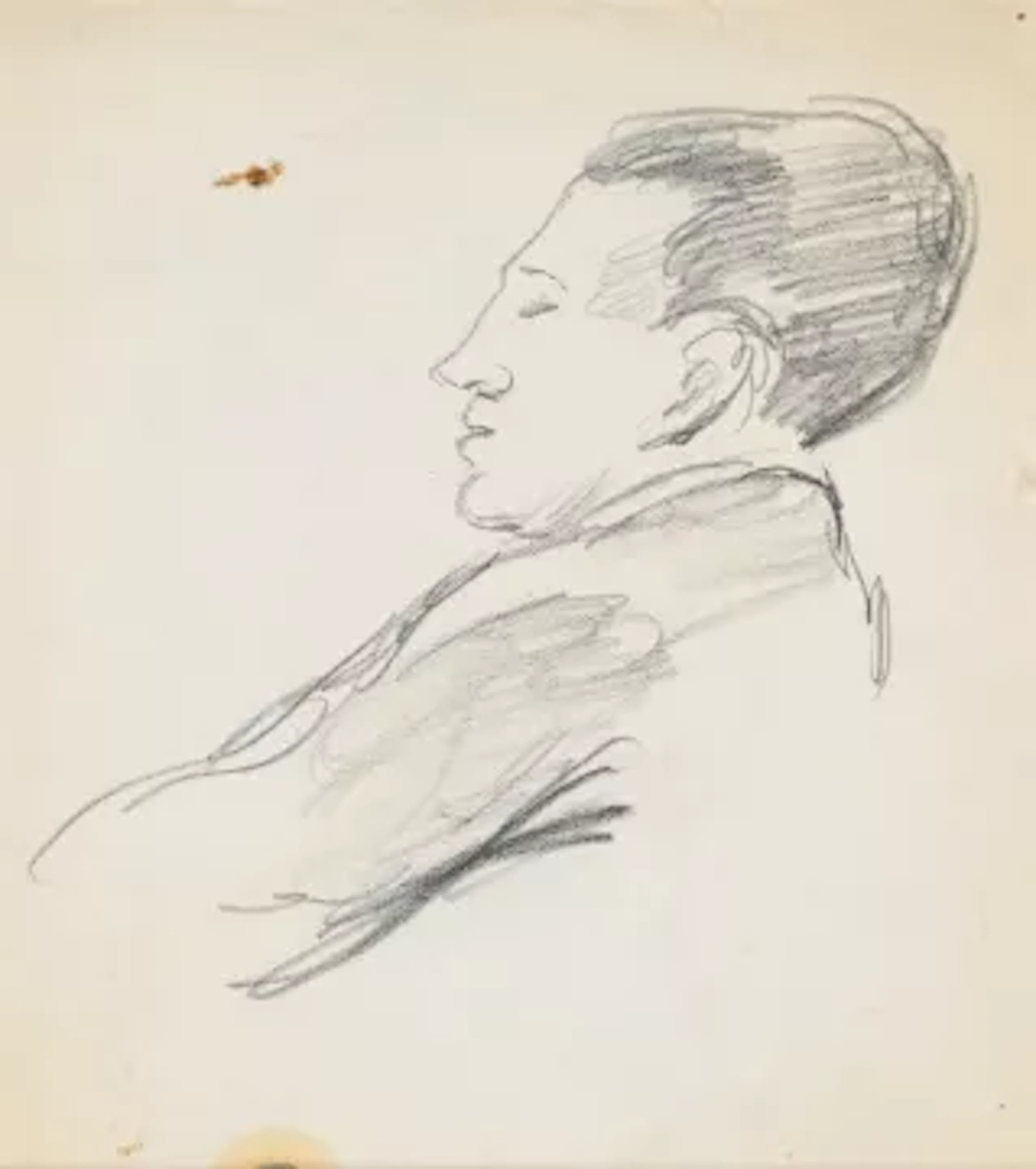
λ VANESSA BELL (BRITISH 1879-1961), STUDY OF A MAN ASLEEP IN A CAFE, VENICE
07/08/2026
£750
Est: £600