



Bring your auction to collectors worldwide!
Get listed nowBy subscribing, you are agreeing to the privacy policy. Unsubscribe anytime.
Barnebys HQ
Brahegatan 10
BOX 5038
114 37 Stockholm
All auctions / Toys & Collectables / Maisto 1:18 - Model motorcycle (46) - Vespa Collection...

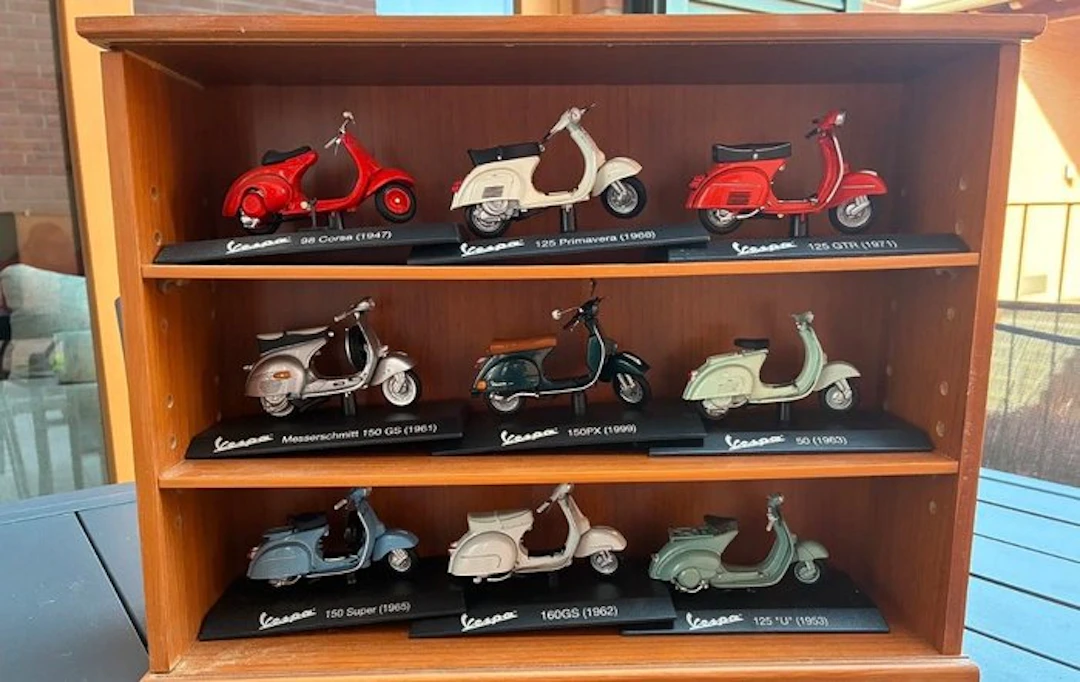
This is the description I would use on Catawiki. I have kept a tone of a collectible catalog, meaningful but without attributing to the lot features we cannot document. ## Vespa Collection – Fabbri Editori – Complete Collection 1:18 – 46 models, 47 booklets and 5 display cases For sale a complete “Vespa Collection” by Fabbri Editori, an important collection devoted to the history and evolution of the Vespa Piaggio, consisting of 46 full-scale 1:18 scale models, accompanied by the entire series of 47 original booklets consecutively numbered from 1 to 47 and five wooden display cases with transparent Plexiglas fronts. The collection traces about six decades of stylistic and technical evolution of the Italian scooter, starting from the MP5 “Paperino” of 1945, a prototype preceding the final Vespa, passing through the fundamental Vespa 98 of 1946, to more modern interpretations such as the Granturismo of 2003 and the LX 125 of 2005. The Piaggio Museum indeed identifies the MP5 “Paperino” as one of the very rare prototypes that preceded the Vespa, while the official birth of the Vespa model dates to 1946. ([Piaggio Group][1]) The Vespa Collection was launched by Fabbri Editori in 2006, on the occasion of the Vespa’s 60th anniversary. The editorial presentation of the time described a collection of 47 issues, with 1:18 scale reproductions and related booklets containing technical sheets, history, culture and in-depth notes on the Vespa world. ([Diesis][2]) It is precisely this setup that makes the lot particularly complete: it is not simply a set of miniatures, but an organic editorial collection preserved with its documentary apparatus. The models are mostly made of cast metal with plastic components and details, in 1:18 scale, and each piece sits on its own black display base, bearing the Vespa logo and the model name with the reference year. The type and scale coincide with those documented for the Fabbri Vespa collections. ([Spazio Collezioni][3]) ### The 46 models present in the lot The names below are those visible on the bases of the actual models present in the five display cases and in the lot photographs: 1. Vespa MP5 “Paperino” (1945) 2. Vespa 98 (1946) 3. Vespa 98 Corsa (1947) 4. Vespa 125 (1948) 5. Vespa 125 Circuito (1950) 6. Vespa Montlhéry (1950) 7. Vespa Hoffmann 125 (1951) 8. Vespa Sport 6 giorni (1952) 9. Vespa 125 “U” (1953) 10. Vespa 125 (1953) 11. Vespa Hoffmann Königin (1954) 12. Vespa 150 Sidecar (1955) 13. Vespa 150 (1956) 14. Vespa TAP (1956) 15. Vespa 150 (1957) 16. Vespa 150 GS (1958) 17. Vespa Messerschmitt 150 GS (1961) 18. Vespa 160 GS (1962) 19. Vespa 125 VNB4 (1962) 20. Vespa 50 (1963) 21. Vespa 90 Sella Lunga (1963) 22. Vespa 125 Super (1965) 23. Vespa 125 Nuova (1965) 24. Vespa 150 Sprint (1965) 25. Vespa 150 Super (1965) 26. Vespa 180 SS (1965) 27. Vespa 90 Super Sprint (1965) 28. Vespa 50L (1966) 29. Vespa 125 Gran Turismo (1966) 30. Vespa 75 (1967) 31. Vespa 125 Primavera (1968) 32. Vespa 50 Special (1969) 33. Vespa 50 Elestart (1969) 34. Vespa 150 Sprint Veloce (1969) 35. Vespa 125 GTR (1971) 36. Vespa 200 Rally (1972) 37. Vespa 125 TS (1975) 38. Vespa 125 ET3 Primavera (1976) 39. Vespa P150X (1978) 40. Vespa P200E (1978) 41. Vespa PK 125 Automatica (1984) 42. Vespa PX 125 T5 (1985) 43. Vespa 125 ET4 (1996) 44. Vespa 150PX (1999) 45. Vespa Granturismo (2003) 46. Vespa LX 125 (2005) Particularly interesting is the presence of some less conventional Vespa history interpretations: the 98 Corsa, the Sport 6 days, the versions produced under the German production Hoffmann and Messerschmitt, the particular TAP, Montlhéry, as naturally the sport and street generations more well-known such as GS, SS, Rally, Primavera, Sprint, PX, P200E and T5. The collection thus allows observing the evolution of shapes, displacements and differing uses of the Vespa project in a single set. ### Why 47 booklets but 46 models This aspect is important to accurately document the collection’s completeness. All original booklets from number 1 to 47 are present, as photographed. The physical full models are 46, because the Vespa 150 Sidecar (1955) corresponds to two editorial issues, dedicated respectively to the first and second part of the Vespa/sidecar complex. The specimen kept in the lot is complete and photographed separately from multiple angles; it sits on the two paired bases that form the complete display of the model. So it is not a missing model: the collection configuration is 47 editorial issues / 46 complete physical models. ### Original booklets The lot includes the entire Fabbri Editori editorial documentation, with 47 consecutive booklets numbered from 1 to 47. The photographs allow visual verification of the full sequence. The booklets are an important part of the collection because they allow placing beside the miniatures the historical and technical dimension of the work: the original series was conceived not only to tell the different models but also technical characteristics, product evolution and Vespa, society and culture. ([Diesis][2]) In the photographs of the editorial material the introductory documentation of the series is also visible. The booklets show normal and slight signs related to conservation and handling, consistent with the age of the collection. ### Five display cases One of the most interesting elements of this lot is the presence of five wooden display cases, each organized on three shelves and prepared to hold nine models. In total the five display cases accommodate 45 Vespa, while the 150 Sidecar constitutes the forty-sixth model and is kept separately. The display cases are equipped with removable transparent plexiglass fronts, which protect the models from dust while keeping them fully visible. The photographs show both the cases open and the configuration with the transparent panels installed. The wood appears overall well preserved. The plexiglass panels show very light micro-scratches due to normal conservation, but no cracks have been reported. The display cases represent an important presentation complement because they allow the collection to be kept organized and ready to be presented. ### Conditions of the models The models are overall in very good display-ready condition. The photographs do not reveal any obvious structural breakages and they are preserved on their respective bases. A particularly detailed check was also carried out on the Vespa Sport 6 days (1952), present with its own identifying base and photographed from both sides. The 150 Sidecar (1955) is also documented through frontal, rear and side photos, from which the body of the Vespa, the sidecar, the windshield, the seat, the wheels and the respective bases are visible. The models were mostly kept inside the display cases, as objects of display. The individual original packaging/blisters are no longer present; the lot is therefore offered without original boxes but with the bases, booklets and the five display cases illustrated in the photographs. ### Historical and collectible value of the collection The charm of this collection lies primarily in the possibility of following, almost chronologically, the development of one of the most recognizable icons of Italian industrial design. Piaggio recalls that the first prototypes were developed in 1945 and that Vespa officially originated in 1946; success quickly became international and production reached extraordinary dimensions already in the following decade. ([Piaggio Group][1]) Within the collection this history is represented in a particularly broad way: from the MP5 Paperino and the 98 of the origins, to sport and competition versions, to productions and interpretations aimed at foreign markets, to the famous Primavera, Sprint, Rally and PX families, up to scooters of the new millennium. It is therefore a collection that interests not only scale-model collectors but also Vespa, Piaggio, Italian design, the history of mobility and 20th-century motor culture enthusiasts. The joint presence of the 46 models, the entire sequence of 47 booklets, the respective identifying bases and the five display cases allows keeping the work as an organic collection, rather than just a set of loose miniatures. The lot includes everything shown in the photos: 46 Vespa models in 1:18 scale with their bases, 47 Fabbri Editori booklets numbered from 1 to 47, and five wooden display cases with plexiglass fronts. The collection will be packed with special care, given the presence of numerous small details and the display case panels."
Estimate:£469.68
To the auctionView all items fromCatawikiorToys & Collectables
Estimate:
£469.68
Bring your auction to collectors worldwide!
Get listed now