


OCT 17 | 10:00 PM

Bring your auction to collectors worldwide!
Get listed nowBy subscribing, you are agreeing to the privacy policy. Unsubscribe anytime.
Barnebys HQ
Brahegatan 10
BOX 5038
114 37 Stockholm
All auctions / Books, Maps & Manuscripts / Marc' Antonio Guigues - La Sfera Geografico-Celeste - 1700

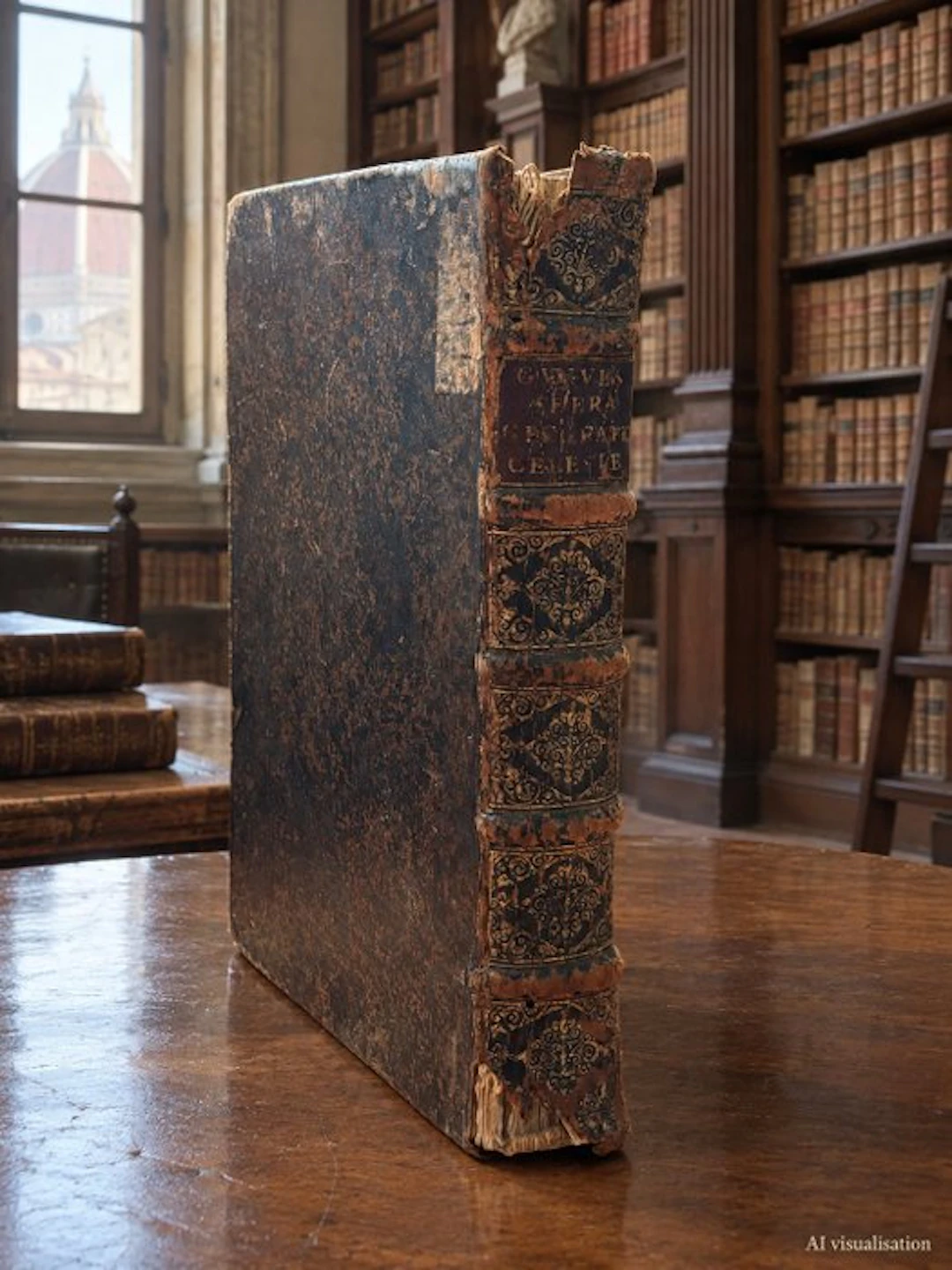
MARC’ANTONIO GUIGUES La Sfera Geografico-Celeste Roma, Gio. Giacomo Komarek Boemo alla Fontana di Trevi, 1700 Prima edizione ⸻ L’autore Marc-Antoine Guigues is a figure today relatively little known, but precisely for this reason particularly interesting in the panorama of scientific and religious culture between the seventeenth and eighteenth centuries. The title page presents him as an “Ecclesiastico Francese”; bibliographic sources connect him to the Roman Catholic and Jesuit milieu in Rome and also recall his activity as secretary to Bishop François-Étienne de Caulet of Pamiers, a leading figure in the religious controversies of late seventeenth-century France. An inventory of the Jesuits’ library in Paris preserves manuscripts attributed to Guigues as Caulet’s secretary and scribe. His output also includes writings of religious, historical, and poetic character. The Sfera Geografico-Celeste, however, represents his most ambitious work and, from the point of view of the history of science, the one of greatest interest. The book is placed at a particularly significant moment: Europe around 1700 was in the midst of transforming its conception of the universe. The Copernican revolution, Galileo’s observations, Kepler’s laws, and Newton’s new physics had already profoundly modified the European scientific landscape; Guigues instead intervenes defending a cosmological conception strongly tied to the geocentric tradition. A copy of the first edition is described by antiquarian bibliography as a rare work of geocentric cosmology. ⸻ The work: geography, astronomy and cosmology The Sfera Geografico-Celeste is a work in which terrestrial geography and astronomy are considered as parts of a single system of knowledge. The very term “sphere” recalls the traditional conception of the universe as a geometric order in which the Earth occupies a central position and terrestrial phenomena can be understood through their relations with the celestial sphere. The volume therefore addresses questions related to the Earth, the heavens, the movements of the stars, celestial coordinates, the seasons, the distribution of light, astronomical phenomena and the structure of the universe, weaving together natural observation, mathematics, philosophy, and religious interpretation. The copy of the first edition consists of [24], 353, [19] pages, in quarto format, and is accompanied by an important iconographic component: an allegorical engraved frontispiece, diagrams, plates, schemes and depictions, elements that testify to how illustration was considered an integral part of the era’s scientific dissemination. The frontispiece that opens the volume also visually translates the fundamental concept of the work: the cosmic order represented through allegorical figures, instruments and symbols, according to that fusion of science, philosophy and emblematic culture typical of the Baroque culture. ⸻ A book born in the heart of Roman scientific and Jesuit milieu It is not by chance that the work was published in Rome in 1700. The city was then one of the main European centers where astronomical knowledge coexisted with the Catholic philosophical and theological tradition. A decisive role was played by the Society of Jesus, which had developed an extraordinary tradition in teaching mathematics, astronomy, cartography and cosmology. A few decades earlier, at the College of the Romano, Cristoforo Clavio had developed and taught a fundamental part of European astronomical mathematics. The Jesuit scientific tradition was therefore not estranged from the new discoveries: on the contrary, it was one of the places where they were studied, discussed and progressively assimilated. And it is precisely this characteristic that makes Guigues interesting: his book belongs to that transitional phase in which the old cosmology had not simply disappeared, but continued to confront the new scientific universe. ⸻ The comparison with Copernicus and Galileo To understand the historical significance of this work one must return to 1543, when Nicolaus Copernicus published De revolutionibus orbium coelestium. Copernicus had placed the Sun, and not the Earth, at the center of the planetary system. The transformation was not only astronomical: it changed a conception of the place of man in the universe that had endured for centuries in Western culture. In the seventeenth century this transformation reached a decisive point with Galileo Galilei. Galileo’s telescope observations — from the Moon’s mountains to the phases of Venus and the moons of Jupiter — provided new evidence incompatible with some aspects of the Aristotelian-Ptolemaic cosmology. The affair culminated in the 1633 trial, when Galileo was condemned by the Holy Office and forced to recant. When Guigues publishes the Sfera Geografico-Celeste in 1700, almost seventy years have passed since the trial: yet the cosmological question is far from closed. ⸻ The ghost of Giordano Bruno Even more significant is the relation to Giordano Bruno. Guigues does not merely propose a generic traditional cosmology: in the book he also tackles the question of the existence of other worlds and the implications of the plurality of cosmological systems. A particularly important testimony is provided by a copy of the first edition, whose description records a passage on page 150 in which Guigues explicitly recalls Bruno and his condemnation. This reference is extraordinarily significant. Bruno had been burned at the stake in Rome in 1600, at Campo de’ Fiori, also in relation to his philosophical and cosmological conceptions. His idea of an infinitely extended universe populated by innumerable worlds belonged to a radically different conception from the closed and ordered universe of traditional cosmology. Bruno’s name, therefore, reappears in Guigues almost as a shadow from the previous century, testimony to a dispute that continued to run through European culture. ⸻ From ancient cosmology to Newton The historical importance of the Sfera Geografico-Celeste emerges even more clearly if we place it between two epochs. On the one hand we have Ptolemy, whose geocentric cosmology had dominated for more than a millennium. On the other we have the new universe of: Copernicus → Kepler → Galileo → Newton. Kepler had transformed planetary motions through his famous three laws; Galileo had changed the very way of observing nature; finally Isaac Newton, with the Philosophiae Naturalis Principia Mathematica of 1687, had provided a mathematical theory of universal gravitation capable of linking the fall of terrestrial bodies with the motion of celestial bodies. And yet, in 1700, Guigues publishes a work in which the previous cosmological tradition still retains its own force. This is precisely its historical value: it not only testifies to what science had discovered, but also what a part of European culture continued to defend and debate while the scientific paradigm was changing. ⸻ The meaning of the dedication to Gio. Ambrogio Centurione The title page also reveals another interesting element. The work is dedicated to the: “Very Rev. Father Gio. Ambrogio Centurione of the Society of Jesus” presented as rector of the College of the Penitentiaries of the Holy House of Loreto. The dedication thus places the book within a precise cultural and religious network, that of Italian ecclesiastical and Jesuit circles. The connection with Loreto is particularly significant: the Holy House was one of the major devotional centers of modern Italy and the College of the Penitentiaries represented an environment where religious culture, formation and knowledge met. The work therefore does not appear as a simple astronomical treatise intended exclusively for specialists: it is also the product of a culture in which knowledge of the universe is embedded within a broader philosophical and religious vision of creation. ⸻ The printer: Gio. Giacomo Komarek The volume came out of the Roman printing house of Giovanni Giacomo Komarek, a Bohemian-born printer active in Rome from the late seventeenth century to the early eighteenth. His name appears associated with several important Roman publications of the time. Bibliographic catalogs document his various printing sites, including l’Angelo Custode, La Torre del Grillo and the Fontana di Trevi. Komarek was therefore not a mere incidental printer. His workshop participated in the production of works of notable cultural significance. Among these is the monumental Perspectiva pictorum et architectorum by Andrea Pozzo, printed in several parts between 1693 and 1700, another work deeply connected to the Roman Jesuit milieu and to the mathematical representation of space. It is a particularly evocative pairing: the same printing environment that published the science of perspective and space representation contributed to the dissemination of a work dedicated to the geographic and cosmological representation of the universal space. ⸻ A document in the history of ideas The Sfera Geografico-Celeste must therefore be considered far beyond simple bibliographic interest. It is a document of the history of ideas. Its value also lies in the apparent contradiction it contains: published in 1700, when the new astronomy had already produced extraordinary results, yet it continues to present a vision of the cosmos deeply tied to tradition. And it is precisely this apparent “resistance” that makes it precious. An old book does not merely tell what we today consider true. It tells how the men of a given time sought to understand the world. Guigues thus shows us a moment of transition: a Europe in which Ptolemy had not yet completely disappeared, Copernicus was not yet universally accepted, Galileo was already a gigantic historical figure and Newton had just opened a new era of physics. ⸻ Conclusion Marc-Antoine Guigues’s Sfera Geografico-Celeste, published in Rome in 1700 by Giovanni Giacomo Komarek, is thus a work that sits at one of the most fascinating moments in the history of European knowledge: the moment in which the ancient cosmological order meets, and progressively confronts, with modern science. Within its pages coexist ancient astronomical tradition, geographic culture, mathematics, natural philosophy, and the religious vision of the universe. The reference to Bruno, the implicit comparison with Copernican revolution, and the Jesuit context in which the volume was born transform what might appear to be a simple cosmographic treatise into a true testimony of the long transition from the medieval and Renaissance universe to the modern universe. Owning today a copy of the first edition means thus preserving not only a 1700 astronomy book, but a tangible witness of an era in which man was learning to look at the sky with new eyes, without having yet completely abandoned the ones with which he had observed it for centuries. It is in this tension between tradition and revolution, between faith and observation, between the cosmos inherited from antiquity and the one born from the discoveries of modern science, that resides the most authentic fascination of the Sfera Geografico-Celeste: a book that belongs not only to the history of astronomy but to the history of how humanity has tried to understand its place in the universe. Collation and state of preservation 23pp, (353pp) Excellent state of preservation; contemporary leather binding to report; slight browning at margins Shipping Delivery in only 24 working hours throughout Europe and 48 working hours for non-EU countries
Estimate:£678.8
To the auctionView all items fromCatawikiorBooks, Maps & Manuscripts
Estimate:
£678.8

OCT 17 | 10:00 PM


Bring your auction to collectors worldwide!
Get listed now£102.95