




Bring your auction to collectors worldwide!
Get listed nowBy subscribing, you are agreeing to the privacy policy. Unsubscribe anytime.
Barnebys HQ
Brahegatan 10
BOX 5038
114 37 Stockholm
All auctions / Furniture, Design & Mirrors / Nineteenth-Century Bifacial Watch Fob - Bronze...

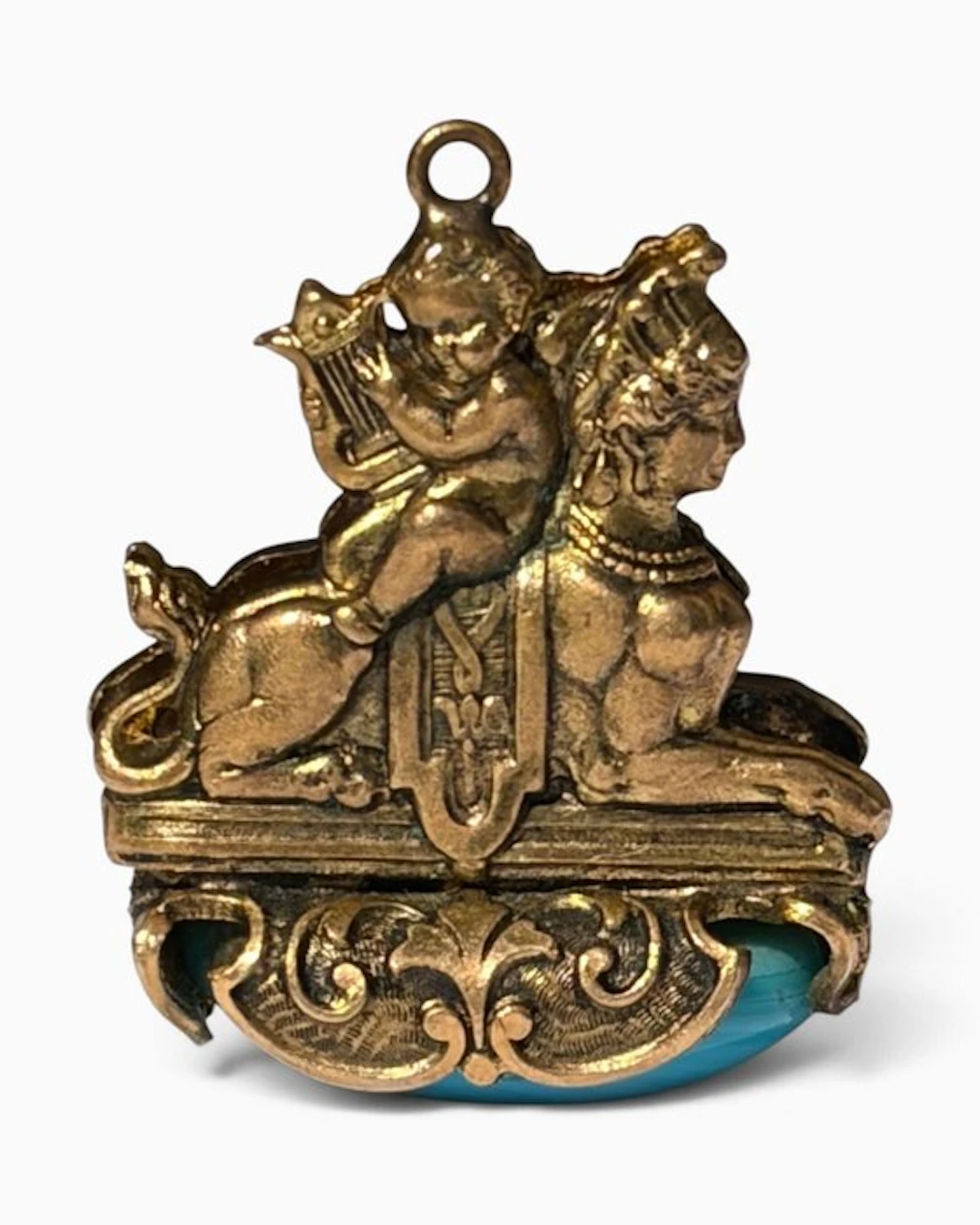
By style, construction features, and technical choices, the object can be attributed to the British goldsmithing manufacture of the late-Georgian / early Victorian era (area of Birmingham or London), chronologically placed between 1820 and 1850. SCULPTURAL ARCHITECTURE AND BIFACIAL STRUCTURE: The pendant’s handle is configured as a complex openwork sculpture that reproduces a mythological subject in Neoclassical Revival style, deeply influenced by the archaeological taste spread by the Grand Tour journeys: a winged putto (Cupid) caught playing the lyre, seated on the back of a majestic winged sphinx. The peculiarity of the manufacture lies in the entirely bidirectional, round, two-faced structure: the entire figurative composition is not a unilateral bas-relief or a hollow shell pressed on a single side, but is reproduced symmetrically on both faces. Front and back retain the same plastic precision, anatomical definition of the curls, feathering of the wings, and finish of the details. Iconographically, the subject embodies the classical allegory of "Love and Art (Cupid with the lyre) subduing and ruling Brutal Force and the Enigma (the Sphinx)." STOCK IDENTIKIT OF THE OWNER: Based on the absence of a private heraldic seal and the complexity of the theme, this piece most likely belonged to a dandy of high society or a young educated gentleman of the era. As men’s fashion in the 19th century was becoming stern and dark, the watch fob represented the only true jewel allowed to display one’s status and cultural level derived from classical studies and Grand Tour travels. ANALYSIS OF MICRO-ENGRAVINGS AND TECHNICAL DETAILS: The piece uses the so-called "faux swivel" type, in which the structural framework was fixed to provide stability to the two-faced plastic apparatus. The executional complexity becomes evident on macroscopic inspection of the interstices: * Burin-finish internal: The inner metal walls, visible through the openings of the sculpture, are entirely raised and finished with meticulous stippling by hand. * Guilloché engraving: The background enclosed by the gleaming scrolls of the lower frame shows a dense, geometric working with parallel micro-waves in guilloché style, coordinated with fine vertical hatchings under the putto’s belly. These microscopic workings testify to an elite manufacture executed on commission to generate sophisticated light refraction contrasts and to enhance the glossy volumes in relief. THE STONE AND THE DYNAMIC TILTING FEATURE: The base accommodates a thick slab of opaque glass paste in the celebrated Robin’s Egg Blue tone (robin’s egg blue), the most noble and coveted chromatic shade of Victorian jewelry. Under direct light, the characteristic concentric swirl marks of the era’s casting are clearly visible. The stone presents an intentional and smooth lower geometric bulge that gives the piece a fascinating tilting effect akin to a misirizzo (roly-poly/tumbler). If placed upright on a smooth surface, the pendant sways and oscillates elegantly without ever tipping over, perfectly balanced by its 17.5 grams of weight. This dynamic brilliantly explains the absence of a heraldic engraving on the gem’s base: the surface was deliberately smoothed and left polished by the craftsman to allow fluid, frictionless movement on the table, while protecting the material from early wear or chipping. An exquisite engineering finesse of the era, designed both as a tabletop amusement during writing and as an active protective system for the gem on the desk. * Era: 19th Century (circa 1820-1850). * Attributions: British goldsmithing manufacture (Birmingham / London). * Manufacturing: Symmetrical, mirror-bidirectional openwork sculpture. * Processing: Original gilding, guilloché geometric engravings, burin relief. * Materials: Bronze/antique gilt brass alloy, robin’s egg blue glass paste. * Total weight: 17.5 grams (exceptionally dense and solid for the type). * Condition: Excellent structural condition. Preserves original gilding with a consistent, soft wear on the reliefs on both sides. Internal interstices show natural green oxidation deposits (verdigris), excellent patinated indicator of historical authenticity. Glass paste perfectly intact, free of chips or cracks. A high-collectibility lot of documented aesthetic rarity, ideal for collectors or to be converted into an exclusive statement pendant for antique chains and bracelets.
Estimate:£340.18
To the auctionView all items fromCatawikiorFurniture, Design & Mirrors
Estimate:
£340.18
Bring your auction to collectors worldwide!
Get listed now
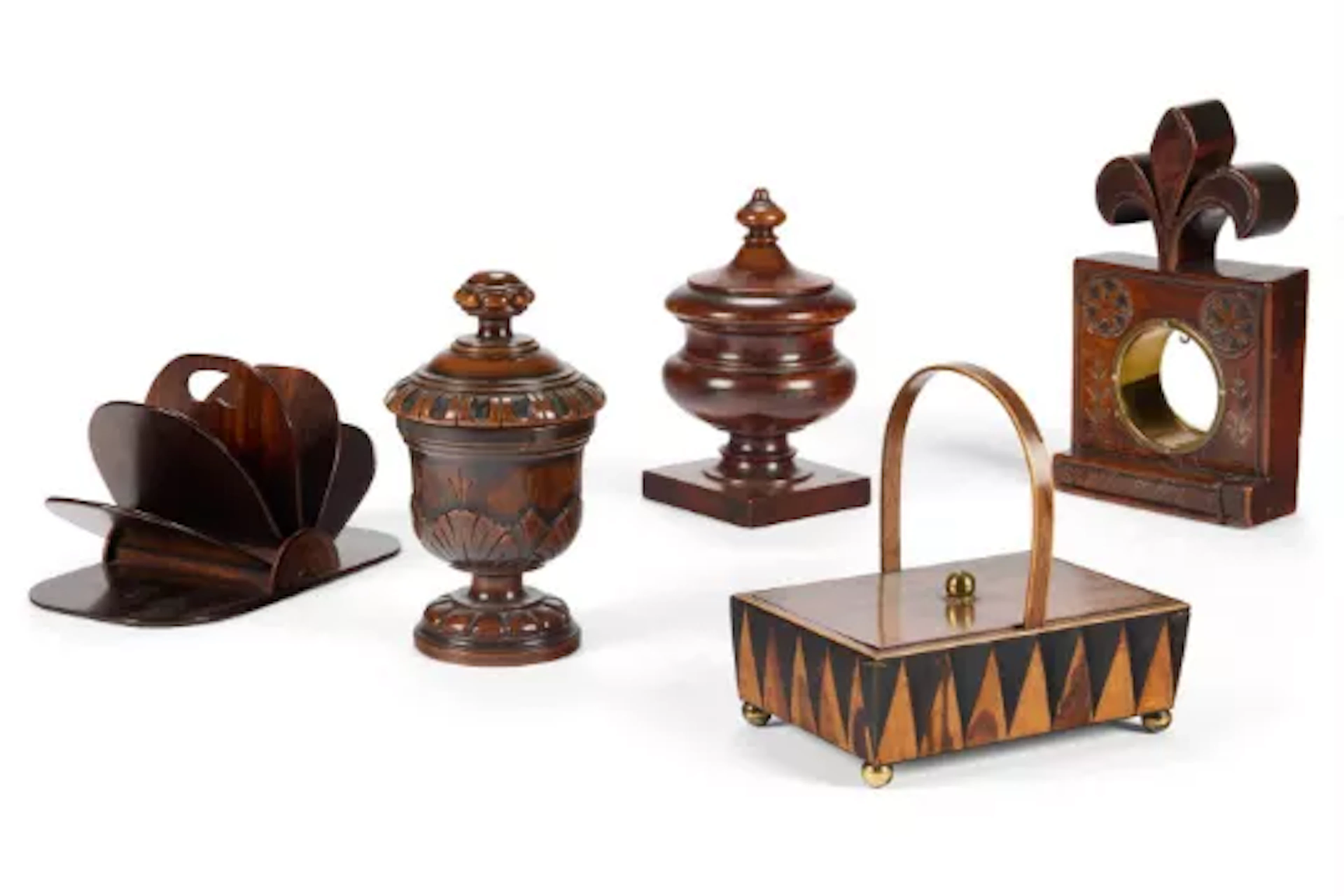
Y A COLLECTION OF FIVE TREEN OBJECTS 18TH AND 19TH CENTURY Including
04/29/2026
£550
Est: £800