OCT 8 | 3:00 PM

Bring your auction to collectors worldwide!
Get listed nowBy subscribing, you are agreeing to the privacy policy. Unsubscribe anytime.
Barnebys HQ
Brahegatan 10
BOX 5038
114 37 Stockholm
All auctions / Ancient Art / Northern India

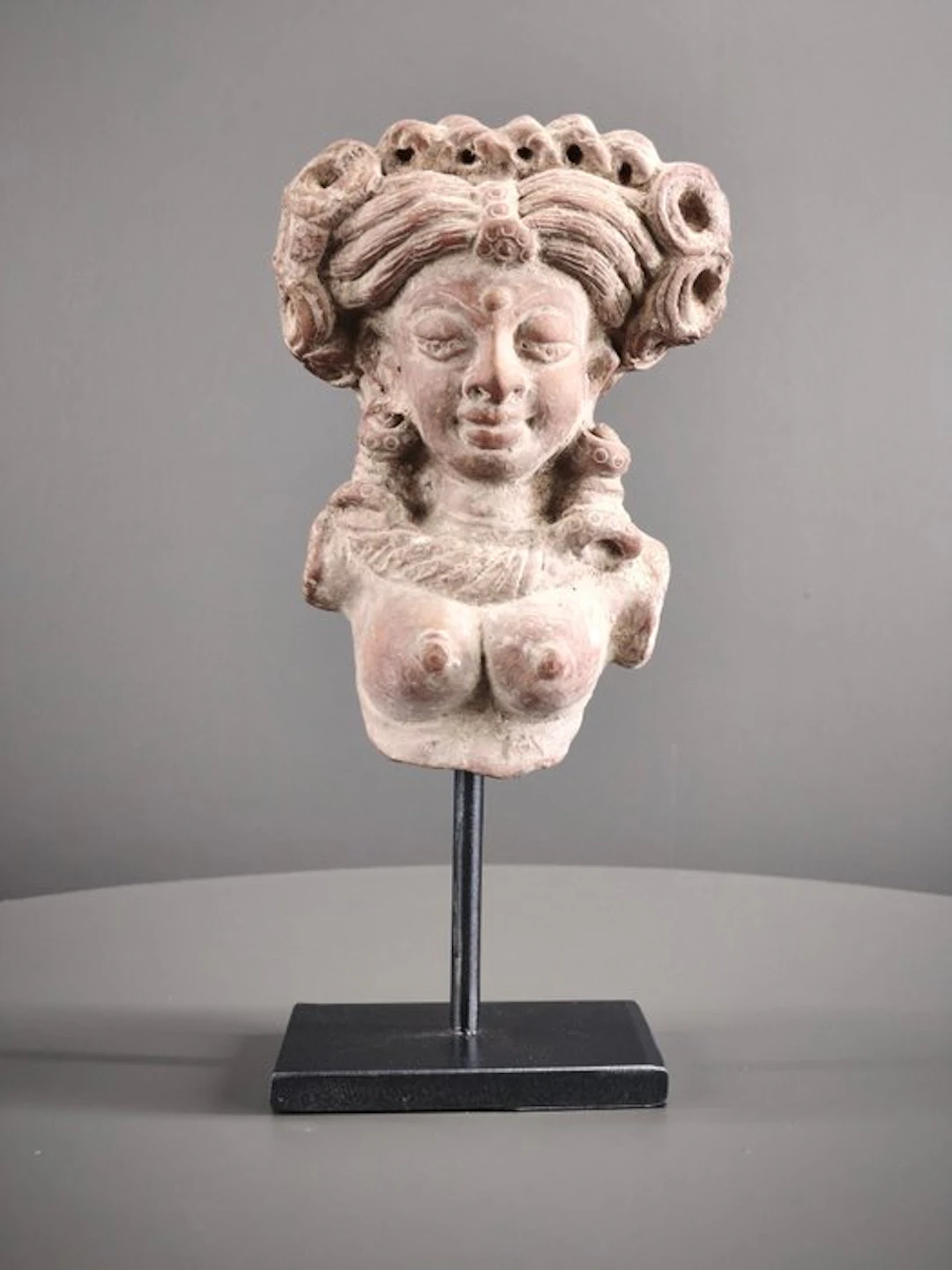
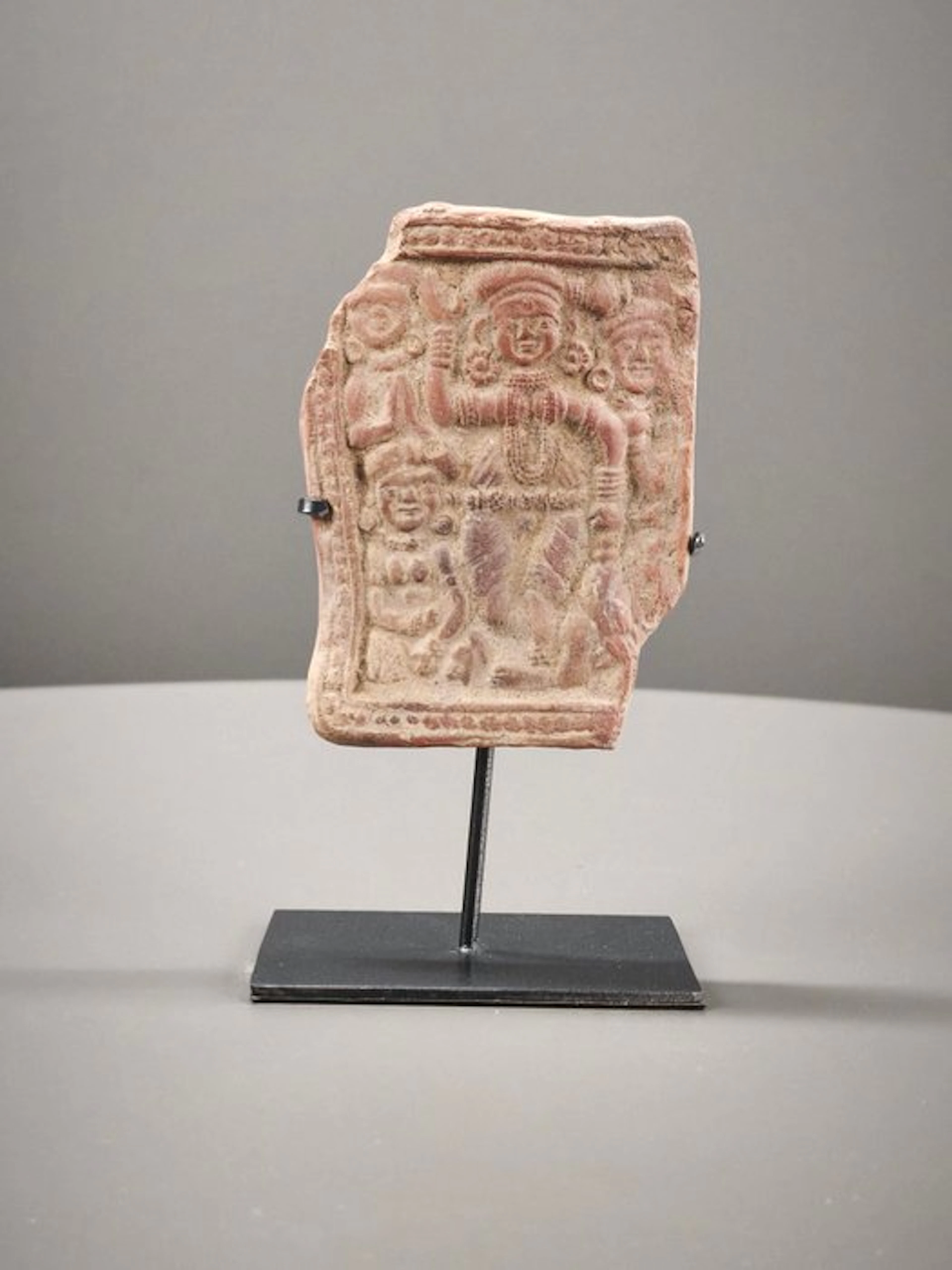
Important fragmentary bust of a female figure, probably a Yakṣī, in terracotta, North India, late Shunga period, probably 1st century BCE. This sculpture stands out for its remarkable decorative richness and for the particularly elaborate treatment of the coiffure. The feminine face, frontal and slightly smiling, features large almond-shaped eyes, full lips and a small circular mark applied to the center of the forehead, probably ornamental or auspicious in character. The coiffure is the most spectacular element of the piece. The hair, parted by a middle ridge, is finely striped and framed by an imposing structure composed of large tubular and perforated circular elements, accompanied by lateral scrolls. This ornamental vocabulary shows important affinities with the hollow-ceramic productions of ancient eastern India and notably with the Chandraketugarh corpus, in Bengal. The figure bears large ear ornaments as well as a broad, ribbed necklace. The chest, strongly modeled and projected forward, belongs to the vocabulary of female representations associated with fertility, abundance and prosperity in ancient Indian art. The identification as Yakṣī is considered probable, though not demonstrable with absolute certainty due to the fragmentary nature of the sculpture. It could more broadly be a female deity or an auspicious female figure associated with abundance. The piece is conceived in hollow volume and not as a simple plaque. The lower opening allows observation of the internal cavity. The manufacture appears to correspond to a process combining molding, assembly of shells, modeling and manual touch-ups. The numerous coiffure details were incised and perforated in the clay. The back is convex and carefully smoothed, while remaining less detailed than the front, suggesting a three-dimensional sculpture designed with a dominant frontal presentation. Stylistically, the work belongs to the late Shunga / Early Historic horizon of North India, probably around the 1st century BCE. Chandraketugarh productions provide a particularly relevant comparison, but no precise archaeological provenance from that site is claimed. The terracotta shows a red-pink to orange tone under beige light and whitish deposits. Abrasion is more pronounced on the projecting parts, while the hollows and perforations retain more deposits. Condition: ancient fragment preserving the head, neck and chest. The arms are missing and an ancient fracture runs through the lower part beneath the chest. Small losses and ancient abrasions, notably in the coiffure and on the exposed reliefs. No major restoration, no large rejoining or obvious modern reconstruction is visible in the examined documentation. Presented on a modern metal base. Provenance: former Belgian private collection, acquired between 1979 and 2009, then transmitted through descendants in 2023. Dimensions without base: 17 × 12 × 8 cm. Weight: 879.6 g. Height with base: 25 cm. No thermoluminescence analysis has been performed. The proposed attribution and dating are based on stylistic, iconographic, technical, material and comparative study of the piece. video link: https://www.dropbox.com/scl/fo/bpfx6i1501h9n0j83c1ux/APX1rJFChR5lOVEXaHNIH6o?rlkey=2i915395sqe0bx69o0dt5p81e&dl=0
Estimate:£1,783.8
To the auctionView all items fromCatawikiorAncient Art
Estimate:
£1,783.8
OCT 8 | 3:00 PM


OCT 8 | 3:00 PM

Bring your auction to collectors worldwide!
Get listed now