




OCT 23 | 8:00 AM

All auctions / Books, Maps & Manuscripts / Pietro Caponsacchi - Apocalypsim Observatio /...

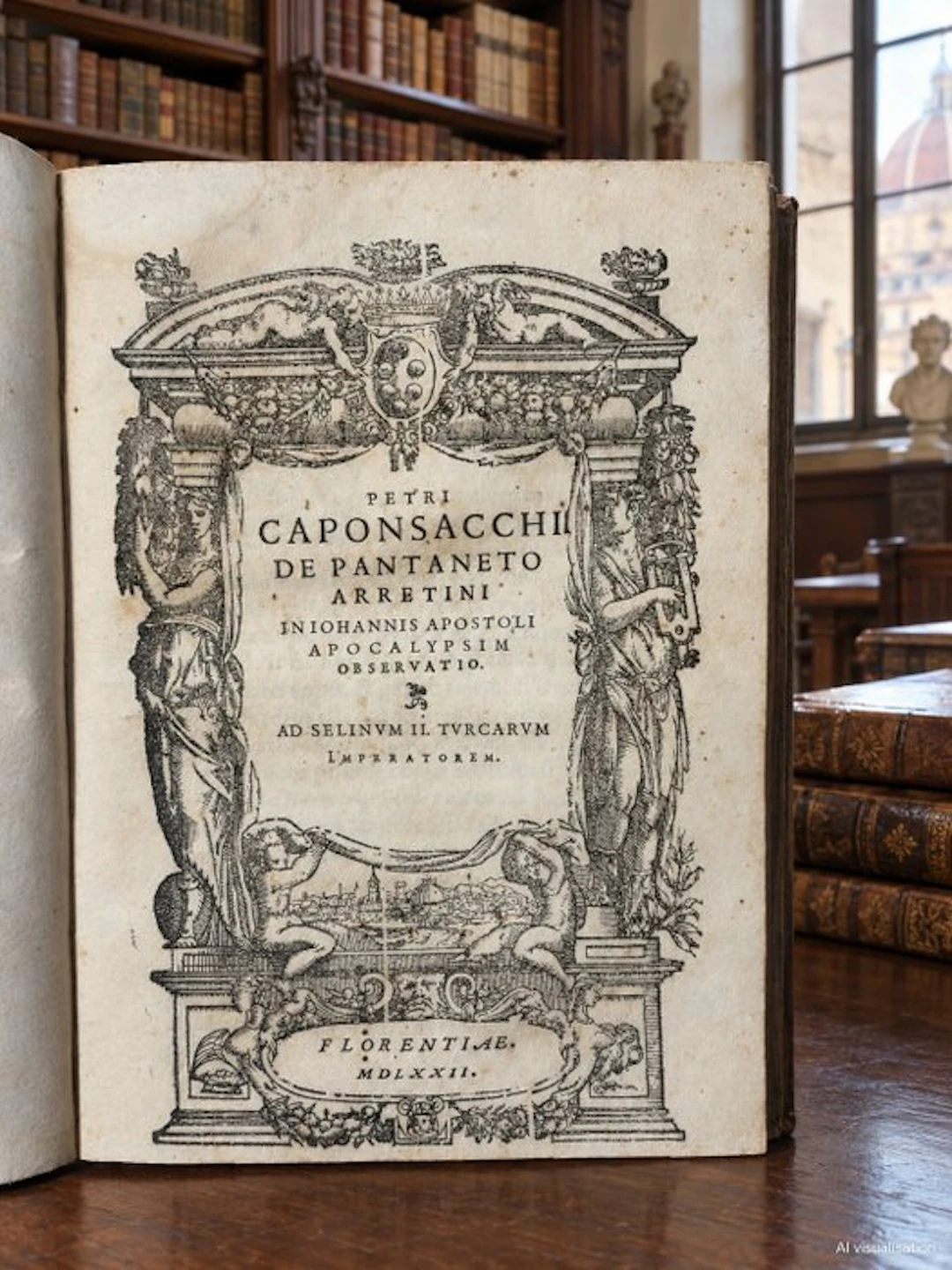
Two works by Pietro Caponsacchi da Pantaneto: biblical exegesis, humanistic culture, and printing in Medicean Florence of the sixteenth century Collation and state of preservation: Excellent condition, pages fresh and clean with very slight imperfections but overall a work of great rarity. Interpretatio in Cantica Canticorum Salomonis 2pp, (67pp) Apocalypsim Observatio 2pp; (167pp) ## Introduction The two works presented here constitute a testimony of particular interest for the study of Italian book culture in the sixteenth century, an era in which humanistic tradition, theological reflection, the renewal of biblical studies, and European confessional competition contributed to defining the role of the book in society. The frontispieces document two publications attributable to Pietro Caponsacchi da Pantaneto, author indicated in the editions with the Latin form Petrus Caponsacchius de Pantaneto Arretinus, both printed in Florence within a year of each other. The first work, entitled De Iohannis Apostoli Apocalypsim observatio, was published in 1572 and addresses the interpretation of the Apocalypse of Saint John, with a dedication to Selim II, sultan of the Ottoman Empire. The second, Interpretatio in Canticorum Salomonis, appeared in 1573 at the Giorgio Marescotti press and was dedicated to Francesco de' Medici, Prince of Tuscany and future grand duke. Reading the two volumes together allows one to relate the religious culture of the time to the political life of Medicean Tuscany and to the intellectual ambitions of Renaissance printing. However, one must distinguish the data directly attested by the frontispieces from historical reconstructions: the initial pages document author, titles, recipients, and editorial indications, but they do not, by themselves, allow establishing the actual diffusion of the volumes, contemporaries’ reactions, or their influence on later biblical interpretations. ## 1. The author: Pietro Caponsacchi da Pantaneto Pietro Caponsacchi, identified in bibliographic sources as Pietro Caponsacchi da Pantaneto, aretino, is a figure in the Tuscan intellectual landscape of the late sixteenth century, whose production lies within biblical exegesis and interpretation of religious texts. Biographical information available is relatively limited compared with more renowned Renaissance authors; it is therefore appropriate to avoid attributing to him ecclesiastical offices, academic roles, or personal relations with the Medici court that are not adequately documented. The frontispieces, however, allow us to identify some significant elements of his intellectual identity and his communication strategies. First of all, the choice of Latin. In the sixteenth century this language continued to represent a fundamental tool of European scholarly communication, used in theology, philosophy, law, and learned production. Publishing in Latin meant addressing a potentially broader audience than the local one, composed of clergy, scholars, educated readers, and members of courtly cultural circles. The adoption of the Latinized form Petrus Caponsacchius de Pantaneto Arretinus responded to a consolidated editorial convention. The name was inserted into a linguistic and cultural system shared by European scholars; the reference to Pantaneto and Arezzo maintained a link with the author’s territorial identity. Caponsacchi’s output does not end with the two titles examined here. Bibliographic tradition also attributes to him a legal work entitled De iustitiae, & iuris auditione and a commentary on the Petrarchan song Vergine bella, published in 1577 by Giorgio Marescotti. This latter fact demonstrates the author’s interest in a reading of literary texts capable of highlighting philosophical and theological meanings. This element is particularly important: Caponsacchi does not appear merely as an author interested in explicating Scripture, but as an interpreter moving within a culture in which literature, philosophy, and religion could be considered complementary disciplines. Thus his method should be framed within the Renaissance exegetical tradition, in which the text was not necessarily read as a simple sequence of propositions, but as a system of images, symbols, historical references, and moral meanings. Understanding sacred text required linguistic skills, knowledge of interpretive tradition, and the ability to identify relations between the literal sense and the spiritual sense. ## 2. The first work: In Iohannis Apostoli Apocalypsim observatio (1572) The first frontispiece bears the title: Petri Caponsacchii de Pantaneto Arretini in Iohannis Apostoli Apocalypsim observatio. Ad Selinum II. Turcarum Imperatorem. Florentiae. MDLXXII. An approximate translation can be formulated as follows: “Observations by Pietro Caponsacchi da Pantaneto, aretino, on the Apocalypse of the Apostle John, addressed to Selim II, Emperor of the Turks.” The Florentine edition of 1572 is bibliographically attributed to Giorgio Marescotti. The title presents the work as an observatio, a term that can indicate a reasoned observation, interpretive exposition, or a series of reflections dedicated to a text. ### The content and religious significance The Apocalypse is the last book of the New Testament and constitutes one of the most complex and influential texts in the Christian tradition. Traditionally attributed to John, it presents a sequence of visions, symbolic figures, judgments, catastrophes, cosmic conflicts, and images of final renewal. The Greek term apokálypsis literally means “revelation” or “unveiling”: it does not originally denote only the destruction of the world, but the manifestation of a reality hidden from ordinary perception. In the biblical text, this revelation concerns the relationship between human history, divine justice, and the fulfillment of God’s plan. Among the most famous images are the seven seals, the trumpets, the bowls of divine wrath, the dragon, the beast, the fall of Babylon, and the heavenly Jerusalem. These elements have fueled theological, moral, political, and prophetic interpretations for centuries. During the Middle Ages and the Renaissance, the Apocalypse was frequently used to reflect on the conflicts of history, religious persecutions, the corruption of power, and the possibility of spiritual regeneration. Its imagery allowed interpretation of the present as part of a broader process, in which earthly events gained meaning in relation to an eschatological perspective, i.e., the ultimate destiny of humanity. Caponsacchi’s title presents the work as an interpretative text dedicated to this complex biblical book. In the absence of a full analysis of the exemplar, it would not be correct to attribute to the author a specific exegetical theory or reconstruct his conclusions in detail. It is, however, possible to state that the work belongs to a long tradition of Apocalypse readings, a book that in the sixteenth century had acquired renewed religious and political significance. ### The dedication to Selim II: an element of exceptional interest The most singular aspect of the frontispiece is the dedication to Selim II, Ottoman sultan from 1566 to 1574. The formula Ad Selinum II. Turcarum Imperatorem explicitly identifies the sovereign as the recipient of the work. Selim II came to the throne after the death of his father Suleiman the Magnificent, under whom the Ottoman Empire had achieved remarkable territorial and military expansion. His reign coincided with a decisive phase in the relations between the Ottoman world and the Christian powers of the Mediterranean. This reference takes on particular meaning if placed in the context of events of 1571. On October 7 of that year, the Holy League fleet, formed mainly by Spanish, Venetian, and Papal forces, faced the Ottoman fleet at Lepanto, achieving a victory that had enormous symbolic value for Christian Europe. The victory at Lepanto was celebrated in numerous European circles as a sign of divine protection. Among the historical figures associated with the battle are Pope Pius V, who promoted the Holy League, and Don John of Austria, commander of the Christian fleet. Venice, which had suffered heavy territorial and commercial losses during the conflict over Cyprus, played a central role in the coalition. Peace, however, did not immediately follow the battle, and Mediterranean rivalry did not cease. The Ottoman Empire retained considerable military and administrative capacity; in 1573 Venice concluded a separate peace with the Ottomans, renouncing its claims to Cyprus. The actual history was thus more nuanced than the celebratory portrayal of a definitive Christian victory. In this scenario, the dedication to Selim II opens an important interpretive question. A text on the Apocalypse addressed to a Muslim sovereign could assume apologetic, polemical, prophetic, or diplomatic value. The choice of recipient could serve to present Christian truth to a sovereign outside Christianity, or to symbolically place Ottoman power within a religious reading of world history. However, one must not turn this possibility into a certainty. The sole dedication does not prove that Caponsacchi met Selim II, that the book was physically handed to him, or that the sultan ever read it. To establish the precise purpose of the address, it would be essential to examine the dedicatory letter and the complete text of the work. What remains is a fact: the frontispiece documents an unusual and intellectually stimulating choice: the projection of a biblical commentary beyond the immediate Christian audience, at a moment when engagement with the Ottoman Empire occupied a central place in European political imagination. ### The frontispiece as cultural manifesto The page is dominated by a complex woodcut frame, arranged as a monumental architectural structure. Columns, allegorical figures, festoons, coats of arms, putti, and vegetal ornaments enclose the text, turning the frontispiece into a symbolic portal of sorts. The composition follows a typical Renaissance book principle: the figurative apparatus is not merely decorative, but contributes to the public presentation of the work and its author. The image communicates prestige, solidity, and authority; the Latin text, arranged according to a hierarchy of magnitudes, identifies the author’s name, the treated subject, the recipient, and the date. The centrality of the title is particularly evident. Caponsacchi’s name occupies a privileged position, while the dedication to Selim II is placed in the lower part of the textual zone. The architectural structure gives the publication a solemn, almost monumental character. This is a significant aspect of the book’s history: in the sixteenth century the frontispiece had become a device of bibliographic identification and, at the same time, a tool of social representation. Through it, author, printer, and recipient participated in a system of cultural and political relationships that went beyond the strictly literary content. ## 3. The second work: Interpretatio in Canticorum Salomonis (1573) The second frontispiece bears a more elaborate title: Interpretatio in Cant. Canticorum Salomonis. Ad Serenissimum Franciscum Medicem Magnum Etruriae Principem. Auctore Petro Caponsacchio de Pantaneto Arretino. Florentiae, ex Officina Georgii Marescotti, M.D.LXXIII. In Italian: “Interpretation of the Song of Songs of Solomon, dedicated to the most serene Francesco de’ Medici, Prince of Tuscany. Work by Pietro Caponsacchi da Pantaneto, aretino. Florence, from the workshop of Giorgio Marescotti, 1573.” The bibliographic description of the edition confirms the author, the title, the dedication to Francesco de’ Medici, and the publication in 1573 at Giorgio Marescotti’s press. The physical extent is recorded as 67 pages. This second publication differs from the first in both the biblical text addressed and the recipient. If the 1572 commentary was addressed to an Ottoman sovereign, the 1573 work is directed to a member of the dynasty that ruled Florence and Tuscany. ### The Song of Songs: poetry, love, and spirituality The Song of Songs, traditionally attributed to Solomon, holds a special place within the Bible. Unlike other biblical books, it does not primarily present legal precepts, historical narratives, or prophetic visions, but a poetic composition focused on love, desire, the pursuit of the beloved, the beauty of the body, and the strength of affectionate bonds. The text is characterized by a richness of natural imagery: gardens, vineyards, flowers, perfumes, animals, landscapes, and fruits become elements of an intensely evocative poetic language. The lover’s relationship is described through metaphors that blend physical, emotional, and symbolic dimensions. This very peculiarity has long sparked an intense interpretive debate. How could a poem of love be included in the canon of Scripture? What relationship should be recognized between its literal meaning and its religious function? The Jewish tradition has read the Song as an expression of the relationship between God and Israel. In Christian tradition, one of the most widespread interpretations has seen in the loving dialogue a representation of the union between Christ and the Church, or between God and the believing soul. In the Middle Ages, this spiritual reading was developed by numerous authors. Among the most important references are Origen, whose exegesis of the Song exerted a significant influence on Christian tradition, and Bernard of Clairvaux, author of famous sermons devoted to the biblical book. The text thus made it possible to address fundamental questions of Christian theology: the nature of divine love, the desire for union with God, the path of interior perfection, and the relationship between human sensibility and spiritual reality. In this context sits Caponsacchi’s work. The title Interpretatio explicitly indicates an interpretive activity: the author’s task is to explain the text and render its meanings intelligible. It is not necessarily a translation, but an exposition aimed at clarifying the sense of the biblical book. Without a complete transcription of the work, it is not possible to determine which interpretations Caponsacchi favored, which authorities he cites, or how much space he grants to the literal versus allegorical reading. The volume’s placement within Christian exegetical tradition, however, allows us to understand its cultural function: to provide tools for a conscious reading of one of the Bible’s most enigmatic poetic texts. ### The dedication to Francesco de’ Medici The book’s recipient is Francesco de’ Medici, son of Cosimo I and future grand duke of Tuscany. In 1573 Francesco was still formally a prince; he would succeed his father in 1574, ruling until 1587. The designation Magnus Etruriae Princeps on the frontispiece thus reflects the historical moment in which the book was published. A dedication to a prince was not a mere formality. In Renaissance culture, it could constitute a tool of intellectual recognition, a way to obtain protection or visibility, and a means to insert the book into the networks of court prestige. A religious work dedicated to a member of the ruling family thus stood at the intersection of culture, devotion, and power representation. Presenting a biblical commentary to a prince suggested that intellectual activity and religious formation could contribute to building the ruler’s image. The dedication, by itself, does not prove that Francesco commissioned the volume, financed the printing, or read the text. It shows, however, that Caponsacchi or the publishing environment in which the work was produced considered appropriate to associate the publication with the Medici prince’s name. This choice takes on further significance in light of Francesco I’s cultural profile. During his government, Florence remained an important artistic and intellectual center. The prince promoted architectural and cultural initiatives, supported scientific and naturalistic interests, and contributed to the development of the Medicean artistic environment. Notably, the Studiolo of Palazzo Vecchio and the transformation of the Uffizi into a gallery for art collection and display are linked to him. Caponsacchi’s publication thus belongs to a milieu in which dynastic prestige was built through relations with letters, the arts, and book production. ### The ship emblem: an iconographic curiosity One of the most interesting elements of the second frontispiece is the central emblem, depicting a ship within an oval frame, surrounded by allegorical figures and vegetal motifs. The ship is a recurring motif in Renaissance imagery: it can evoke journey, navigation, fortune, stability, or crossing of a difficult path. In moral and religious contexts, the image of the ship can also recall the Church as the community that traverses the vicissitudes of history. It is important, however, to distinguish general symbolic reading from bibliographic identification. The mere appearance of the image does not allow to ascertain with certainty which specific meaning the printer or author attributed to it, nor to confidently identify the motto or the publishing house to which the emblem belongs. For a precise identification one would need to compare the mark with catalogs of fifteenth- and sixteenth-century typographic devices and with other editions of Giorgio Marescotti. If confirmed, the identification could help reconstruct the workshop’s production continuity and distinguish elements belonging to the shop from those commissioned for a single publication. ## 4. Giorgio Marescotti: the printer and his workshop The second work explicitly carries the formula Ex Officina Georgii Marescotti, identifying the place of printing. The first edition, that of 1572, is also attributed to Marescotti by bibliographic tradition. Giorgio Marescotti was one of the most active printers in Florence in the late sixteenth century. Of French origin, he arrived in the city around 1553-1554 and initially worked in the shop of Lorenzo Torrentino, a printer of Flemish origin who played an important role in Florence’s book production under Cosimo I de’ Medici. In 1558 Marescotti started his own publishing and printing activity. His professional trajectory reflects a significant transformation of Renaissance printing. Printing was not merely a craft; it was an economic enterprise requiring investments in type, paper, presses, specialized staff, distribution, and relations with authors and patrons. A printer had to know production costs, identify a potential audience, organize text composition, and ensure works were presented in a form meeting readers’ expectations. In Marescotti’s case, the variety of production is particularly telling. His catalog included literary, religious, scientific, technical, and musical works. In subsequent years he would publish, among others, Vincenzo Galilei’s Dialogo della musica antica et moderna (1581) and musical works related to the birth of the new practice of operatic singing. In 1600 he would also print Jacopo Peri’s Euridice, a foundational publication in the history of theatrical music. These publications belong to a later phase than Caponsacchi’s two books, but demonstrate the breadth of his workshop’s editorial interests. It is interesting to note how the same workshop could handle a biblical commentary, a work on music, and texts related to new forms of theater. Renaissance printing was not necessarily specialized in a single field: it often had to adapt to different markets, patrons’ requests, and the cultural opportunities of the moment. ### The material quality of the two editions The images of the frontispieces allow some observations about the presentation of the volumes. The 1572 book’s frontispiece is organized around a large woodcut frame, with an ornamental apparatus occupying almost the entire page. The text is centered and divided into blocks of varying size, according to a hierarchy distinguishing author, title, recipient, and place and date of publication. In the 1573 volume, by contrast, the layout is plainer. The text occupies the upper part of the page, while the ship emblem concentrates attention in the central zone. The publisher’s formula and the date are placed at the bottom, in a neat, readable arrangement. These differences should not necessarily be read as deliberate aesthetic choices by Marescotti: they may also depend on the availability of woodblocks, the typography of the texts, or the materials used. To establish whether the two pages use tools from the same workshop, a direct comparison of ornamental details would be required. The photographs also show old paper with stains, color variations, and signs of time. These elements are compatible with a long material history, but alone do not allow dating possible restorations, determining the original condition of the paper, or reconstructing the exsamples’ full provenance. ## 5. Florence in 1572-1573: power, culture, and religion To understand the full meaning of the two publications, one must place them in late sixteenth-century Florence. Cosimo I’s government had progressively transformed the city and the Tuscan territories into a centralized regional state. In 1569 Pope Pius V granted Cosimo the title of grand duke, helping to consolidate the international prestige of the dynasty. Upon his death in 1574, Francesco I succeeded him. The Medici court used the arts, architecture, public ceremonies, and cultural production as instruments of self-representation. Patronage did not merely serve aesthetic ends: it contributed to making the ruler’s legitimacy visible and to inserting Florence into a network of European political and cultural relations. The printed book participated in this system. A dedication to a prince, a choice of a prestigious figurative apparatus, and publication in Latin could confer greater authority on a work than a text destined for a strictly local circulation. At the same time, the second half of the sixteenth century was marked by the reorganization of European religious life after the Protestant Reformation. The Council of Trent, concluded in 1563, had defined fundamental aspects of Catholic doctrine and promoted a more intense attention to seminarian formation, ecclesiastical discipline, and the transmission of religious content. In this confessional context, biblical commentaries and tools for interpreting Scripture had special importance. Reading the Bible was not a purely individual activity: it involved exegetical traditions, ecclesiastical authority, linguistic skills, and doctrinal questions. This does not mean that Caponsacchi’s two works should be considered direct responses to Reformation controversies. The frontispieces do not allow us to say so. It is, however, legitimate to recognize that they belong to a period in which Scriptural interpretation was closely connected to religious and intellectual life in Europe. Another contextual element is the Mediterranean comparison between Christian powers and the Ottoman Empire. The dedication to Selim II in the 1572 edition and that to Francesco de’ Medici in 1573 link two very different political spaces: on one side, the Ottoman Empire; on the other, the Tuscan court. The presence of these two recipients in the work of a single author suggests an editorial strategy aimed at addressing different interlocutors. However, without further documents, one cannot prove that the two dedications were part of a unified program conceived by the author. ## 6. Impact and reception of the works in their time Assessing the historical impact of an old book requires caution. The prestige of an author, the beauty of a frontispiece, or the importance of the recipient do not automatically demonstrate wide diffusion or particular cultural influence. In the case of Caponsacchi’s two works, the bibliographic descriptions confirm the existence of the editions and their preservation in library collections. The 1572 volume is described as a quarto edition of 167 pages, with five preliminary or final pages unnumbered according to the catalog description, a woodcut frame on the frontispiece, and an errata section. The bibliographic entry for the 1573 volume notes a publication of 67 pages. These data allow distinguishing the two works as autonomous editorial products, each with its own material structure and precise bibliographic identity. There is, however, no evidence, from the information considered here, to quantify print runs, identify the number of readers, reconstruct a network of reprints, or demonstrate direct influence on later theologians and authors. It is therefore preferable to speak of significant testaments to Florence’s religious and book culture rather than attributing to them undocumented European notoriety. Their importance can be recognized independently of broad commercial diffusion. An old book is, in fact, a historical source in many ways: it documents a text, but also printing practices, patronage relationships, the circulation of ideas, and how a society represented knowledge. In Caponsacchi’s case, comparing the two publications is particularly useful because it shows how the same author could address different recipients through distinct biblical themes. The Apocalypse, with its prophetic and universal dimension, lent itself to reflections on history’s fate; the Song of Songs, with its poetic language, allowed a deeper exploration of the relationship between human love and spirituality. The difference between the two texts makes it possible to grasp the breadth of sixteenth-century exegetical tradition, capable of engaging with both the symbolic language of prophecy and the biblical poetry. ## 7. Bibliographic curiosities and aspects to explore further ### Dating in Roman numerals Both frontispieces bear the year in Roman numerals: MDLXXII for 1572 and MDLXXIII for 1573. This dating form was widely used in period editions. In the first case, the bibliographic description also records a more precise date in the colophon: August 30, 1572. This indication, present at the end of the volume, provides a more specific bibliographic information than the year shown on the frontispiece. ### The quarto format of the first edition The 1572 volume is identified as a quarto edition (4to). This term does not denote a fixed measurement but a bibliographic format derived from folding the printing sheet, normally producing four leaves (eight pages) per sheet. The quarto format was suitable for many scholarly and religious works, offering a larger reading space than pocket formats. The exemplar cataloged measures about 23 centimeters in height. ### The presence of errata The volume description for 1572 notes an errata section at the end of the book. This is a very interesting element in the history of book production: correcting typographical errors was an important practice in a process that involved numerous manual steps. Errors could arise from type setting, manuscript transcription, proofreading, or changes during printing. A list of errata testifies to an attempt to control text quality and signal to the reader the corrections needed. ### Relation to the Petrarchan tradition Another curiosity concerns Caponsacchi’s later production. In 1577 Giorgio Marescotti printed his Discorso intorno alla canzone del Petrarcha Vergine Bella, dedicated to Joanna of Austria, wife of Francesco de’ Medici. The publication broadens the author’s interpretive frame: Caponsacchi moves between biblical exegesis and literary commentary, showing how sixteenth-century culture could read different texts through shared interpretative tools. The comparison between the Bible and Petrarch’s poetry does not imply that the two genres were considered identical, but shows how strong the conviction was that a text could contain additional moral, philosophical, and spiritual meanings beyond its literal surface. ## 8. Conclusion The two editions by Pietro Caponsacchi da Pantaneto, published in Florence in 1572 and 1573, constitute a significant testimony for understanding the relationship between biblical exegesis, humanistic culture, political patronage, and printing production in the late sixteenth century. The first work, dedicated to the Apocalypse of Saint John and addressed to Selim II, is ideally placed in a context where the reading of biblical prophecies could intertwine with religious and political concerns of Mediterranean Europe. The second, dedicated to the Song of Songs and addressed to Francesco de’ Medici, belongs to the tradition of spiritual interpretation of biblical poetry and to the Tuscan court’s cultural network. The two publications show that Renaissance bookmaking was far more than a simple container of texts. The choice of Latin, the structure of the frontispieces, the iconographic apparatus, the dedications, and the typographic indications all contributed to shaping the work’s identity and defining its ideal readership. Pietro Caponsacchi emerges as a writer interested in interpreting complex, religious, and literary texts within a tradition that placed great importance on the relationship between word, symbol, and meaning. Giorgio Marescotti, for his part, represents the material and entrepreneurial side of this culture: his workshop turned texts into objects destined for preservation, reading, and circulation. The historical interest of the two volumes also lies in their differing orientation. The Apocalypse and the Song of Songs belong to profoundly different biblical registers, yet both invite the reader to move beyond a purely literal understanding and to question the relationship between human experience and spiritual reality. The fact that they were published within a year of each other offers the opportunity to observe, through a single author, the variety of interpretive paths of sixteenth-century religious culture. Finally, these works remind us how important it is to preserve and study ancient library heritage. Each copy bears traces not only of intellectual production but also of a material history of printing, reading, conservation, and transmission. Their pages allow us to approach an era in which the written word was an essential instrument for organizing knowledge, building court prestige, and addressing the great questions of faith and history. In conclusion, the two volumes of Caponsacchi represent a significant testimony to the cultural complexity of Medicean Florence: two works with different content and recipients, yet united by the centrality of interpretation, by the value assigned to biblical tradition, and by the capacity of printing to connect author, reader, and power. Their study enables us to restore to the ancient book its dual nature as intellectual document and historical artifact, precious not only for what it communicates, but also for the cultural world that made its birth possible. Express shipping: delivery in Europe within 24 working hours; for non-EU countries only 48 working hours.
Estimate:£587.65
To the auctionView all items fromCatawikiorBooks, Maps & Manuscripts
Estimate:
£587.65


OCT 23 | 8:00 AM




OCT 27 | 4:00 PM
Bring your auction to collectors worldwide!
Get listed nowBy subscribing, you are agreeing to the privacy policy. Unsubscribe anytime.
Barnebys HQ
Brahegatan 10
BOX 5038
114 37 Stockholm
