







All auctions / Toys & Collectables / Russia. 17 x 625 gold roubles / 2500 francs 1890, 1893, 1894 (No reserve price)

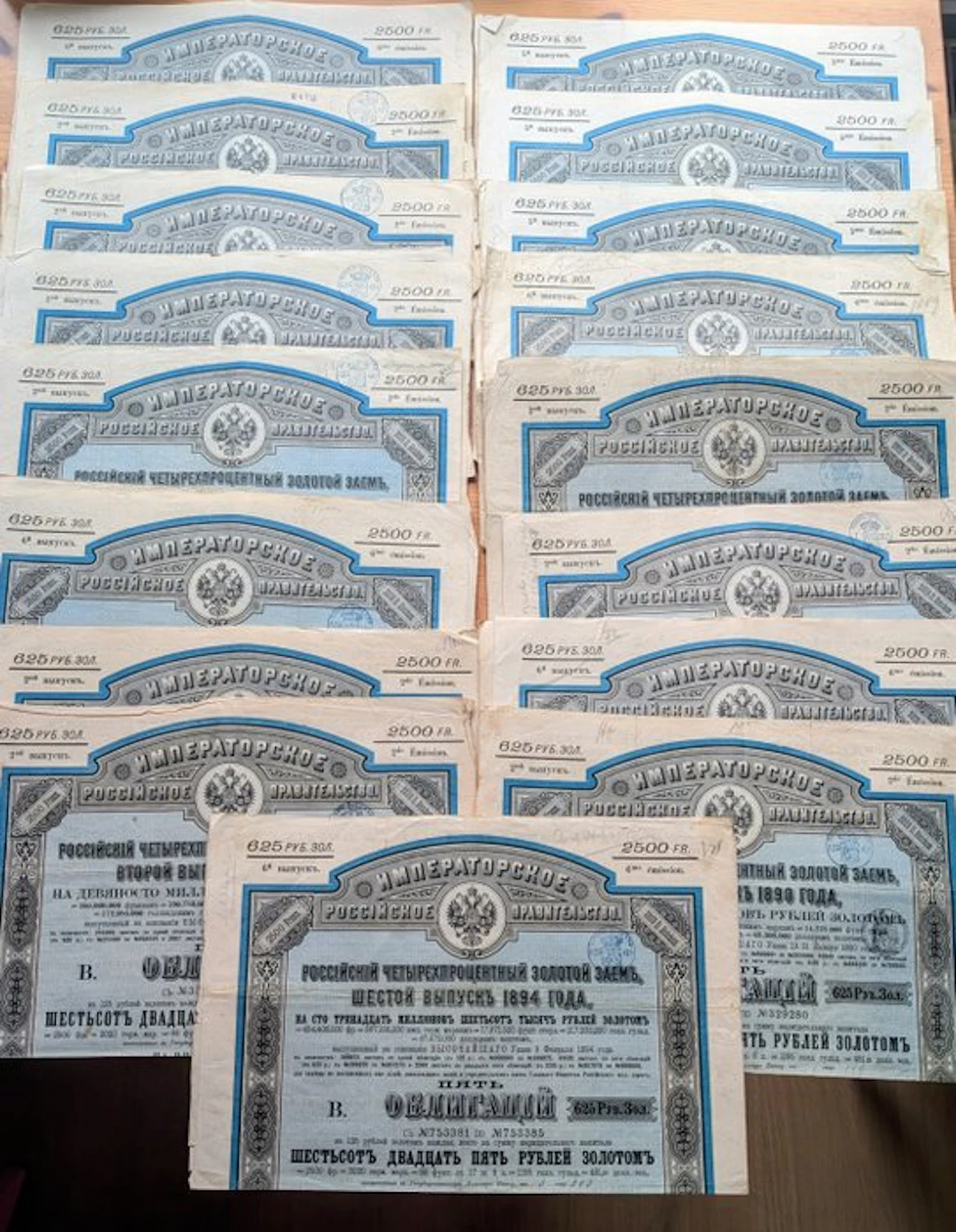
Seventeen large bearer certificates of the Imperial Russian Government’s 4% Gold Loan — the famous “emprunts russes” that half of Europe bought, and that nobody ever got paid back for. What they are Each certificate represents five obligations of 125 gold roubles, so 625 gold roubles in total, printed in five currencies on the same sheet: 2,500 French francs, 2,020 Reichsmarks, £98 17s 6d, 1,195 Dutch guilders and $481.25 in US gold dollars. That multi-currency header is the whole point of these loans: Finance Minister Vyshnegradsky (and later Sergei Witte) was borrowing Western money to build Russian railways and to put the rouble on the gold standard, and the paper was deliberately made tradeable in Paris, Berlin, London, Amsterdam and New York on equal terms. The list of paying agents on the front reads like a who’s who of 1890s banking: Banque de Paris et des Pays-Bas, Crédit Lyonnais, Mendelssohn & Co, Baring Brothers, Hope & Co, Kidder Peabody. The lot contains: 9 × Russian 4% Gold Loan, 2nd issue 1890 (90 million gold roubles, ukase of 19/31 January 1890) 3 × Russian 4% Gold Loan, 5th issue 1893 (44.5 million gold roubles, ukase of 9/21 August 1893) 5 × Russian 4% Gold Loan, 6th issue 1894 (113.6 million gold roubles, ukase of 9/21 February 1894 — issued specifically to buy out the shareholders of the Grande Société des Chemins de Fer Russes when the state nationalised the network) Blue-and-black steel-engraved border with the imperial double-headed eagle; Russian text on the front, French, German and English on the reverse; facsimile signatures of the Director of the State Commission for the Redemption of Debts and the Accountant. These are the “B” series (625 roubles); the loans were also issued as single bonds of 125 roubles and in 3,125-rouble pieces. Why this lot is more interesting than a pile of bonds Fifteen of the seventeen still carry their renewal talon and the remaining coupon sheet, and the coupons tell the story on their own. On every certificate the clipping stops at the same point: the 1890 bonds are clipped up to coupon 110 (September 1917), the 1893/1894 bonds up to coupon 95–96 (October 1917 / January 1918). Everything after that is still attached. In other words, the original owner walked into the bank and collected his quarterly interest right up until the Bolsheviks repudiated all Tsarist debt in February 1918 — and then there was nothing left to clip. The uncashed coupons from 1918 to 1923/24 are, quite literally, the paper trail of the largest sovereign default in history. The lot has a clear Dutch provenance. Most pieces carry the blue “Noord-Holland 1.25 Gl” stamp-duty impression applied when foreign securities were admitted to trading in the Netherlands, and several have handwritten page references to the Russian State Debt Book (Государственная Долговая Книга) in the margin. The three 1893 certificates each have the complete coupon sheet (nos. 97–120); three of the 1894 certificates likewise (nos. 96–120). A full inventory of serial numbers is given below. Serial numbers (5 consecutive bonds each): 2nd issue 1890: 278816–820, 297996–298000, 308841–845, 329276–280, 332386–390, 422716–720, 475871–875, 535391–395, 552766–770 5th issue 1893: 203686–690, 207311–315, 261896–900 6th issue 1894: 637271–275, 645656–660, 649786–790, 753381–385, 754816–820 Legal tender / financial value: none. These are bonds, not banknotes, and the debt was repudiated by Soviet decree on 3 February 1918; the 1996–97 Franco-Russian settlement closed the matter for French holders and nothing was ever paid to Dutch holders. Sold strictly as historical collector’s items (scripophily). Mintage / print run: not applicable (securities). For reference: 82,649 five-bond certificates were issued in the 2nd issue, 24,492 in the 5th and 91,420 in the 6th. Condition and damage: all pieces have been folded (one or two horizontal folds, some with a vertical fold) and show handling wear consistent with 30 years of quarterly visits to the bank. Several have small edge tears, nicks and old pencil or ink annotations in the margins; light foxing here and there. Specific damage: the 1893 certificate nos. 207311–315 has staining and a small chip out of the top edge; the 1894 certificate nos. 649786–790 has a tear along the centre fold and at the top edge; on a few 1890 pieces some of the remaining coupons are loose rather than attached. Two certificates (nos. 332386–390 and 753381–385) are without coupon sheet. Overall good, honest, uncleaned condition. See photos for a good impression; they form part of the description.
Estimate:£1.69
To the auctionView all items fromCatawikiorToys & Collectables
Estimate:
£1.69
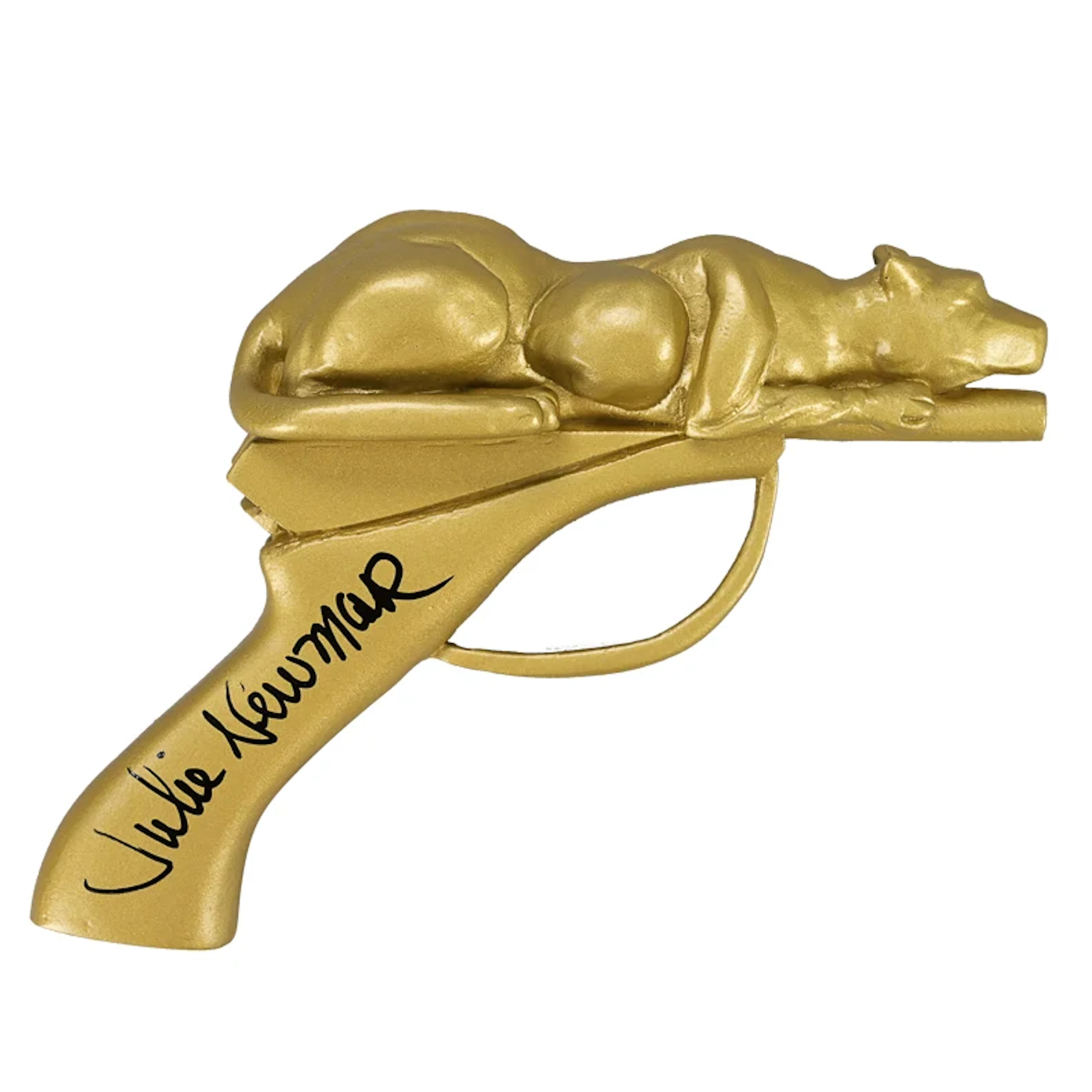
Julie Newmar Autographed 1966 Batman Series Catwoman Catgun
£1,128.1


OCT 23 | 8:00 AM


OCT 27 | 4:00 PM
Bring your auction to collectors worldwide!
Get listed nowBy subscribing, you are agreeing to the privacy policy. Unsubscribe anytime.
Barnebys HQ
Brahegatan 10
BOX 5038
114 37 Stockholm
