


OCT 17 | 10:00 PM

All auctions / Ethnographical / Shattuckite 925 Silver Pendant - Height: 5 cm - Width: 3.5 cm- 33 g - (1)

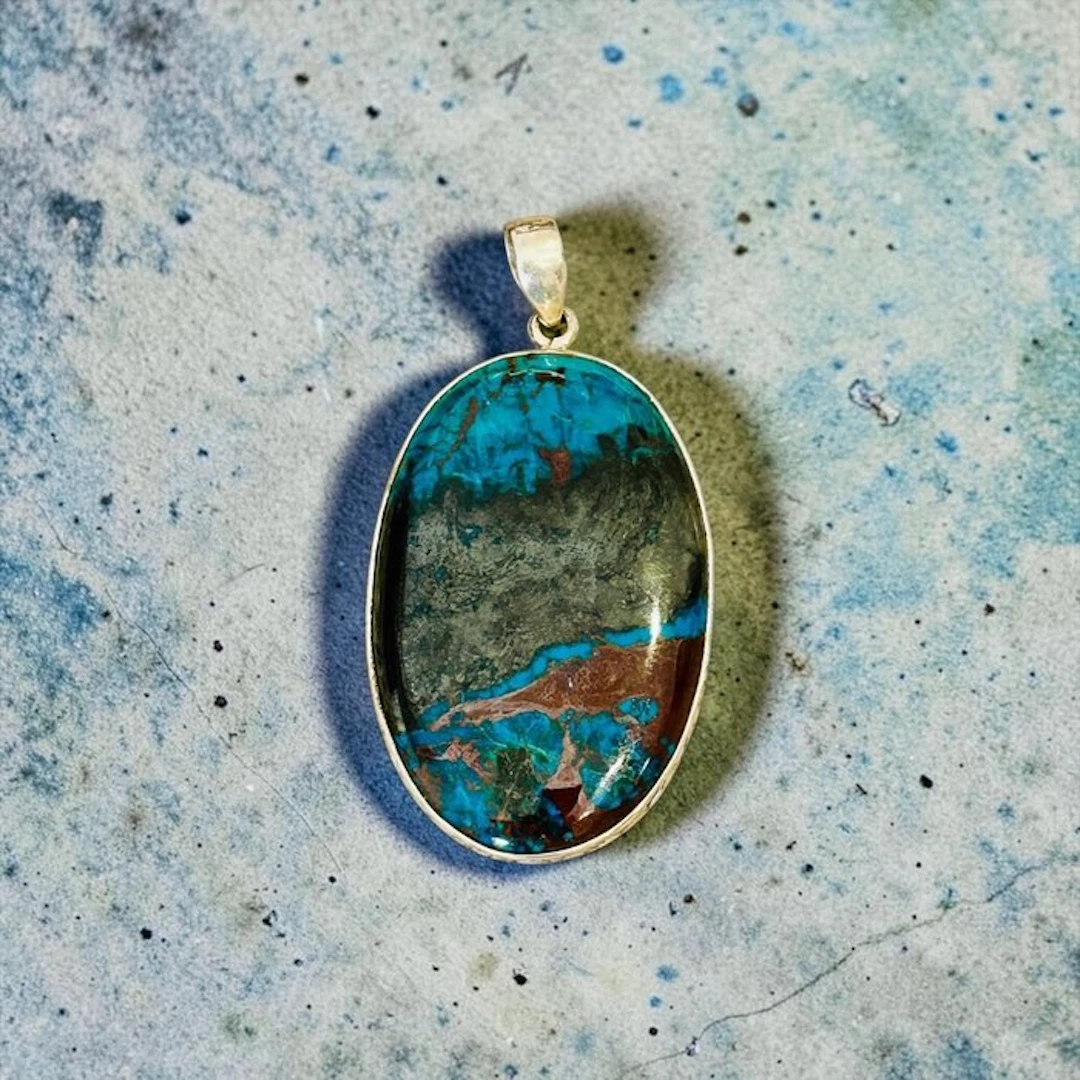
1. Shattuckite Mineral Shattuckite natural (Shattuckite), an uncommon copper mineral, presented in a spectacular XL oval cabochon. It stands out for the combination of intense turquoise blue, deep blue, dark matrix, and large reddish-brown zones. The pattern is completely irregular and makes every specimen a unique piece. 2. Chemical formula Cu₅(SiO₃)₄(OH)₂ Shattuckite is a copper hydroxyl silicate. Copper is responsible for its blue and blue-green hues. 3. Mineralogical classification Crystal system: orthorhombic. Hardness: approximately 3.5 on the Mohs scale. Color: blue, intense blue, turquoise and blue-green. Luster: vitreous to silky depending on its formation. It is considerably less common in jewelry than quartz, agate, amethyst, or lapis lazuli. 4. History and origin of the name Shattuckite was identified in the early 20th century and owes its name to the Shattuck Mine in Bisbee, Arizona, a historic American copper mine. Subsequently, deposits were found in other parts of the world, but it remains a relatively little-known mineral to the general public. 5. Size XL We are looking at a large cabochon, with a presence far greater than usual in commercial jewelry. The XL format also has a mineralogical advantage: it allows observing a much larger surface of the rock and clearly appreciating its different phases, colors, veins, and matrix. 6. A stone that looks like a landscape This piece has an especially interesting pattern. The upper part develops intense turquoise blues; the center is dominated by a large dark area with a metallic-earthy appearance, and the lower part again combines blue, green, and reddish-brown matrix. Seen as a whole, it resembles an almost abstract mineral landscape. This is not added artwork: it is the result of natural geological processes. 7. Gemological curiosities Shattuckite normally forms in the oxidation zones of copper deposits, where it can coexist with other secondary copper minerals. Therefore some specimens exhibit extraordinarily complex compositions. In a large cabochon, the lapidary’s job is precisely to find within the rock the cut that best shows that natural composition. 8. Cabochon and polishing The stone has been worked into an oval cabochon, without facets. This type of cut is especially suitable for opaque minerals because it does not aim to produce flashes like a transparent gem. Its function is to reveal color, the veins, the matrix, and the internal pattern. Polishing provides visual depth to the blue. 9. 925 silver setting The mineral is completely surrounded by a 925 sterling silver mounting. The 925 contrast is visible on the handle and is photographically documented. The silver has been analyzed by XRF (X-ray fluorescence). 10. A mounting with presence A thin metal sheet to hold the stone was not simply used. The cabochon is surrounded by a complete and visible silver frame, which adds presence to the whole and protects the perimeter of the mineral. In an XL piece, the proportion between mineral and mounting is especially important. 11. Authenticity The visible structure shows irregular changes in color, matrix, small veins, and natural transitions between the different mineral zones. These irregularities are precisely part of the appeal of a natural stone: two cabochons never reproduce exactly the same pattern. Macro photographs allow detailed examination of the surface and are an essential part of the description. 12. Counterfeits, treatments, and imitations This section is especially important. Blue minerals are among the most imitated and manipulated materials on the market due to their commercial appeal. They may include dyed stones, stabilized materials, colored resins, reconstructed minerals, compounds, and other stones sold under incorrect denominations. In copper minerals it is also common for different species with a similar appearance to be marketed indistinguishably. Therefore responsible identification must consider color, matrix, structure, mineral associations, and material behavior, avoiding reliance solely on an attractive blue. 13. Rarity and collector value Shattuckite does not belong to the group of minerals that repeatedly appear in commercial jewelry. Its interest increases when it combines three features: good blue development, attractive matrix, and substantial size. This piece also adds a full 925 silver mounting, making it appealing to both jewelry enthusiasts and mineral collectors. 14. Tribute to those who make each piece possible Behind a finished mineral there is far more work than we usually see. This piece is also intended as a small tribute to the miners who extract the rock, workers who select the material, cutters, lapidaries, polishers, and silver artisans. From the deposit to the finished cabochon, knowledge, manual effort, and crafts passed down through generations are involved. Nature creates the mineral over millions of years; human work allows discovering it, selecting it, and turning it into a piece we can preserve. 15. Conservation and care Shattuckite is significantly more delicate than minerals like quartz. It should be protected from knocks, drops, abrasives, chemicals, and sudden temperature changes. Ultrasonic cleaning is not recommended. Gently clean with a soft cloth and store separate from harder stones that could scratch it. Tips Because of its XL size, we recommend using a chain or cord of appropriate strength. It is a piece designed to stand out: it works particularly well as a central pendant on neutral colors, where the natural blue achieves maximum presence. Seller profile Engineer, MBA and Master in Marketing, with more than 40 years of international business and commercial experience. Each piece is individually selected applying criteria of authenticity, mineralogy, aesthetics, jewelry construction, and market value. Special attention is paid to less common minerals, specimens with personality, and silver settings that add real value to the whole. Our objective is not to offer merely decorative jewelry, but a piece that combines nature, knowledge, human work, and geological history. Authenticity, discernment, and real value. It is not just buying, it is knowing how to choose.
Estimate:£126.92
To the auctionView all items fromCatawikiorEthnographical
Estimate:
£126.92
OCT 17 | 10:00 PM


Bring your auction to collectors worldwide!
Get listed nowBy subscribing, you are agreeing to the privacy policy. Unsubscribe anytime.
Barnebys HQ
Brahegatan 10
BOX 5038
114 37 Stockholm
