


OCT 8 | 3:00 PM

Bring your auction to collectors worldwide!
Get listed nowBy subscribing, you are agreeing to the privacy policy. Unsubscribe anytime.
Barnebys HQ
Brahegatan 10
BOX 5038
114 37 Stockholm
All auctions / Arts & Graphics / SIMEON SOLOMON (BRITISH 1840-1905), SOMNUS; AMOR, VOLUPTAS; AND MORS
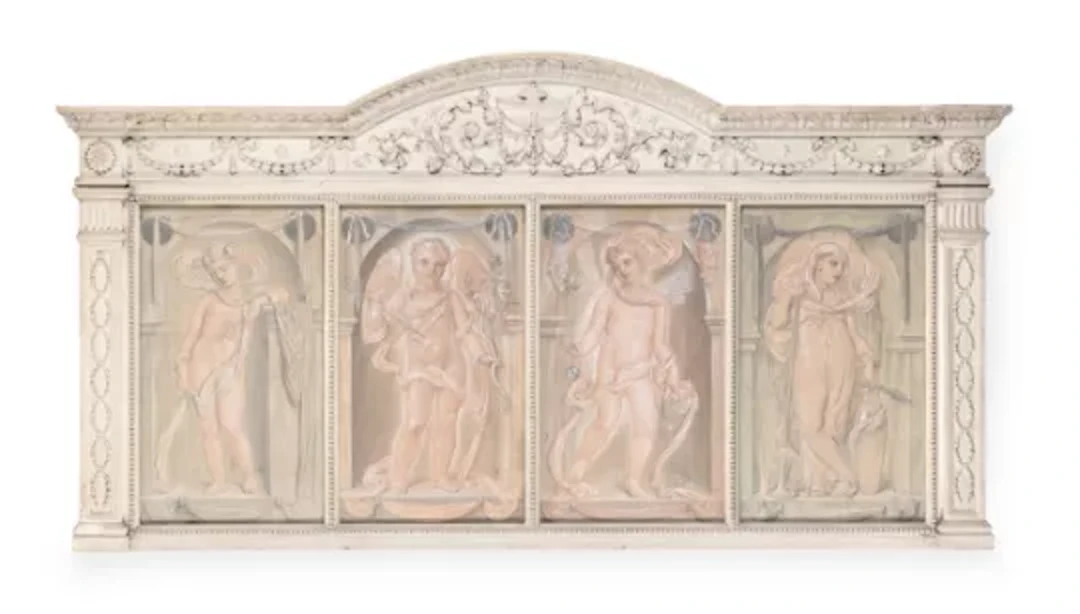
SIMEON SOLOMON (BRITISH 1840-1905) SOMNUS; AMOR, VOLUPTAS; AND MORS Coloured chalks over pencil, four sheets framed as one Each inscribed with their titles (to the lower draperies) Overall 74 x 152.5cm (29 x 60in.), each individually 51 x 29.5cm (20 x 11½in.) In the original frame Provenance: Mrs Abrahams and by bequest to the mother of the present owner. Simeon Solomon was the last of eight children born into an affluent, artistically inclined middle-class Jewish family. His father was a prosperous hat importer, his mother Kate Levy Solomon an amateur artist who painted miniatures. Other members of the family were professional artists, his brother Abraham (1823-1862) was famous for social commentary genre scenes) and his sister Rebecca (1832-1886) a successful female artist who exhibited frequently. After initial study at Cary’s Art School, Solomon entered the Royal Academy Schools in 1856, exhibiting there for the first time in 1858. By 1859 Solomon had met Dante Gabriel Rossetti (1828-1882) and Edward Burne-Jones (1833-1898) and formed close ties with the Pre-Raphaelites and by extension others in their circle such as the writer Algernon Swinburne (1837-1909), the essayist and art critic Walter Pater (1839-1894) and historian and educationalist Oscar Browning (1837-1923), with whom he travelled to Rome in 1867. These men were noted aesthetes and through their influence Solomon was received into likeminded ascetic and homosexual circles. In 1871 Solomon penned his own prose poem – A Vision of Love Revealed in Sleep, privately printed with a dedication to Burne-Jones. In this dreamlike narrative the artist engages in sporadic conversations with his Soul and encounters personified emotions including Love, Hope and Despair of which he made allegorical drawings. The defining moment in Solomon’s personal and professional life occurred in February of 1873, Solomon was arrested in a public lavatory in London with a stable hand called George Roberts and charged with indecent exposure and ‘attempting to commit sodomy’. He was found guilty, fined £100 and sentenced to six weeks in the Clerkenwell House of Correction: his public reputation was ruined, and it resulted in a downwards spiral of his professional and personal life. After 1872 we see a stylistic change in his work, painting mainly heads, sometimes a single head or the compositional device of placing two heads on either side of the pictorial plane, a format which offered considerable compositional and thematic possibilities. His subject matter was often allegorical depictions of abstract concepts or personifications of emotions, the themes explored in Solomon’s 1871 poem, alongside drawings of Night, Sleep, Death, which often reflected his inner turmoil and personal thoughts on elicit love. Following his public shaming Solomon found difficulty selling his work. He continued to exhibited in provincial galleries such as Liverpool, Manchester, and Birmingham and occasionally in London and there were periods of chronic poverty, alcoholism and in and out of St. Giles Workhouse in London. Solomon became increasing dependent on alcohol and died in the workhouse on 14 August 1905, aged 65. The present set of four drawings date from circa 1880 and the cherubic putti are the embodiment of some of his favourite motifs, Sleep, Love, Desire and Death. Stylistically the drawings are similar to the unpublished illustrations Solomon executed for the nursery rhyme, 1, 2, Buckle My Shoe, (Princeton University Library's children's book collection). Although treated by society as an outcast Solomon was though still supported by family and some friends, and the present work may be an example of this having descended through the Abraham family, who were relatives of the Solomons. The four putti each embody a fundamental facet of the human condition: Desire, Sleep, Death, and Pleasure and Solomon has bestowed them with classical attributes. Amor (Desire) grips a bow intertwined with myrtle, a plant sacred to his mother Venus, the arrow is pointed toward his own midsection, symbolizing the profound, self-inflicted vulnerability of desire. Somnus (Sleep) is distinguished by two large wings sprouting from his brow which differentiates him from Cupid and symbolizes how sleep silently sweeps down upon the human mind. Across his chest, he holds a stalk of poppies evoking dreams, sedation, and the narcotic ease of slumber. Mors (Death) is personified as a solemn, draped, angelic putti. This treatment mirrors the ancient concept of Death as the twin brother of Sleep. He holds a downward-pointing trumpet toward the earth, representing the final summons. To his side, a shrouded funerary amphora stands which signifies mortality and the physical remains left behind, the hand placed over the vase holds a dried sprig, serving as a poignant reminder of the short span of human life and the withered nature of the flesh. Voluptas (Pleasure) carries a basket overflowing with flowers and roses, representing the flowering of passion. The floating, transparent sphere or bubble is a vanitas motif, this fragile orb serves as a visual warning that sensory gratification and earthly delights are inherently insubstantial, destined to vanish in an instant. Condition Report Disclaimer, SIMEON SOLOMON (BRITISH 1840-1905), SOMNUS; AMOR, VOLUPTAS; AND MORS, SIMEON SOLOMON (BRITISH 1840-1905) SOMNUS; AMOR, VOLUPTAS; AND MORS Coloured chalks over pencil, four sheets framed as one Each inscribed with their titles (to the lower draperies) Overall 74 x 152.5cm (29 x 60in.), each individually 51 x 29.5cm (20 x 11½in.) In the original frame Provenance: Mrs Abrahams and by bequest to the mother of the present owner. Simeon Solomon was the last of eight children born into an affluent, artistically inclined middle-class Jewish family. His father was a prosperous hat importer, his mother Kate Levy Solomon an amateur artist who painted miniatures. Other members of the family were professional artists, his brother Abraham (1823-1862) was famous for social commentary genre scenes) and his sister Rebecca (1832-1886) a successful female artist who exhibited frequently. After initial study at Cary’s Art School, Solomon entered the Royal Academy Schools in 1856, exhibiting there for the first time in 1858. By 1859 Solomon had met Dante Gabriel Rossetti (1828-1882) and Edward Burne-Jones (1833-1898) and formed close ties with the Pre-Raphaelites and by extension others in their circle such as the writer Algernon Swinburne (1837-1909), the essayist and art critic Walter Pater (1839-1894) and historian and educationalist Oscar Browning (1837-1923), with whom he travelled to Rome in 1867. These men were noted aesthetes and through their influence Solomon was received into likeminded ascetic and homosexual circles. In 1871 Solomon penned his own prose poem – A Vision of Love Revealed in Sleep, privately printed with a dedication to Burne-Jones. In this dreamlike narrative the artist engages in sporadic conversations with his Soul and encounters personified emotions including Love, Hope and Despair of which he made allegorical drawings. The defining moment in Solomon’s personal and professional life occurred in February of 1873, Solomon was arrested in a public lavatory in London with a stable hand called George Roberts and charged with indecent exposure and ‘attempting to commit sodomy’. He was found guilty, fined £100 and sentenced to six weeks in the Clerkenwell House of Correction: his public reputation was ruined, and it resulted in a downwards spiral of his professional and personal life. After 1872 we see a stylistic change in his work, painting mainly heads, sometimes a single head or the compositional device of placing two heads on either side of the pictorial plane, a format which offered considerable compositional and thematic possibilities. His subject matter was often allegorical depictions of abstract concepts or personifications of emotions, the themes explored in Solomon’s 1871 poem, alongside drawings of Night, Sleep, Death, which often reflected his inner turmoil and personal thoughts on elicit love. Following his public shaming Solomon found difficulty selling his work. He continued to exhibited in provincial galleries such as Liverpool, Manchester, and Birmingham and occasionally in London and there were periods of chronic poverty, alcoholism and in and out of St. Giles Workhouse in London. Solomon became increasing dependent on alcohol and died in the workhouse on 14 August 1905, aged 65. The present set of four drawings date from circa 1880 and the cherubic putti are the embodiment of some of his favourite motifs, Sleep, Love, Desire and Death. Stylistically the drawings are similar to the unpublished illustrations Solomon executed for the nursery rhyme, 1, 2, Buckle My Shoe, (Princeton University Library's children's book collection). Although treated by society as an outcast Solomon was though still supported by family and some friends, and the present work may be an example of this having descended through the Abraham family, who were relatives of the Solomons. The four putti each embody a fundamental facet of the human condition: Desire, Sleep, Death, and Pleasure and Solomon has bestowed them with classical attributes. Amor (Desire) grips a bow intertwined with myrtle, a plant sacred to his mother Venus, the arrow is pointed toward his own midsection, symbolizing the profound, self-inflicted vulnerability of desire. Somnus (Sleep) is distinguished by two large wings sprouting from his brow which differentiates him from Cupid and symbolizes how sleep silently sweeps down upon the human mind. Across his chest, he holds a stalk of poppies evoking dreams, sedation, and the narcotic ease of slumber. Mors (Death) is personified as a solemn, draped, angelic putti. This treatment mirrors the ancient concept of Death as the twin brother of Sleep. He holds a downward-pointing trumpet toward the earth, representing the final summons. To his side, a shrouded funerary amphora stands which signifies mortality and the physical remains left behind, the hand placed over the vase holds a dried sprig, serving as a poignant reminder of the short span of human life and the withered nature of the flesh. Voluptas (Pleasure) carries a basket overflowing with flowers and roses, representing the flowering of passion. The floating, transparent sphere or bubble is a vanitas motif, this fragile orb serves as a visual warning that sensory gratification and earthly delights are inherently insubstantial, destined to vanish in an instant. Provenance:, A Vision of Love Revealed in Sleep, 1, 2, Buckle My Shoe, vanitas, Condition Report Disclaimer
Estimate:£30,000
To the auctionView all items fromDreweattsorArts & Graphics
Estimate:
£30,000
OCT 8 | 3:00 PM


OCT 8 | 3:00 PM
Bring your auction to collectors worldwide!
Get listed now
£2,000

OCT 17 | 10:00 PM