




All auctions / Jewellery & Gems / Six 19th C. African & Native American Trade Bead Necklaces - Glass

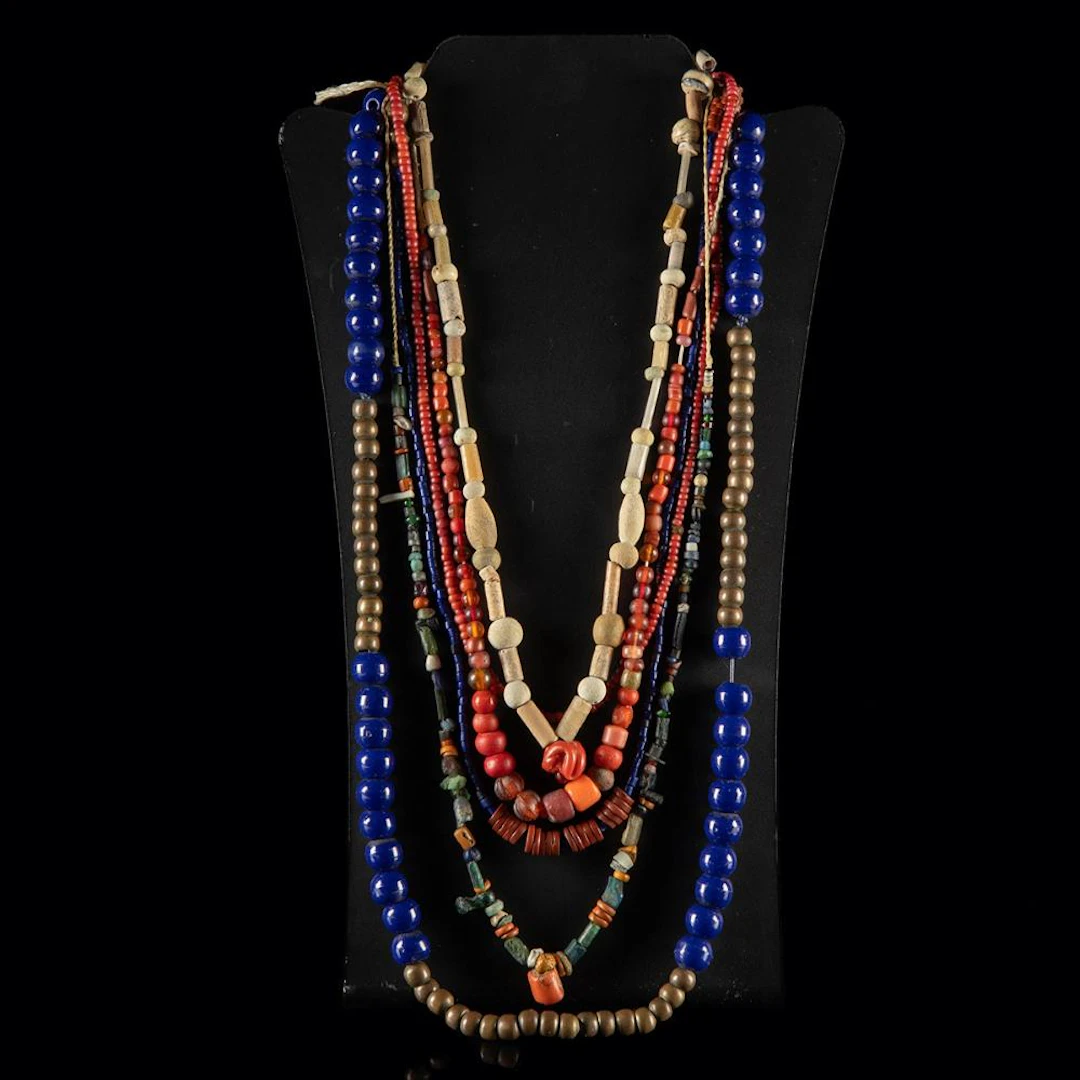
Africa and North America, Indigenous tribes. A group of six strands assembled from the polyglot currency of the bead trade: heavy cobalt glass rounds of Padre type, long files of salmon and brick seed beads, small olive-toned brass spheres, tubular and disc beads of pale stone, and scattered accents of green, turquoise, amber, and white glass. One strand carries red white-heart pony beads punctuated by a single cobalt bead, strung on light brown handspun wool of Germantown type and said to have been acquired from a Pomo maker. European glass, chiefly Venetian, Bohemian, and Dutch, circulates here alongside worked stone and cast brass spacers. Such strands served at once as adornment, portable wealth, and medium of exchange, their worth reckoned by bead type, color, and length rather than weight. Restringing is the norm in this material; these read as working jewelry. Glass beads became one of the defining commodities of Atlantic and trans-Saharan commerce from the 16th century onward. Venetian furnaces at Murano, later joined by Bohemian and Dutch competitors, produced beads to order for specific markets, shipping millions annually against gold, ivory, palm oil, textiles, and, notoriously, enslaved people. Regional preferences were exacting: a color or form desirable on the Niger might be worthless on the Gold Coast, and traders carried sample cards to avoid ruinous mismatches. The large opaque cobalt beads belong to the family collectors call "Padre" or "Pony" beads, wound or drawn glass produced in enormous quantities through the 19th century and traded from West Africa to the American Plains and the Pacific Northwest. White hearts, drawn tubes of translucent red glass over an opaque white core, were prized in North America precisely because the underlying white layer made the red burn brighter; they dominate Plains, Great Basin, and California beadwork of the middle and later 19th century. Among the Pomo of the Clear Lake and Russian River drainages, whose own bead economy in clamshell disc and magnesite cylinders set the standard of value in central California, imported glass entered that same reckoning and was strung, worn, and exchanged by the established measure of length. The coral-toned strands imitate Mediterranean red coral, itself a prestige import into the Sahel, while stone and brass elements were commonly added by local stringers to lengthen and dignify a strand. Germantown yarn, commercially spun and aniline-dyed wool shipped west from Pennsylvania mills after about 1865, entered Southwestern, Plains, and Californian material culture as weaving and stringing fiber alike. This item may fall under the Safeguard Tribal Objects of Patrimony (STOP) Act or other federal laws protecting Native American, Alaska Native, or Native Hawaiian cultural heritage. As such, it is not eligible for international shipping, and may also be subject to repatriation or tribal consultation within the United States. Buyers are responsible for ensuring their legal right to acquire, possess, or transfer this item under all applicable laws. This lot cannot be shipped outside the United States. Item # 195261
Estimate:£186.88
To the auctionView all items fromArtemis Fine ArtsorJewellery & Gems
Estimate:
£186.88


OCT 27 | 4:00 PM
Bring your auction to collectors worldwide!
Get listed nowBy subscribing, you are agreeing to the privacy policy. Unsubscribe anytime.
Barnebys HQ
Brahegatan 10
BOX 5038
114 37 Stockholm
