
Bring your auction to collectors worldwide!
Get listed nowBy subscribing, you are agreeing to the privacy policy. Unsubscribe anytime.
Barnebys HQ
Brahegatan 10
BOX 5038
114 37 Stockholm
All auctions / Jewellery & Gems / Spectacular Gold Necklace in the Archaeological Style With Carnelian

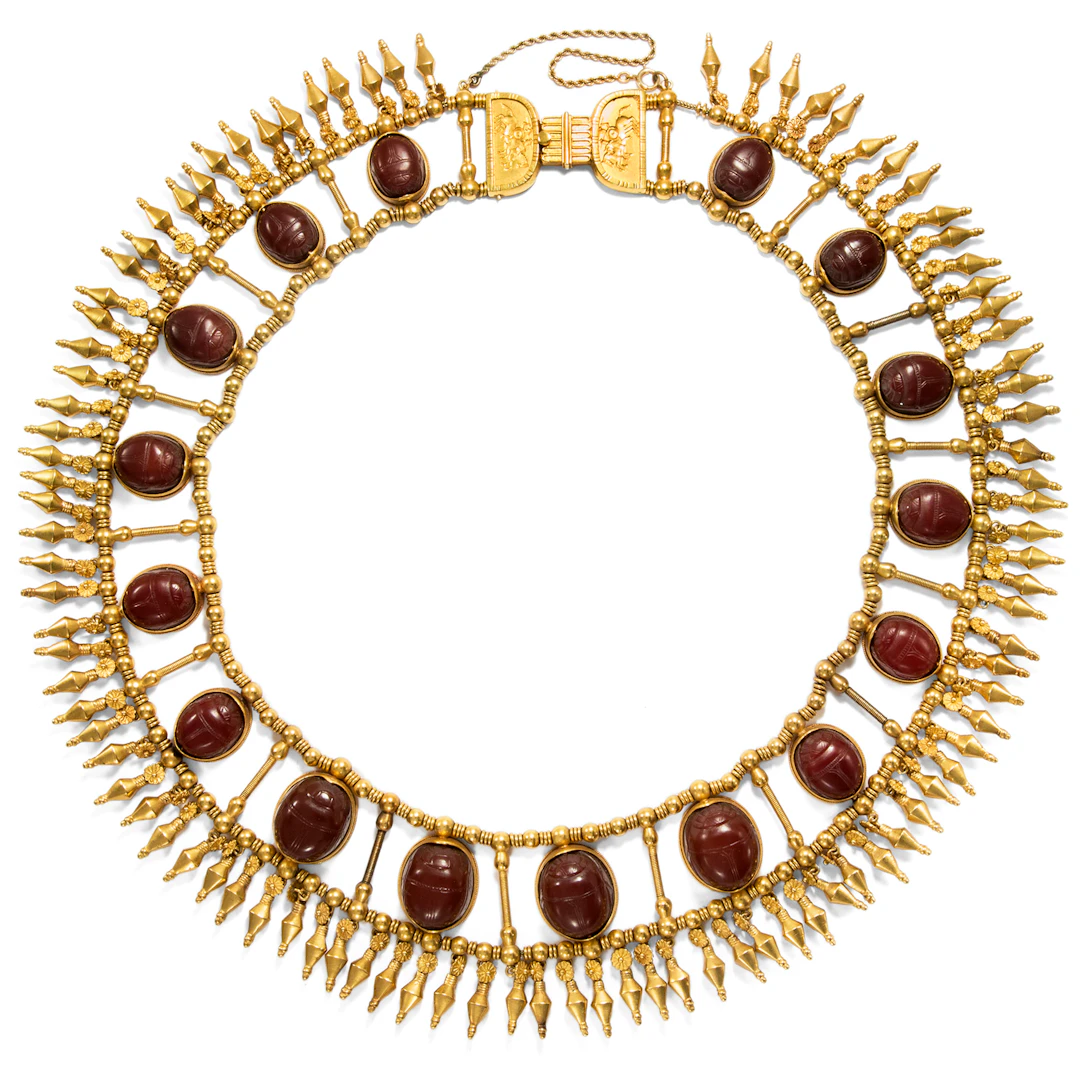
Guardian of life, emblematic creature of the sun, embodiment of the sun god: the ancient Egyptians paid almost boundless veneration to the scarab. This devotion went so far that almost every Egyptian wore a small scarab, carved from stone or clay, as a lucky amulet around the neck. The present necklace brings this ancient belief into the modern age in spectacular form. The elaborate and detailed craftsmanship in high-carat gold presents no fewer than sixteen carnelian scarabs. Each individual beetle sculpture is set in gold and strung between two chains of golden spheres. Fine golden struts separate the beetles from one another, lending the design a rhythmic rigour. Countless tiny amphorae of gold, each adorned with a golden blossom, are attached as further embellishment. On the clasp we see finely engraved horsemen with spears. The reverse of the piece is equally surprising. Each scarab, created at the same time as the necklace itself, is engraved on the back as well, depicting warriors, athletes, heroes and animals in the style of Graeco-Roman gems. In this way, the necklace, worn close to the neck, protects its wearer in a double sense. Until the beginning of the nineteenth century, the forms of genuinely ancient jewellery were still unknown. Neither in the Renaissance nor in Classicism had excavations brought to light authentic jewellery from antiquity. The designs of those eras were merely approximations of an ideal, reconstructed from other contexts such as architecture or Pompeian wall painting. With the discovery of genuine Etruscan jewellery in Italy from the 1820s onwards, this changed abruptly. Princess Alexandrine of Canino, for instance, was known to take pleasure in wearing some of the original Etruscan pieces unearthed on her estate near Rome — much to the envy of her friends. Yet the number of finds, all of them accidental, remained small, and truly original jewellery thousands of years old could only be owned by a very few ladies. Goldsmiths of the period therefore soon began producing jewels after the now at last identifiable ancient models. Particularly outstanding in this respect were Pio Castellani of Rome and his sons, who created jewellery that from the mid-century onwards became a hallmark known throughout Europe and a genuine fashion. In Germany and Austria, corresponding pieces began to appear from the mid-1860s. The present necklace is a work of the 1870s. Its design does not strictly follow one specific epoch of the past, but blends elements of Egyptian art with references to Roman antiquity into a harmonious whole. The necklace is unsigned. Its formal language and exceptionally high-quality workmanship, however, strongly suggest an origin in the circle of the Castellani in Rome or of their pupils, such as Carlo Giuliano in London. In 1871, for example, Alessandro Castellani exhibited at the International Exhibition in London a parure of carnelian scarabs in gold settings, modelled on Etruscan prototypes from the Campana Collection; comparable works are today preserved in the Museo Nazionale Etrusco di Villa Giulia in Rome.
Estimate:£34,309.34
To the auctionView all items fromHofer AntikschmuckorJewellery & Gems
Estimate:
£34,309.34
Bring your auction to collectors worldwide!
Get listed now