


OCT 17 | 10:00 PM

Bring your auction to collectors worldwide!
Get listed nowBy subscribing, you are agreeing to the privacy policy. Unsubscribe anytime.
Barnebys HQ
Brahegatan 10
BOX 5038
114 37 Stockholm
All auctions / Arts & Graphics / Two 17th C. Engravings by Joachim von Sandrart - Centaur & Satyr

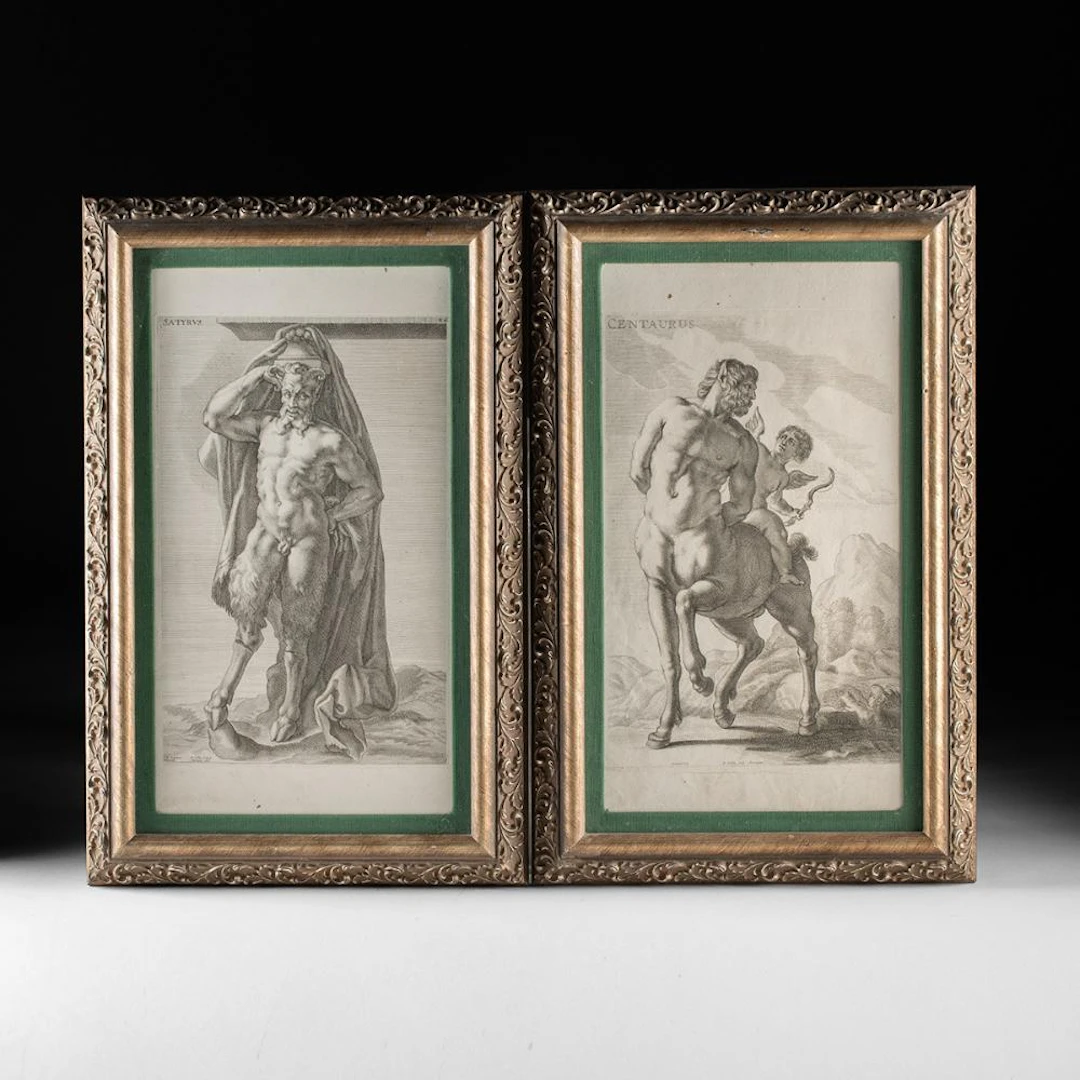
Designed by Joachim von Sandrart (German, 1606-1688). Engraved by Richard Collin (Luxemburg, 1626-1698). "Centaurus" and "Satyrus" engraved plates on laid paper from "Sculpturae Vetris Admiranda..." Nuremberg and Frankfurt, 1680. A pair of copperplate engravings on laid paper, lettered "CENTAVRVS" and "SATYRVS" at the upper left of each plate, presented as book leaves with integral Latin letterpress on the reverse. The centaur strides through a rocky landscape with a winged Eros astride his back, bow in hand, the beast's equine ears and shaggy mane rendered in dense burin hatching. The satyr stands frontally, horned and bearded, goat-legged and cloven-hooved, one arm raised to steady a basket above his head while drapery cascades behind. Both record celebrated marbles for Joachim von Sandrart's compendium of ancient sculpture, drawn by Sandrart and cut by Richard Collin, engraver to the Spanish crown. Each is inscribed below the image with the designer's and engraver's names, the satyr adding "Antverpiae 1676," the year the copper was cut. Both leaves come from Sandrart's "Sculpturae veteris admiranda, sive delineatio vera perfectissimarum eminentissimarumque statuarum" (Nuremberg: Christian Sigismund Froberger for the author; Frankfurt: Michael and Johann Friedrich Endter and Johann von Sandrart, 1680), the first Latin edition, partially translated by Christoph Arnold from the German Teutsche Academie of 1675 to 1679. Seventy plates, chiefly by Collin after Sandrart. The Centaurus is folio 15 (leaf D3, catchword "VE-"), the Satyrus folio 38 (leaf K2, catchword "CE-"), each tied to its text leaf by a letterpress binder's key. The Latin versos are learned essays rather than captions. The Centaurus text opens with Palaephatus, who explained the centaurs away as young Thessalian horsemen who speared wild bulls and were mistaken at a distance for man and horse fused; it then rehearses the mythic genealogy from Ixion and the cloud shaped into Juno's likeness, lists the centaurs the poets favor (Chiron, Eurytus, Amycus, Grynaeus, Rhoetus, Arnaeus, Lycidas, Medon, Pisenor, Caumas, Memnorus, Pholus), cites Diodorus and Antimachus on their defeat by Hercules and expulsion from Pelion, and reads the hybrid as a moral emblem of appetite mastered by temperance. It closes by placing the marble in the garden of Cardinal Scipione Borghese's palace outside the Porta del Popolo, under life size, much restored, with Cupid gripping the beast in one hand and driving him with the bow in the other, the tail and hooves preserving ancient form and the shaggy hair and horse's ears offered as proof of great antiquity. The Satyrus text canvasses whether satyrs were sons of Bacchus or Saturn, quotes Pliny on four-footed satyrs in the Indian mountains and Pausanias on Euphemus and the Satyrides islands, retells the sailors' encounter with lascivious island satyrs, and passes to modern demonology: the exiled woman carried off by a satyr, Plutarch's satyr brought to Sulla, and the black recurved horn preserved in the Swedish royal treasury, wrenched from a devil on horseback by a pious knight on Christmas Eve and left behind with the Latin name Trollus. It ends with the Roman satyr statue in white marble, standing in a garden, a short and solid figure conspicuously muscular. The centaur reproduces the Borghese Centaur ridden by Eros, restored by Nicolas Cordier in 1608 (left arm, tail and legs of the centaur; wings, arms and support of the Eros), sold under duress to Napoleon in 1807 and now in the Musee du Louvre. The satyr very likely follows one of the colossal satyr telamones known as the Satiri della Valle, found near the Theatre of Pompey and long displayed in the Della Valle courtyard, later Albani, and at the Capitoline since the 1730s. Sandrart's figure departs from the marble in three respects: the animal skin across the chest is omitted, the raised arm is on the same side as the advanced leg where the ancient carving reverses that relation, and the swagged drapery is his own invention. Joachim von Sandrart, painter and theorist, wrote the first substantial German history of art. Richard Collin, born in Luxembourg and later working in Brussels, signed himself "Calcographus Regius," engraver to the Spanish crown. Item # 179144
Estimate:£189.18
To the auctionView all items fromArtemis Fine ArtsorArts & Graphics
Estimate:
£189.18
OCT 17 | 10:00 PM


Bring your auction to collectors worldwide!
Get listed now£1,697
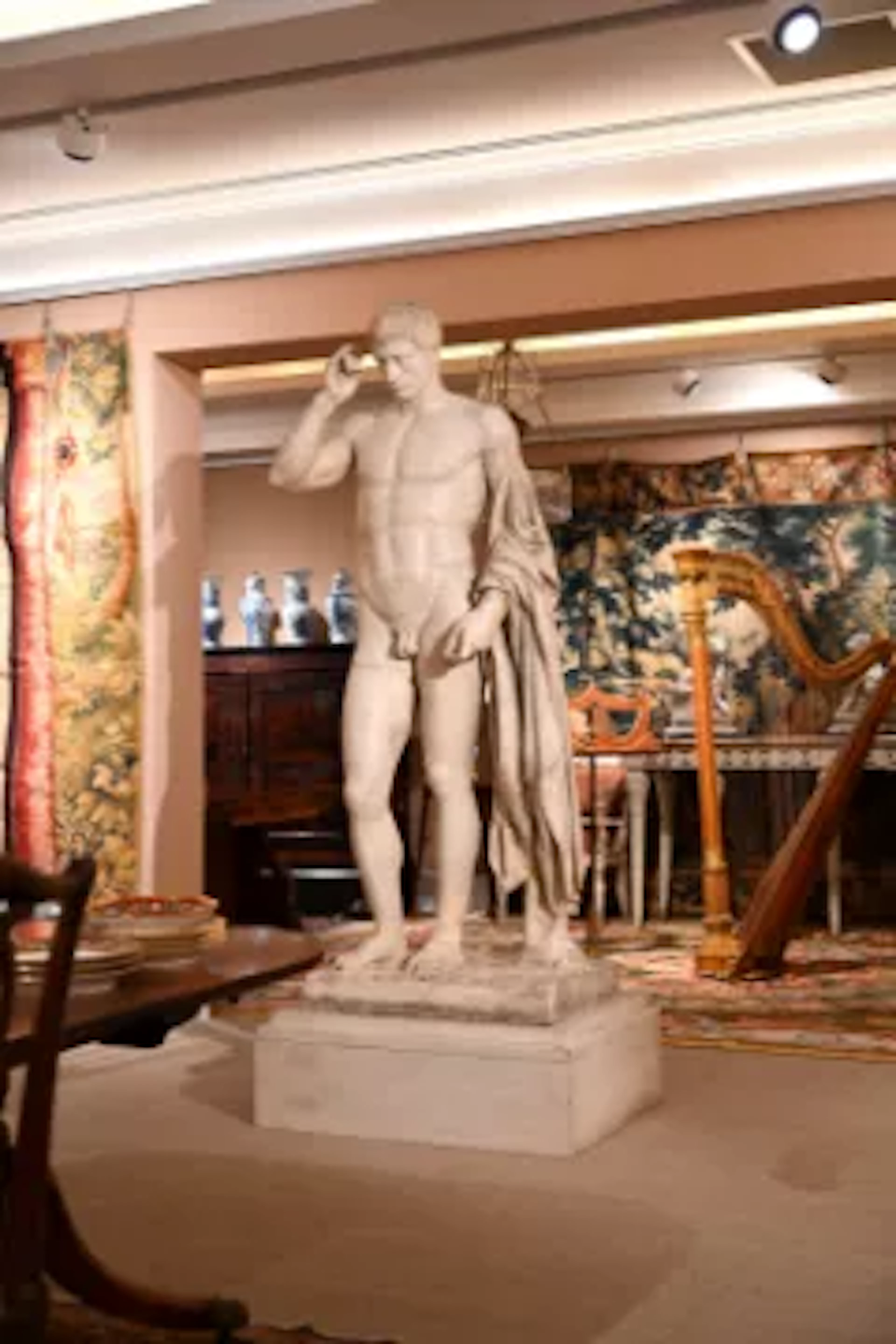
AN IMPRESSIVE LIFE SIZE PLASTER MODEL OF GERMANICUS, OR MARCUS CLAUDIUS
09/09/2026

£12,000
Est: £7,000