


OCT 17 | 10:00 PM

Bring your auction to collectors worldwide!
Get listed nowBy subscribing, you are agreeing to the privacy policy. Unsubscribe anytime.
Barnebys HQ
Brahegatan 10
BOX 5038
114 37 Stockholm
All auctions / Contemporary Art / Vitaly Leshukov Soldatov (1968) - El viento sobre los campos

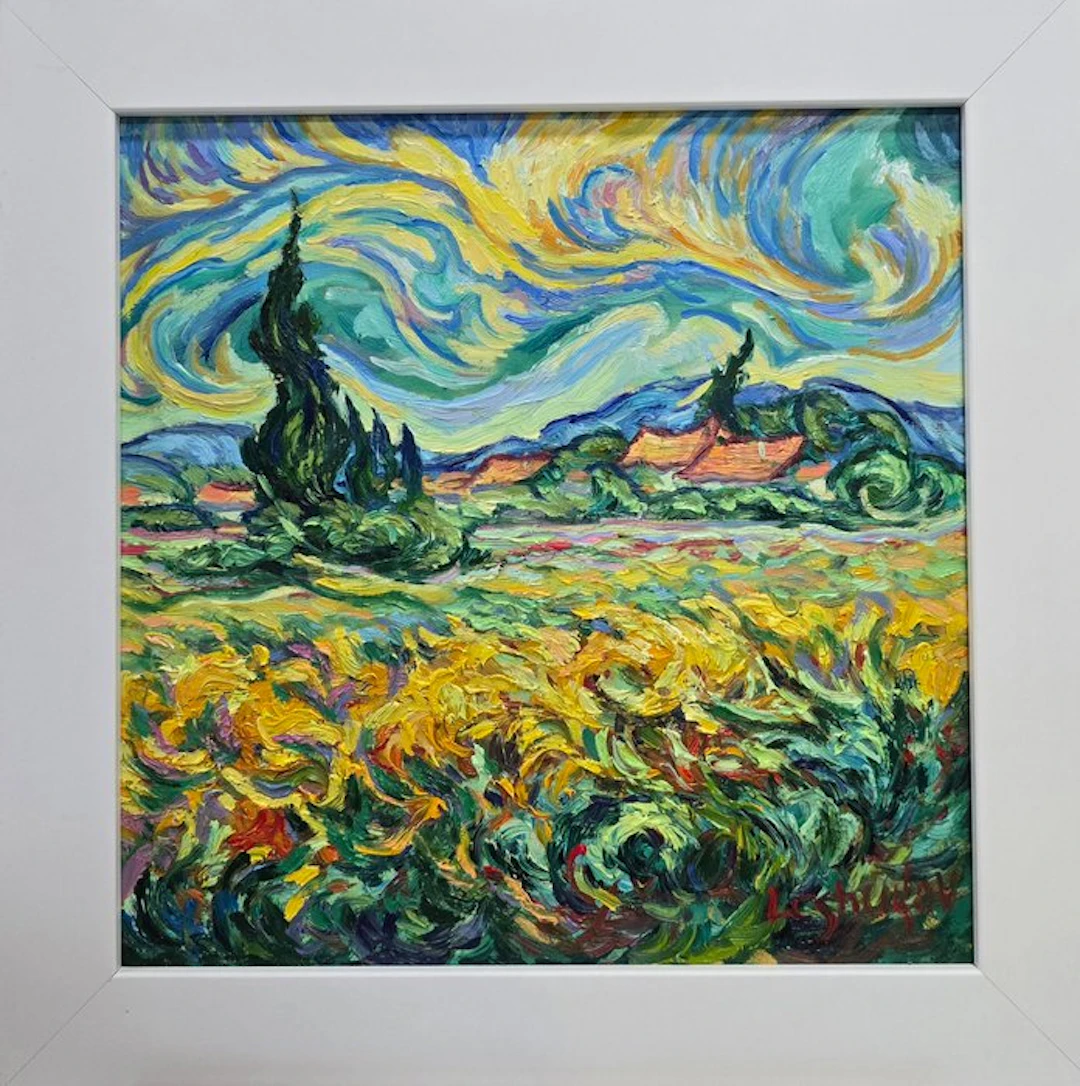
Pictura Galeria presents this magnificent artwork by Vitaly Leshukov, depicting a rural landscape transformed by a vibrant and dynamic sky, where nature becomes an explosion of color, movement, and emotion. The painting stands out for its excellent technique and the high pictorial quality it conveys. · Frame dimensions: 37x37x3 cm. · Artwork dimensions: 30x30 cm. · Oil on panel hand-signed by the artist in the bottom right corner, Leshukov. · The piece is in good conservation condition. · The work is sold with a precious frame (included in the auction as a gift). The work comes from an exclusive private collection in Girona. Important note: the photographs included are an integral part of the lot description. The artwork will be professionally packaged by an IVEX expert (https://www.instagram.com/ivex.online/), using high-quality materials to ensure its protection. The shipping price covers both the cost of professional packaging and the transport itself. Shipping will be carried out by Correos or GLS with tracking. International shipping available. This painting presents a vibrant, highly dynamic rural landscape, where the land, vegetation, mountains, houses, and sky seem to participate in a single energy. The scene extends from a foreground covered with yellow and green fields to a small cluster of dwellings at the foot of some hills. Above all, an extraordinarily dynamic sky opens up, swept by color undulations that turn the landscape into an intense, luminous, and deeply emotional vision. In the lower part unfolds an extensive strip of vegetation that occupies almost half of the composition. This foreground is formed by a wide variety of greens, yellows, ochres, blues, purples, reds, and browns. The colors interlace and form swirls that suggest plants, grasses, wildflowers, and crops moved by the wind. The earth does not appear still, but full of life and constant motion. The yellows dominate much of this lower zone and impart an intense sense of light. Some approach gold, while others take on orange tones or mix with light greens. These luminous areas may recall a mature field under the sun, dry summer grasses, or flowers in bloom in a warm season. Their presence conveys fertility, abundance, and warmth. Among the yellows there are numerous greens that traverse the surface in curved lines and irregular clusters. The tones vary from very dark greens to bluish and turquoise hues. This variety creates depth and allows differentiation between the nearer plants and those farther away. The vegetal shapes seem to grow, twist, and extend over one another. Small red, violet, and blue details emerge among the vegetation like scattered flowers or patches of earth. These color notes break the continuity of greens and yellows, further animate the foreground. Although secondary elements, they help the eye travel to every corner and discover new color combinations. The central field appears somewhat more open and horizontal. In this area, soft greens, pale yellows, pinks, and blues are distributed in bands suggesting agricultural plots, paths, or stretches of grass. This relative visual calm creates a transition between the abundance of the foreground and the structures in the background, allowing the composition to breathe. On the left rises a large dark cypress that becomes one of the main protagonists of the landscape. Its vertical and pointed silhouette contrasts with the horizontal lines of the fields and the undulations of the sky. The tree stands tall from a base surrounded by shrubs and vegetation, reaching nearly to the top of the painting. The cypress is composed of deep greens, blues, blacks, and some yellowish highlights. Its forms seem to twist upward, as if the tree were driven by an invisible current. The darkness of its foliage creates a strong contrast with the bright sky and provides a point of stability within a composition dominated by movement. Next to the large cypress appear other smaller trees that repeat its vertical shape. These silhouettes accompany the main tree and create a sequence that leads the eye toward the center of the landscape. Their diminishing sizes also help convey distance and allow perceiving the depth of the rural space. In the middle ground a small set of houses with reddish-orange roofs is distinguishable. The buildings are partially surrounded and hidden by trees, shrubs, and fields. Their simple forms add a human dimension to the scene and evoke a tranquil life tied to agriculture and the rhythm of nature. The warm roofs contrast with the greens of the surroundings and the blues of the mountains. Some coverings seem to catch direct light, showing golden, pink, and orange tones, while other parts remain in shadow. The houses integrate into the landscape without imposing on it, as if they had grown alongside the vegetation. Toward the right, a cluster of rounded trees surrounds the houses. Their crowns are expressed through green circles and spirals that convey volume and movement. These shapes seem to sway under the same wind that sweeps the fields and the sky. The vegetation creates a natural barrier around the small rural nucleus and reinforces its protected character. Behind the houses rise several hills and mountains with gentle profiles. Their blue, violet, green, and turquoise colors indicate their distance and contrast with the warmth of the terrain. The mountains do not form a rigid line, but a rolling succession that follows the general rhythm of the composition and visually links the earth with the sky. The sky occupies a very important part of the image and has extraordinary energy. Rather than presenting as a uniform surface, it is made up of wide curves, spirals, and currents of blue, yellow, green, white, orange, and violet. These forms suggest wind-swept clouds, air currents, or shifting light that continually transforms the atmosphere. In the upper central area appears a large spiral that immediately draws the eye. Blues, pinks, yellows, and whites rotate around a luminous core, creating the impression of a moving cloud or a celestial force. This swirl adds drama to the sky and seems to concentrate the energy that later extends over the mountains and fields. The yellow bands in the sky introduce an intense sense of luminosity. They could correspond to dawn light, a brilliant sunset, or a moment when the sun remains hidden behind clouds. These yellows mix with blues and greens, creating an atmosphere that does not belong to a specific hour, but to an emotional vision of the landscape. The celestial undulations seem to respond to the shapes of the land. The swirls of the foreground, the curves of the trees, and the mountains find their continuation in the currents of the sky. In this way, no part of the scene remains isolated: all elements appear connected by a single natural impulse. The light does not come from a single point, but seems distributed throughout the composition. It shines on the yellow clouds, the golden fields, the roofs, and certain fragments of vegetation. This distribution creates a radiant landscape and ensures that even the darker areas retain small glints of color. The work conveys a powerful and active nature. The wind seems to pass through the crops, bending the plants, rustling the trees, and transforming the sky. However, this movement does not evoke threat but vitality. The landscape seems to breathe and change before the viewer’s eyes, showing the earth’s enduring strength. The absence of human figures does not make the scene seem uninhabited. The houses, cultivated fields, and paths suggest a nearby presence, though invisible. One can imagine inhabitants sheltered in the dwellings, working among the crops, or traveling the paths that connect the plots. Human life remains discretely integrated into the surroundings. The warm and cool colors are in constant balance. The yellows, oranges, and reds bring light, energy, and closeness, while the blues, greens, and violets introduce depth and freshness. This chromatic coexistence makes the landscape feel intense without losing harmony, turning a rural view into an emotionally rich experience. Overall, the work represents a rural landscape teeming with life, where golden fields, cypresses, houses with reddish roofs, mountains, and the undulating sky seem to move under a single natural force. The composition conveys energy, luminosity, and a connection among all elements of the environment. More than simply showing a place, the painting expresses the emotion of contemplating a living, changing, and powerful nature.
Estimate:£425.1
To the auctionView all items fromCatawikiorContemporary Art
Estimate:
£425.1
OCT 17 | 10:00 PM


Bring your auction to collectors worldwide!
Get listed now£8,477.54