


OCT 8 | 3:00 PM

Bring your auction to collectors worldwide!
Get listed nowBy subscribing, you are agreeing to the privacy policy. Unsubscribe anytime.
Barnebys HQ
Brahegatan 10
BOX 5038
114 37 Stockholm
All auctions / Watches & Clocks / AN INTERESTING OAK AND ELM CASED THIRTY-HOUR LONGCASE CLOCK
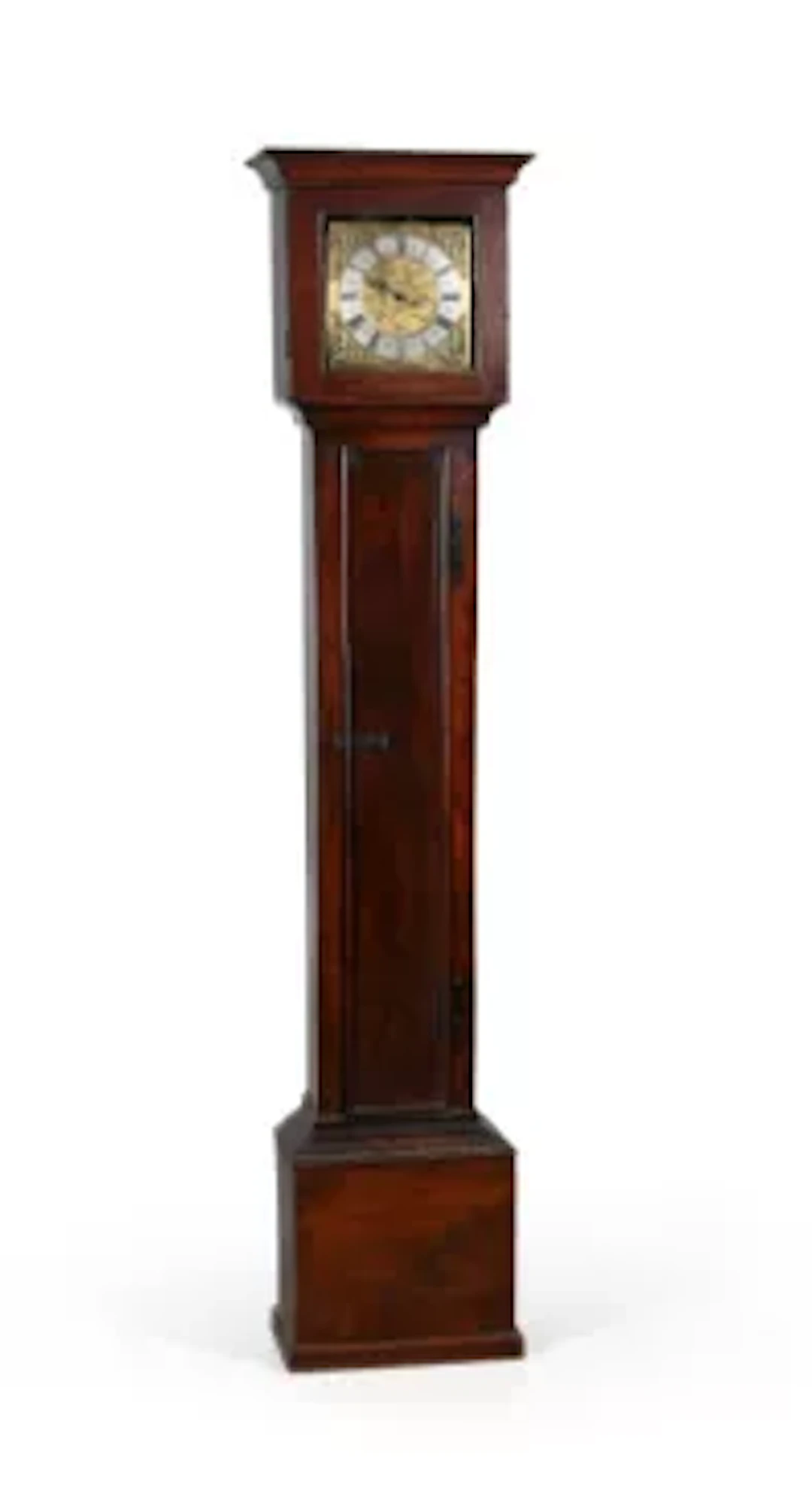
AN INTERESTING OAK AND ELM CASED THIRTY-HOUR LONGCASE CLOCK PROBABLY SOMERSET, CIRCA 1710, REPURPOSING A LANTERN CLOCK MOVEMENT MADE CIRCA 1680 The posted countwheel bell striking movement with Huygens’ endless winding now running on chains, the going train now with anchor escapement regulated by seconds pendulum swinging behind the frame, and the strike train with iron countwheel and overlift via a hoop wheel cut with a single slot, the frame with column-turned corner posts previously fitted with integral cast finials and feet, fitted with a 9.75 inch square brass dial with low-position calendar aperture to the stylised symmetrical floral scrollwork engraved centre, within applied silvered Roman numeral chapter ring with cruciform half hour markers, with scroll pierced iron hand and applied twin cherub and crown cast spandrels to angles, the movement and dial hanging via hoop and spurs from an iron hook applied to the backboard of the oak and elm case, the hood with cavetto cornice over full-width opening front with glazed dial aperture and iron butterfly hinges visible to the leading edge of the right-hand side, over slender trunk with concave throat and narrow door with iron strap hinges and D-section edge mouldings, on plinth base with relatively complex cavetto and ogee upper mouldings above a plain skirt. 207cm (81.5ins) high, 46cm (18ins) wide, 28cm (11ins) deep. Provenance: The Dr. John A. Robey collection of early weight-driven clocks and related items. Literature: Extensively illustrated and described in Robey, John GOTHIC CLOCKS TO LANTERN CLOCKS, Short-Duration & Rural Clocks 1480-1800 (enlarged second edition) pages 292-95. John Robey notes that the movement corner posts conform to the West Country practice of being cast in one piece with the finials and feet. The pivot bars also have unusual apertures to the lower edges similar to those seen on lantern clocks by Thomas Veale of Chew Magna, as well as posted longcase movements by Lawrence Debnam of Frome. At the time of conversion to a longcase clock the brass feet, finials, side doors, fret and bell bearer were removed and most likely recycled. The escapement was converted from verge with short bob pendulum to anchor regulated by seconds pendulum, incorporating iron front and rear cocks for the pallet arbor. The pulleys were also modified to run on chains (incorporating unusual double spikes to the centres). The dial was probably engraved locally and has the feel of a clockmaker looking to capture the essence of higher style engraving seen on dials by the likes of Lawrence Debnam (see dial sold in these rooms, 7th March 2023, lot 72). The case was also purpose made for the present movement and dial as is constructed to allow them to hang at the correct level from the backboard (with no evidence of cheeks and seatboard ever being fitted). John Robey suggests that it is probable that the conversion from a lantern to longcase clock was probably undertaken whilst still in the family of the first owner. Condition Report: As catalogued the movement has been converted from a lantern clock for use as a lantern clock, hence no longer has a domed bell superstructure, finials, feet, frets, side doors and backplate. The dial was also replaced at this time and the escapement converted from verge with short bob pendulum to anchor with long pendulum. The pulleys were also converted to run on chains (originally rope). Evidence in the form of spare holes etc. of this ‘repurposing’ can be seen throughout the movement. It is likely that the trains have been repinioned and the current escapewheel is a replacement made by John Robey to address irregularities with the one that came with the clock – this earlier escapewheel is included with the clock. The wheel driving the calendar wheel appears relatively modern (earlier one was probably lost or removed). The movement is in working condition however may benefit from a gentle clean/service is intending to put into long-term service. The dial is in good condition with the only notable fault being a casting fault to the inside edge below the II numeral. The case is generally in structurally sound condition. The top board of the hood is probably an old replacement as is the front rail behind the hood door. The backboard is particularly thick to allow the clock to be hung from it and continues into the base stopping about six/seven inches short of the lower edge of the box. A section of elm board has been inserted to occupy this space. The backboard and infill piece has evidence of historic worm infestation which appears not to be active or compromising to the structure of the case. The trunk appears to be in good original condition with attractive old surface and colour. The ‘skins’ of the box base as well as the skirt are probably 19th century replacements. Faults to the case are otherwise limited to historic bumps, scuffs, edge wear, shrinkage, movement, minor historic worm infestation and other blemishes commensurate with age and use. Clock is complete with pendulum and weight. Condition Report Disclaimer, AN INTERESTING OAK AND ELM CASED THIRTY-HOUR LONGCASE CLOCK, PROBABLY SOMERSET, CIRCA 1710, REPURPOSING A LANTERN CLOCK MOVEMENT MADE CIRCA 1680, The posted countwheel bell striking movement with Huygens’ endless winding now running on chains, the going train now with anchor escapement regulated by seconds pendulum swinging behind the frame, and the strike train with iron countwheel and overlift via a hoop wheel cut with a single slot, the frame with column-turned corner posts previously fitted with integral cast finials and feet, fitted with a 9.75 inch square brass dial with low-position calendar aperture to the stylised symmetrical floral scrollwork engraved centre, within applied silvered Roman numeral chapter ring with cruciform half hour markers, with scroll pierced iron hand and applied twin cherub and crown cast spandrels to angles, the movement and dial hanging via hoop and spurs from an iron hook applied to the backboard of the oak and elm case, the hood with cavetto cornice over full-width opening front with glazed dial aperture and iron butterfly hinges visible to the leading edge of the right-hand side, over slender trunk with concave throat and narrow door with iron strap hinges and D-section edge mouldings, on plinth base with relatively complex cavetto and ogee upper mouldings above a plain skirt. 207cm (81.5ins) high, 46cm (18ins) wide, 28cm (11ins) deep. Provenance:, The Dr. John A. Robey collection of early weight-driven clocks and related items. Literature:, Extensively illustrated and described in Robey, John GOTHIC CLOCKS TO LANTERN CLOCKS, Short-Duration & Rural Clocks 1480-1800 (enlarged second edition) pages 292-95. GOTHIC CLOCKS TO LANTERN CLOCKS, Short-Duration & Rural Clocks 1480-1800, John Robey notes that the movement corner posts conform to the West Country practice of being cast in one piece with the finials and feet. The pivot bars also have unusual apertures to the lower edges similar to those seen on lantern clocks by Thomas Veale of Chew Magna, as well as posted longcase movements by Lawrence Debnam of Frome. At the time of conversion to a longcase clock the brass feet, finials, side doors, fret and bell bearer were removed and most likely recycled. The escapement was converted from verge with short bob pendulum to anchor regulated by seconds pendulum, incorporating iron front and rear cocks for the pallet arbor. The pulleys were also modified to run on chains (incorporating unusual double spikes to the centres). The dial was probably engraved locally and has the feel of a clockmaker looking to capture the essence of higher style engraving seen on dials by the likes of Lawrence Debnam (see dial sold in these rooms, 7th March 2023, lot 72). The case was also purpose made for the present movement and dial as is constructed to allow them to hang at the correct level from the backboard (with no evidence of cheeks and seatboard ever being fitted). th, John Robey suggests that it is probable that the conversion from a lantern to longcase clock was probably undertaken whilst still in the family of the first owner. Condition Report:, As catalogued the movement has been converted from a lantern clock for use as a lantern clock, hence no longer has a domed bell superstructure, finials, feet, frets, side doors and backplate. The dial was also replaced at this time and the escapement converted from verge with short bob pendulum to anchor with long pendulum. The pulleys were also converted to run on chains (originally rope). Evidence in the form of spare holes etc. of this ‘repurposing’ can be seen throughout the movement. It is likely that the trains have been repinioned and the current escapewheel is a replacement made by John Robey to address irregularities with the one that came with the clock – this earlier escapewheel is included with the clock. The wheel driving the calendar wheel appears relatively modern (earlier one was probably lost or removed). The movement is in working condition however may benefit from a gentle clean/service is intending to put into long-term service. The dial is in good condition with the only notable fault being a casting fault to the inside edge below the II numeral. The case is generally in structurally sound condition. The top board of the hood is probably an old replacement as is the front rail behind the hood door. The backboard is particularly thick to allow the clock to be hung from it and continues into the base stopping about six/seven inches short of the lower edge of the box. A section of elm board has been inserted to occupy this space. The backboard and infill piece has evidence of historic worm infestation which appears not to be active or compromising to the structure of the case. The trunk appears to be in good original condition with attractive old surface and colour. The ‘skins’ of the box base as well as the skirt are probably 19th century replacements. Faults to the case are otherwise limited to historic bumps, scuffs, edge wear, shrinkage, movement, minor historic worm infestation and other blemishes commensurate with age and use. Clock is complete with pendulum and weight. Condition Report Disclaimer
Estimate:£1,000
Sold for:£1,000
View all items fromDreweattsorWatches & Clocks
Hammer price:
£1,000
Estimate:
£1,000
OCT 8 | 3:00 PM


OCT 8 | 3:00 PM
Bring your auction to collectors worldwide!
Get listed now£8,000
Est: £2,500
£423.87

OCT 17 | 10:00 PM