


OCT 8 | 3:00 PM

Bring your auction to collectors worldwide!
Get listed nowBy subscribing, you are agreeing to the privacy policy. Unsubscribe anytime.
Barnebys HQ
Brahegatan 10
BOX 5038
114 37 Stockholm
All auctions / Books, Maps & Manuscripts / Lazare de Baïf - De Re Vestiaria, Vascularia & Navali - 1553

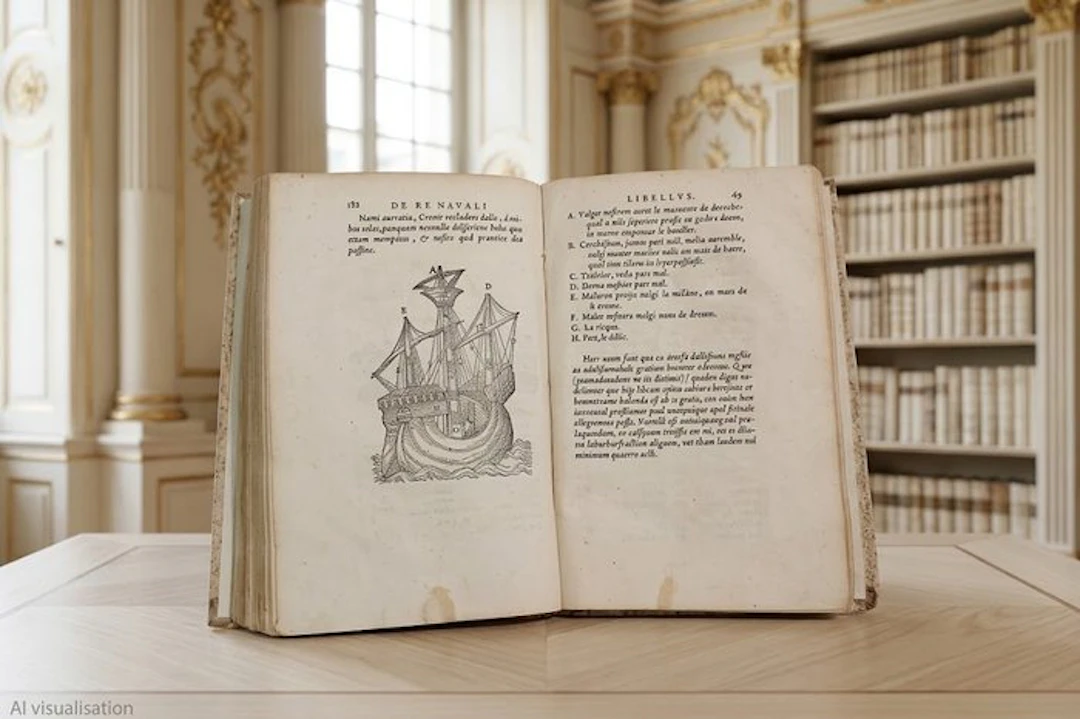
DE RE VESTIARIA, VASCULARIA ET NAVALI: THE MATERIAL WORLD OF ANCIENT ROME Rare and important humanist work dedicated to the study of the material culture of ancient Rome, with particular attention to clothing, everyday utensils, vessels, and Roman ships. Lazare de Baïf, a French diplomat, poet, and scholar of the Renaissance, carries out one of the first systematic attempts at archaeological reconstruction of Roman life through classical sources. The work is enriched with numerous woodcut illustrations depicting garments, tools, containers, and parts of ancient ships. Printed in Paris in 1553 by Charles Estienne, a renowned printer of the Estienne family, it represents a masterpiece of Renaissance antiquarian literature. An example bound in later parchment with a rigid spine in leather and a title label. WHY TO BUY RARO TRATTATO DI ARCHEOLOGIA RINASCIMENTALE – One of the earliest works dedicated to the scientific study of objects of Roman daily life. RICCO APPARATO ICONOGRAFICO – Numerous wood engravings illustrate clothing, vessels, tools, and naval constructions of classical antiquity. CHARLES ESTIENNE A PARIGI 1553 – Edition produced by one of the most important French printers of the XVI century. INTERESSE PER STORIA DELL’ARTE E DEL COSTUME – A fundamental work for the study of ancient fashion, material culture, and the reception of the Roman world in the Renaissance. MARKET VALUE For a complete example of the original Paris edition of 1553, with preserved woodcut apparatus and ancient binding, the market value can be roughly estimated between €400 and €800. Exemplars in superior condition, with notable provenances or particular bibliographic features, can reach higher values. PHYSICAL DESCRIPTION AND CONDITION Later binding in rigid parchment with leather spine, with a title label and gold decorations. Frontispiece: De re vestiaria, vascularia & navali: ex Bayfio. Lutetiae, Apud Carolum Stephanum, Typographum Regium, 1553. Work in Latin with some woodcuts in the text depicting clothing, vessels, utensils, and ships of ancient Rome. Present printer’s mark at the frontispiece. Paper with slight browning, stains, and physiological foxing; some margins show signs of aging and small flaws. Binding with some abrasions and surface wear. In ancient books with a long history, some imperfections may be present, not always noted in the description. This listing contains AI Visualizations. Refer to the original photographs to verify the object’s actual condition. The images are an integral part of the description. Pp.: (2); 190; 26nn; (2). FULL TITLE AND AUTHOR De re vestiaria, vascularia & navali ex Bayfio. Lutetiae, Apud Carolum Stephanum, 1553. Lazare de Baïf. CONTEXT AND SIGNIFICANCE The European Renaissance witnessed a growing interest in direct knowledge of the classical antiquity through texts, monuments, and material remains. Lazare de Baïf’s tract represents one of the first works in which the objects of Roman daily life are studied not merely as decorative elements, but as historical and cultural testimonies. The work tackles three fundamental realms: Roman clothing (vestiaria), everyday objects and containers (vascularia), and ships (navalia). Through comparison with classical authors such as Cicero, Virgil, Ovid, and other ancient writers, Baïf attempts to reconstruct forms, functions, and meanings of Roman objects. The woodcut illustrations constitute a significant element, anticipating modern archaeological studies and influencing the representation of antiquity in European culture. BRIEF BIOGRAPHY OF THE AUTHOR Lazare de Baïf (1496–1547) was an important French humanist, diplomat, and court poet of Francis I. Father of the poet Jean-Antoine de Baïf, he belonged to the Pléiade cultural milieu and helped spread classical studies in France. He served as ambassador to Venice and Rome, gaining direct contact with the testimonies of Italian antiquity. His studies on Roman uses and customs contributed to the development of Renaissance antiquarian culture. PRINTING HISTORY AND CIRCULATION The 1553 edition was printed in Paris by Charles Estienne, a member of the famous family of humanist printers Estienne, active in producing classical, scientific, and philological texts. The work enjoyed international circulation among scholars of antiquity, artists, and architects interested in rediscovering the Roman world. The tract remained a reference work for Renaissance knowledge of ancient material culture and helped shape European antiquarian taste between the 16th and 17th centuries. BIBLIOGRAPHY AND REFERENCES Bibliothèque nationale de France, Catalogue général. Biblioteca Nazionale Centrale di Firenze. SBN – Servizio Bibliotecario Nazionale. WorldCat. USTC – Universal Short Title Catalogue. CERL Thesaurus. Adams, Catalogue of Books Printed on the Continent of Europe. Brunet, Manuel du libraire et de l’amateur de livres. Graesse, Trésor de livres rares et précieux. Mortimer, French Sixteenth Century Books.
Estimate:£254.55
To the auctionView all items fromCatawikiorBooks, Maps & Manuscripts
Estimate:
£254.55
OCT 8 | 3:00 PM


OCT 8 | 3:00 PM
Bring your auction to collectors worldwide!
Get listed now
£1,286.07

OCT 17 | 10:00 PM