Stay up-to-date with the antiques world

By subscribing, you are agreeing to the privacy policy. Unsubscribe anytime.

Barnebys

Barnebys HQ

Brahegatan 10
BOX 5038
114 37 Stockholm

Company

  • About Us
  • Join Barnebys
  • Our Partners
  • Press
  • Career

Explore More

  • Barnepedia
  • Buying / Selling at auction
  • Auction Houses / Dealers / Galleries

Support

  • FAQ
  • Terms of Use
  • Privacy and Cookies policy
  • Contact us
  • Barnebys Group AB
  • Barnebys.se
  • Barnebys.com
  • Barnebys.co.uk
  • Barnebys.de
  • Barnebys.fr
  • Barnebys.es
  • Barnebys.it
  • Barnebys.hk
  • All auction items
  • Categories
  • Auction results
  • Magazine
  • Ancient Art
  • Arts & Graphics
  • Asian Art
  • Books, Maps & Manuscripts
  • Carpets, Rugs & Textile
  • Coins & Banknotes
  • Contemporary Art
  • Ethnographical
  • Fashion & Vintage
  • Folk Art
  • Furniture, Design & Mirrors
  • Glass
  • Jewellery & Gems
  • Lighting
  • Medals, Arms & Armour
  • Miscellaneous
  • Music & Musical Instruments
  • Nautica, Technica & Optic
  • Photographs
  • Porcelain & Pottery
  • Postcards & Stamps
  • Sculptures
  • Silver & Gold
  • Sports & Leisure
  • Tin & Metals
  • Toys & Collectables
  • Vehicles
  • Watches & Clocks
  • Wine & Spirits
  • Works of art
  • All auction items
  • Auction results
  • Magazine
  • Get a valuation
  • Auction system

Barnebys Magazine

LatestEditor's picksTopics
Magazine/Glass/18th-century British & Continental glass

18th-century British & Continental glass

Did you know that in 1745 England introduced a tax on the weight of glass?

22 February 2016
18th-century British & Continental glass

This meant that glass-designers started to favour light Rococo designs over heavy Baroque styles. Designers also steered away from bases which were reinforced with a ''folded foot'' which lead to any glass made after 1745 being more susceptible to breaking.

In the 18th-century, American homes were filled with designs from the US, including Chippendale from Philedelphia. However, glassware was still imported from England.

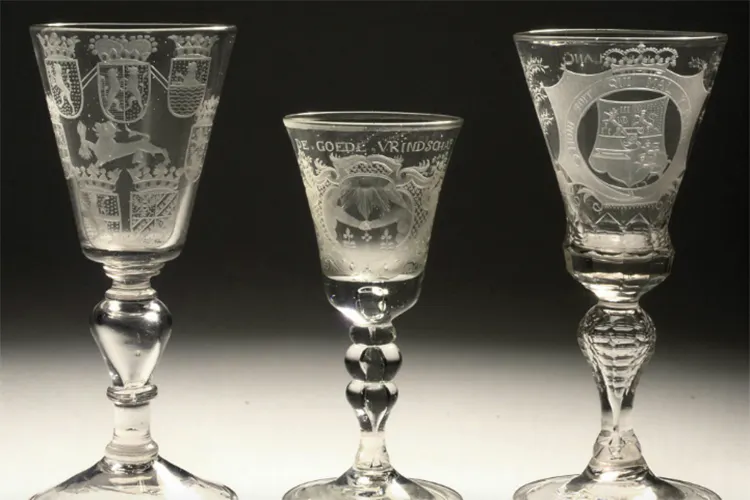
Dutch engraved 'vriendschapsglas' 18th century. Sold at Christie's in 2010 for €1 563. Image via Christie's.

During the 18th century, stemware was made from lead glass, or ''flint'' glass, a technique which was invented by London craftsman George Ravenscroft in 1676. Flint was the preferred form of glass for ale, cordial and wine vessels.

By the mid-18th century, glassware was designed for more than just drinking. Candlesticks, dessert glasses, various-sized decanters were introduced to English homes. Decanters were labelled with silver tags which indicated their contents, for example port, sherry. These labels can still be picked up on the market today.

Dutch craftsmen had a great influence on English glassware. Many glasses were sent to Holland for engraving, as the Dutch were hailed as the most skilled engravers. In the 18th century, English glass companies had opened factories in Holland.

Toovey's sale on 25th February will include British & Continental glass. Toovey's sale will take place 23rd-25th February. Search the entire catalogue on Barnebys here.
wine glasstoovey's18th centurycrystalglassware

Subscribe to Barnebys Magazine

By subscribing, you are agreeing to the privacy policy. Unsubscribe anytime.

Explore related articles

All things Vyse
Ceramics

All things Vyse

Treasure Trove at Toovey's
News

Treasure Trove at Toovey's

Bring your auction to collectors worldwide!