Mannerism surfaced around 1520 as a response to the High Renaissance and persisted until the early 17th century. Its inception was largely influenced by the political and religious turmoil of the period, notably the sack of Rome in 1527 by the army of Charles V. Mannerist artworks thus served as a reflection of the uncertainty prevalent in this era, showcasing unexpected and occasionally unsettling images and compositions. Mannerism appears almost as a playful endeavour, with each artist striving to innovate and exceed their limits by manipulating rules, colours, and forms.
The main features of Mannerism include the following: indefinite space, the distortion and twisting of moving bodies (characterised by the use of the serpentine line or figura serpentinata), the use of bright colours, and the use of symbols.
Here are five perfect examples of the Mannerist movement:
Self-Portrait in a Convex Mirror, Parmigianino
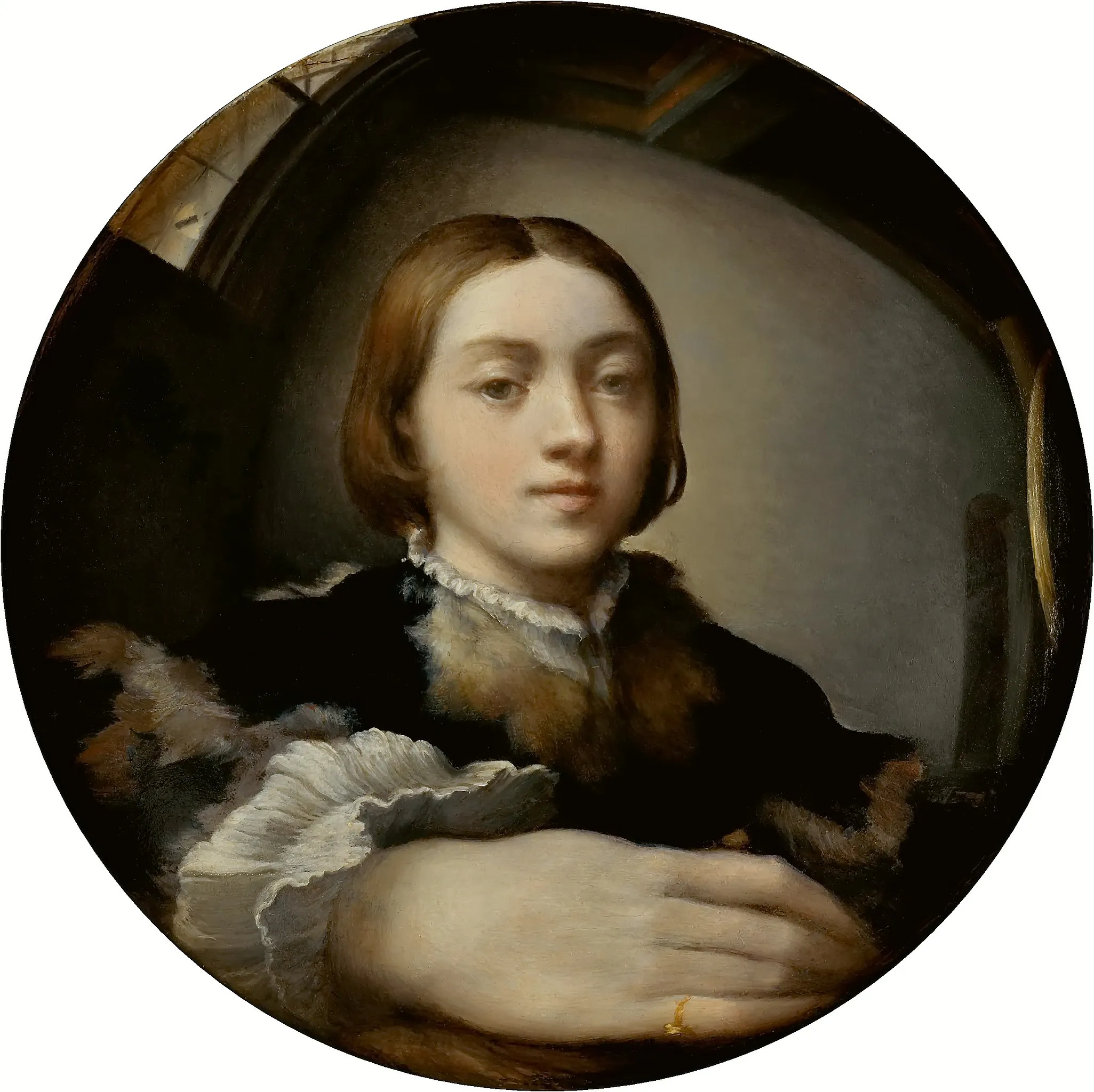
Girolamo Francesco Maria Mazzola, more commonly known as Parmigianino, was an Italian Mannerist painter and printmaker who practiced his art in Florence, Rome, Bologna and in his hometown of Parma. His artistic production is distinguished by a certain sensuality and the tendency to elongate forms.
This self-portrait presents the artist at the age of 21, located in the middle of a room distorted by the use of a convex mirror using the anamorphosis technique. The hand in the foreground appears significantly stretched and altered by the effects of the mirror. The work was created on a convex panel specially prepared to reproduce the curvature of the mirror.
See also: How the Medici Family Influenced Renaissance Florence
In 1524, Parmigianino went to Rome with some paintings, including this self-portrait, in the hope of obtaining the patronage of the Medici family. Upon his arrival in the capital, he was celebrated and even compared to Raphael. Although he died at the age of 37, Parmigianino became one of the major figures of Mannerism, with his influence extending to engraving.
The Deposition from the Cross, Jacopo Pontormo
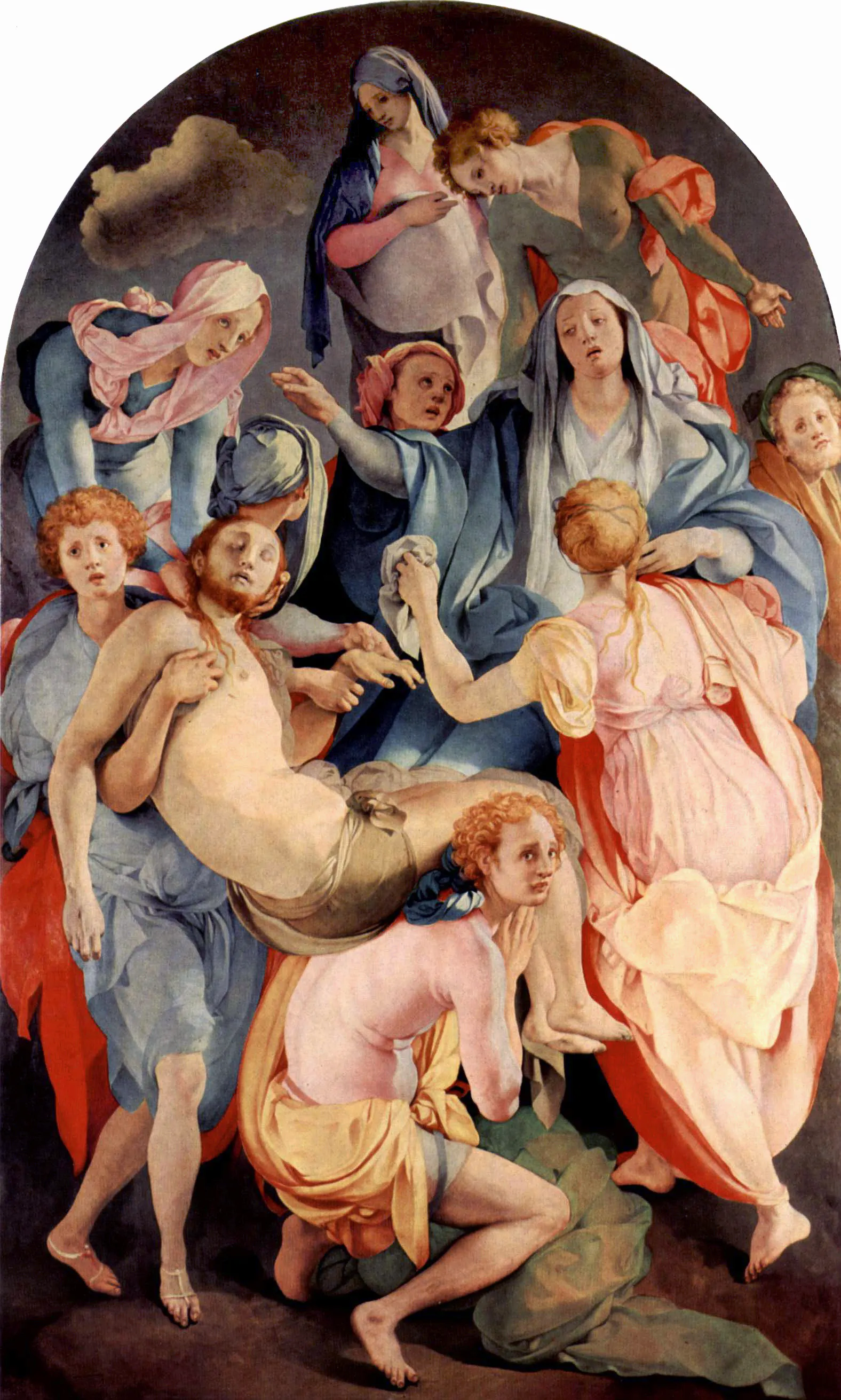
This Pontormo altarpiece depicts a biblical scene of Christ's descent from the cross. Mannerist characteristics are evident in this work, with a veritable whirlwind of moving figures. The body of Christ is represented in the centre of the painting in a serpentine line. The bright colours, even for the pulpit, of pink and white, reinforce these distinctive features which make Pontormo an eminent figure of Mannerism.
The fascinating particularity of the painting lies in the impression of slow motion despite the obvious movement of the characters. The faces, almost all directed towards the viewer (with the exception of the two faces in the background turned towards Mary), create an atmosphere of immobility and isolation, in resonance with the face of Christ.
Pontormo accentuates certain anatomical distortions inherited from his master Michelangelo (1475-1564): the disproportionate neck of the Virgin and the elongated torsos of the men who support the body of Christ are examples.
See also: Michelangelo: From Man to Genius
This work marks the advent of the Mannerist style thanks to its unusual colour palette, its elongated figures adopting distorted poses, and the creation of an unrealistic and totally decontextualised space. The cross, normally present in a descent from the cross, has disappeared. Mary, positioned in the upper right centre of the painting, seems to somehow replace it, while the figures in the background do not seem subject to the laws of gravity. The drapes flutter in the wind, creating an atmosphere of levitation.
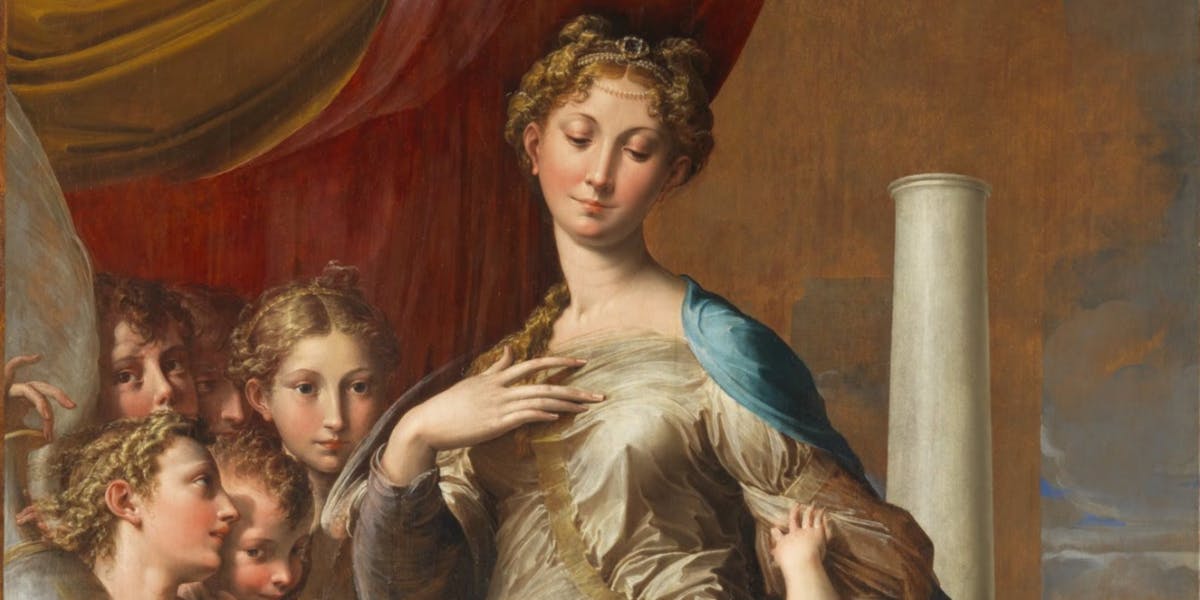
The Virgin with the Long Neck, Parmigianino

This work could be considered the most accomplished representation of Italian Mannerism as it is rich in symbols. Parmigianino focused on the figure of the Madonna, characterised by the elongation of her neck and fingers, as well as unrealistic proportions, often earning her comparison to a graceful swan. The posture of the Virgin and that of Jesus follow a serpentine line, with a languorous, supple and detached movement. The tired and unstable body of the child Jesus evokes a descent from the cross or a Pietà, foreshadowing his destiny.
Would you like to receive similar articles directly to your inbox? Subscribe to our newsletter!
On the left, the crowd characteristic of Mannerist scenes is made up of angels similar to curious children, eager to observe Jesus. The architectural framework, although producing a 'classic' effect, remains largely undefined and even threatening, thus creating a disturbing ambiguity. To the right of the column, the small figure of Saint Jerome, with elongated limbs, holds a scroll while looking back over his shoulder.
See also: Bronzino: An Ingenious Portraitist
Commissioned in 1534 for the funeral chapel of Francesco Tagliaferri in Parma, the work remained unfinished in 1540, the year of the artist's death. Perhaps no other creation so distinctly illustrates the Mannerist approach because Parmigianino breaks with the artistic conventions of the Renaissance. Rather than distributing his characters symmetrically on either side of the Virgin, he deliberately disrupts the space by favouring disproportion, with on one side the angels, with human proportions, clustered together, and on the other the unique and slender figure of Saint Jerome, whose reduced size barely reaches the knee of the Virgin.
See also: The Story of Leonardo Da Vinci's Unfinished Saint Jerome Painting
The Conversion of Mary Magdalene, Veronese
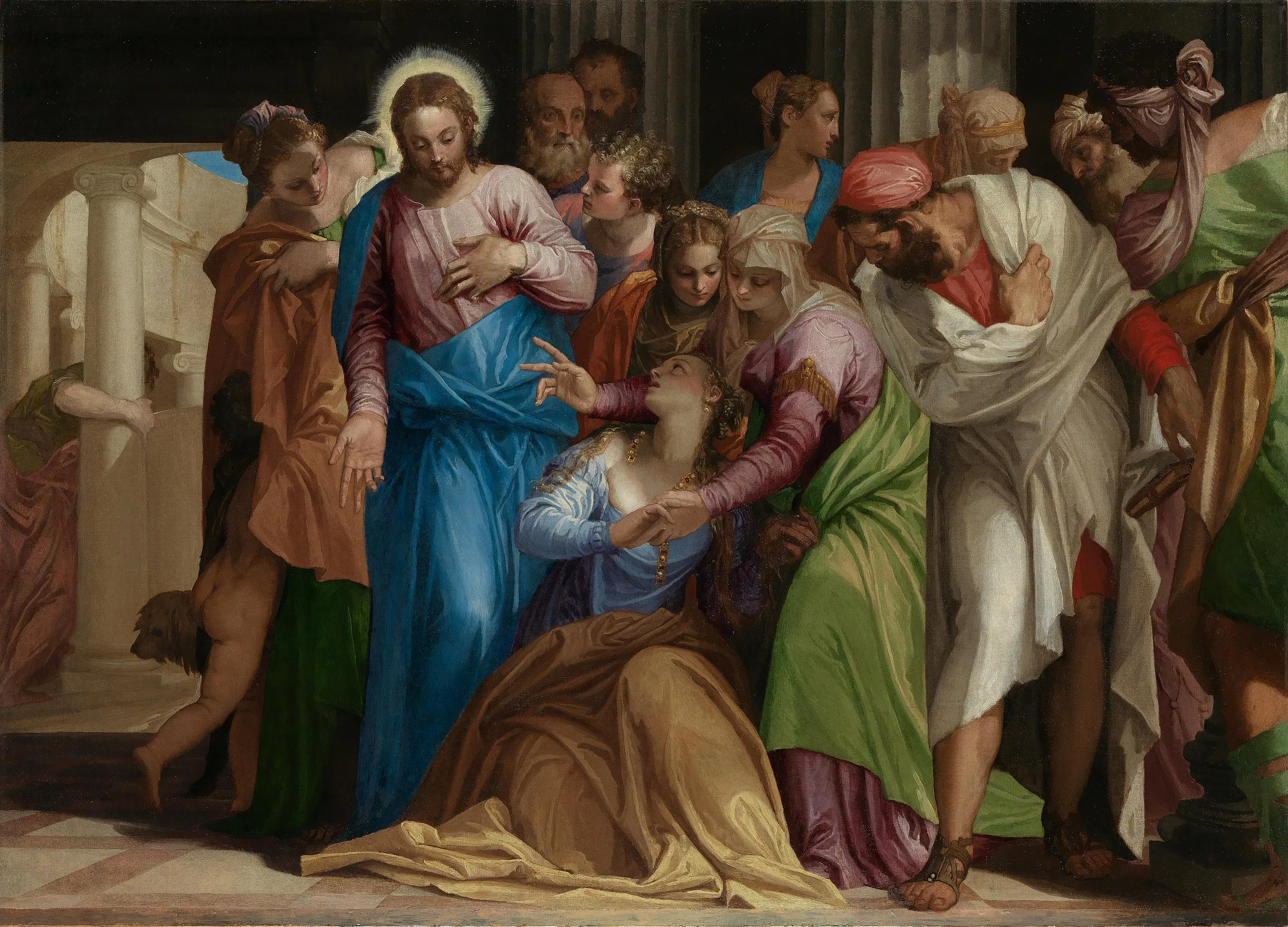
Veronese is famous for his frescoes and oil paintings that incorporate the trompe l'oeil technique. He used bright colours to depict meticulously detailed scenes with distinct figures standing out clearly from the background. His marked contrasts, theatrical architectural structures and well-defined rhythm made him an essential master of 16th century painting.
Not everyone agrees on the subject of this particular painting: the general opinion is that it represents the conversion of Mary Magdalene. In the painting, she is depicted in an outfit inappropriate for the religious building, to symbolise her previous life.
See also: Christian Iconography in Art, Explained
In this work, all the characteristics of mannerism are brought together. The main characters, Jesus and Mary Magdalene, are surrounded, even overwhelmed, by other characters. The background, which depicts a religious building, is barely recognisable. The moving bodies adopt complex postures and all the subjects almost create an architectural form. The palette is very distinctive: bright apple green, orange, pink, blue, contrasted by white draperies.
Abduction of a Sabine Woman, Giambologna
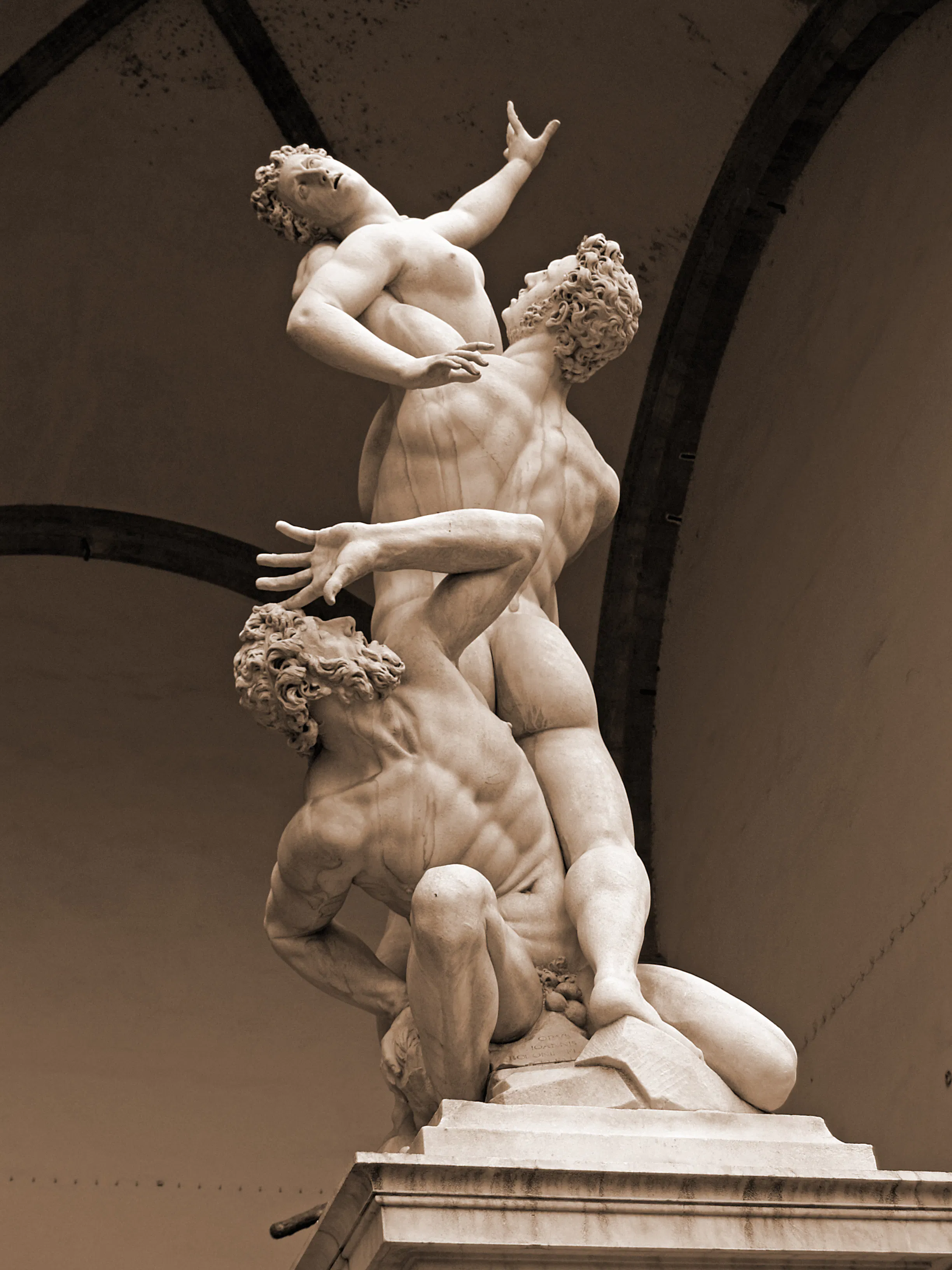
This sculpture depicts a mythological story from Roman history, recounting the episode where the Romans, newly settled in Italy, attempted to marry women from the Sabine tribe. Faced with their refusal, the Romans decided to kidnap the women during a banquet.
See also: How an Ancient Sculpture Changed Renaissance Art
The representation of violence between the three characters (a Roman, whose pronounced musculature testifies to his strength, a naked woman whom he seizes as she struggles to escape his grasp, and an older man, crouching under the Romain, manifesting fear) reveals technical prowess and innovative characteristics. Indeed, Giambologna has the three characters standing on a single base, skilfully arranging their bodies in a serpentine line, without any stiffness or tension.
The figures create a swirl and thus offer a changing perspective as the viewer explores the work. The multiplicity of points of view was also one of the effects sought by Mannerist sculptors.