Are you familiar with all six of the following paintings? Probably so, because they are not only among the most iconic works of Spanish painting, but also among the most famous pieces in art history.
Diego Velázquez, Las Meninas
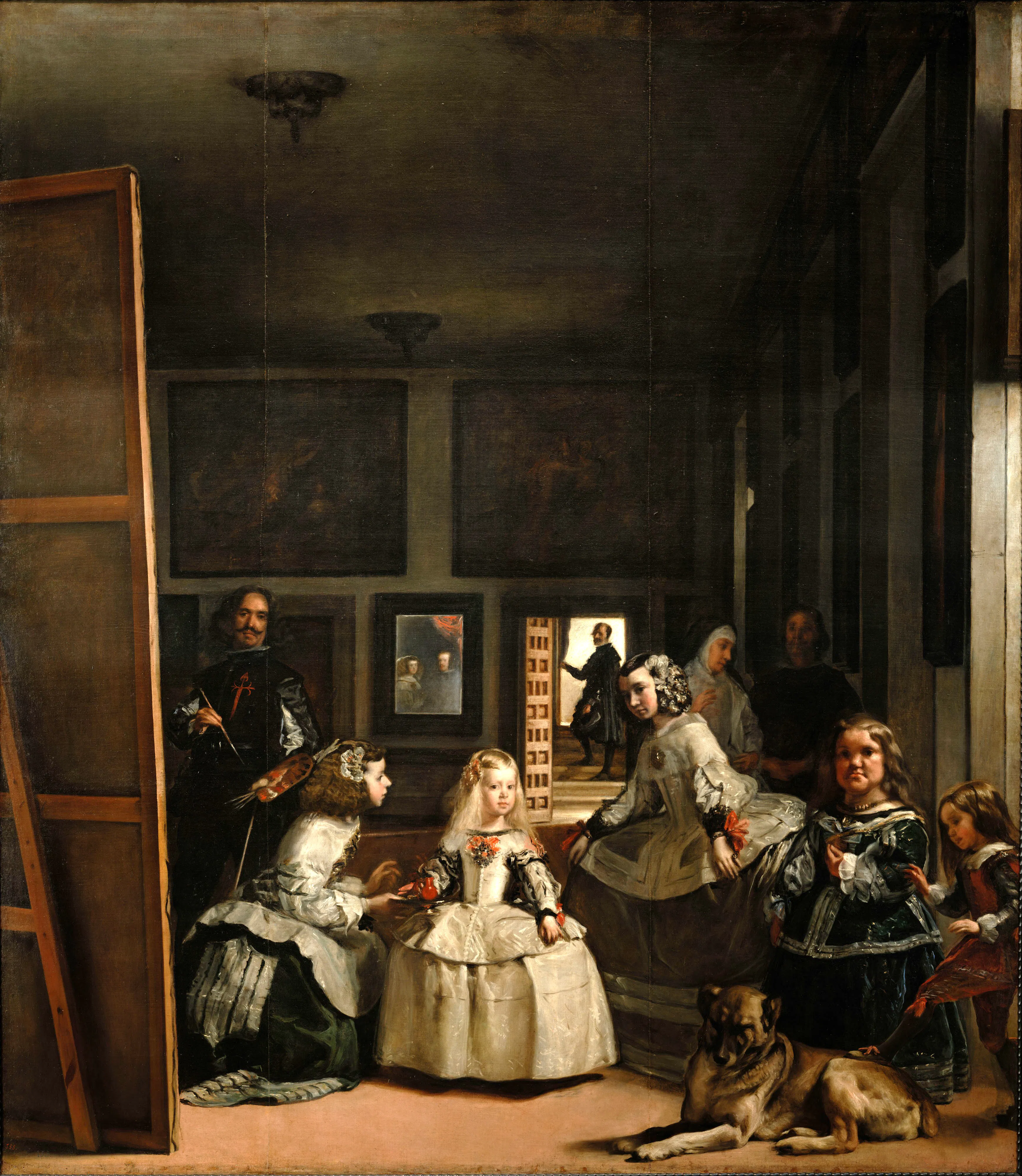
When Diego Velázquez painted his most famous work, Las Meninas ("The Ladies-in-Waiting") in 1656, he was 57 years old and had been court painter to the art-loving King Philip IV of Spain for over 30 years. He held various court offices, including curator of the royal art collection and Marshal of the Palace, which legitimised his constant presence near the royal family. He was also assigned a large room in the Alcázar of Madrid, the king's main residence and the predecessor of the present-day Royal Palace, which served as his studio. It was there that he painted Las Meninas, which depicts Infanta Margarita Teresa, Philip IV's only child from his second marriage to Maria Anna of Austria, surrounded by members of her court, as well as Diego Velázquez himself and a large dozing dog. In the background, Marshal of the Court José Nieto Velázquez (it is unknown if he was related to the painter) can be seen in an open doorway. Between the two Velázquez gentlemen, one can discern the double bust of the royal couple, presumably a reflection. Possibilities include either a mirror image of the painting Diego Velázquez was working on in Las Meninas or a direct reflection of the royal couple being painted. In either case, some of the figures present, including the Infanta and the painter, would not be looking directly at the viewer, but rather at the royal couple, whose perspective the viewer adopts. This theory is further supported by the painting's original location: the king's private study in the Alcázar, where not just any viewer would have had the opportunity to assume such a personal perspective.
See also: Diego Velázquez: The Portraitist of the Spanish Court
Pablo Picasso, Guernica
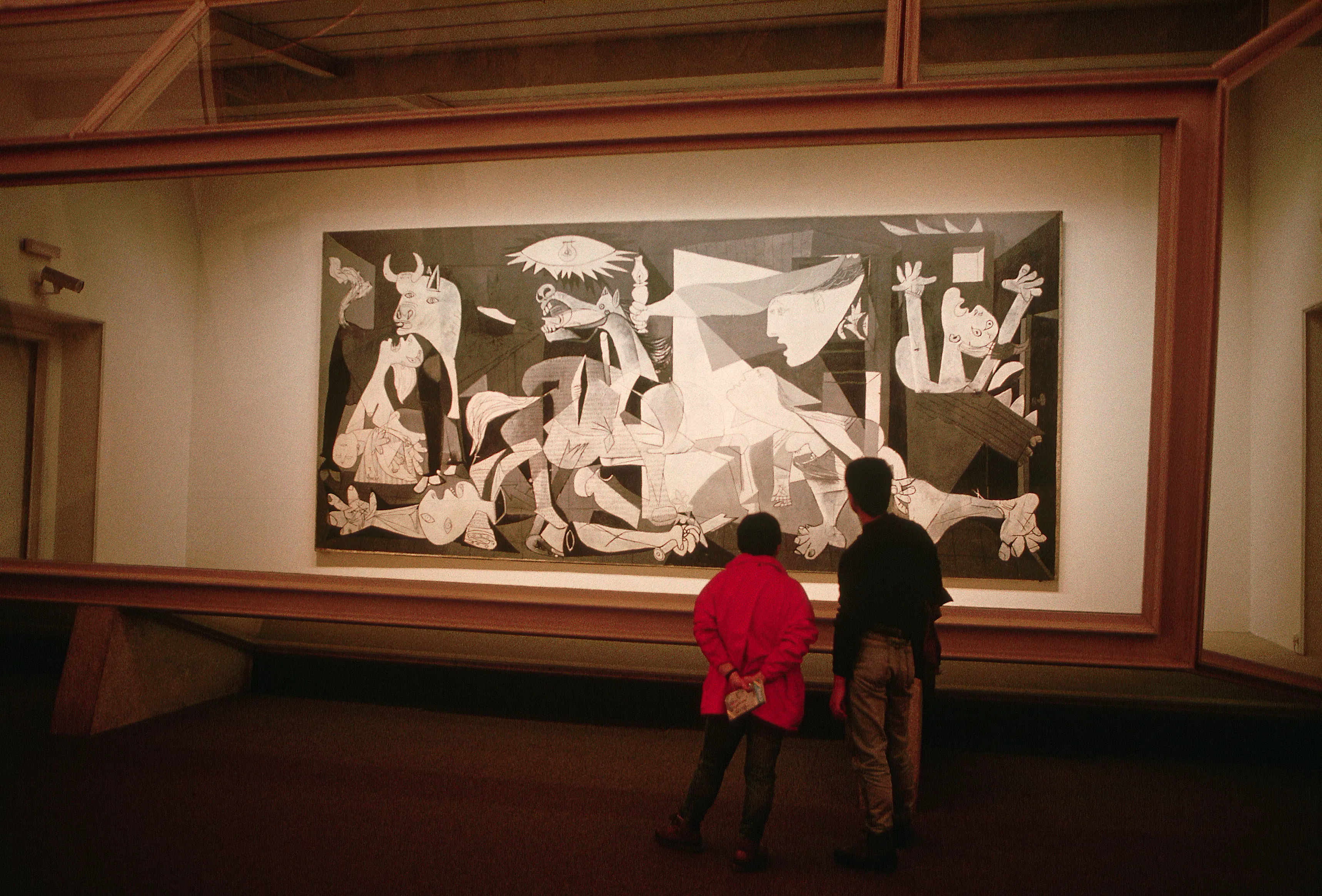
In 1936, Pablo Picasso was commissioned by the Spanish government to paint for the Spanish pavilion at the Paris World's Fair, which was to be held the following year. Picasso's initial idea was the theme "Painter and Model," but he abandoned this after the devastating bombing of the Basque town of Guernica by the German and Italian air forces, who supported the Francoist insurgents, on April 26, 1937. Picasso then created a dramatic anti-war painting in shades of gray, white, and black, addressing the suffering caused by war. At its center is a dying horse (for Picasso, it was a symbol of immeasurable suffering); alongside it is a bull, a dying warrior, and four women, one of whom is burning in her home, while another mourns her dead child. After it was exhibited in Paris, Guernica toured Scandinavia, England, and finally the United States to raise money for the victims of the Spanish Civil War. Since Picasso bequeathed his work to a future Spanish republic, Guernica initially remained at the Metropolitan Museum of Art in New York. Although Spain did not become a republic after Franco's death in 1975, but rather a parliamentary monarchy, Guernica was nevertheless returned to its creator's homeland in 1981, where it has been on display at the Museo Reina Sofía in Madrid since 1992.
See also: Picasso: The Universal Artist
Francisco de Goya, The Naked Maja
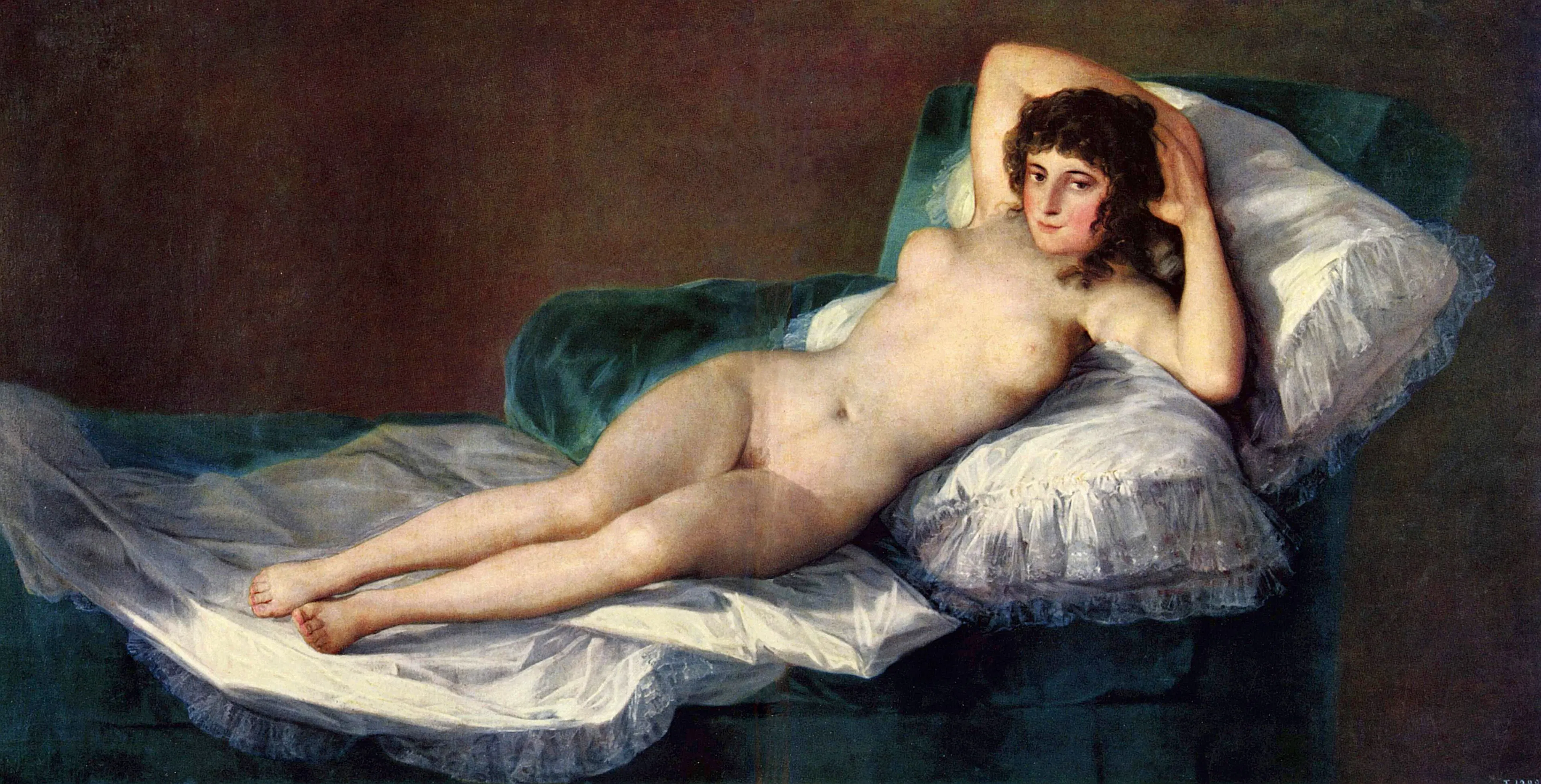
Among the many nude depictions of young women in art history, Francisco de Goya's La maja desnuda ("The Naked Maja") is undoubtedly one of the most famous—even though (or perhaps precisely because) it was long kept hidden from the public. The censor was none other than the Spanish Inquisition, which considered the portrayal of such a shameless and pubic-haired young woman a scandalous display of moral decay. The painting, as well as its second version, La maja vestida ("The Clothed Maja"), was discovered in 1808 in a secret cabinet of erotic paintings belonging to the recently deposed statesman Manuel de Godoy. He, and later the creator of the Majas, Francisco de Goya, were summoned before the Inquisition tribunal. Goya was asked to name the patron, but his reply is unknown. This patron, and the identity of the woman depicted, are the great mysteries of the Majas that make the paintings even more fascinating. One of Godoy's many mistresses was considered, as was the glamorous Duchess of Alba, who had been portrayed repeatedly by Goya. However, it is likely that the woman in question was simply an unnamed young woman from a lower social class. These women, called maja, were distinguished primarily by their striking clothing, which was based on traditional Spanish dress.
See also: The 7 Most Expensive Works by Francisco Goya
Salvador Dalí, The Persistence of Memory
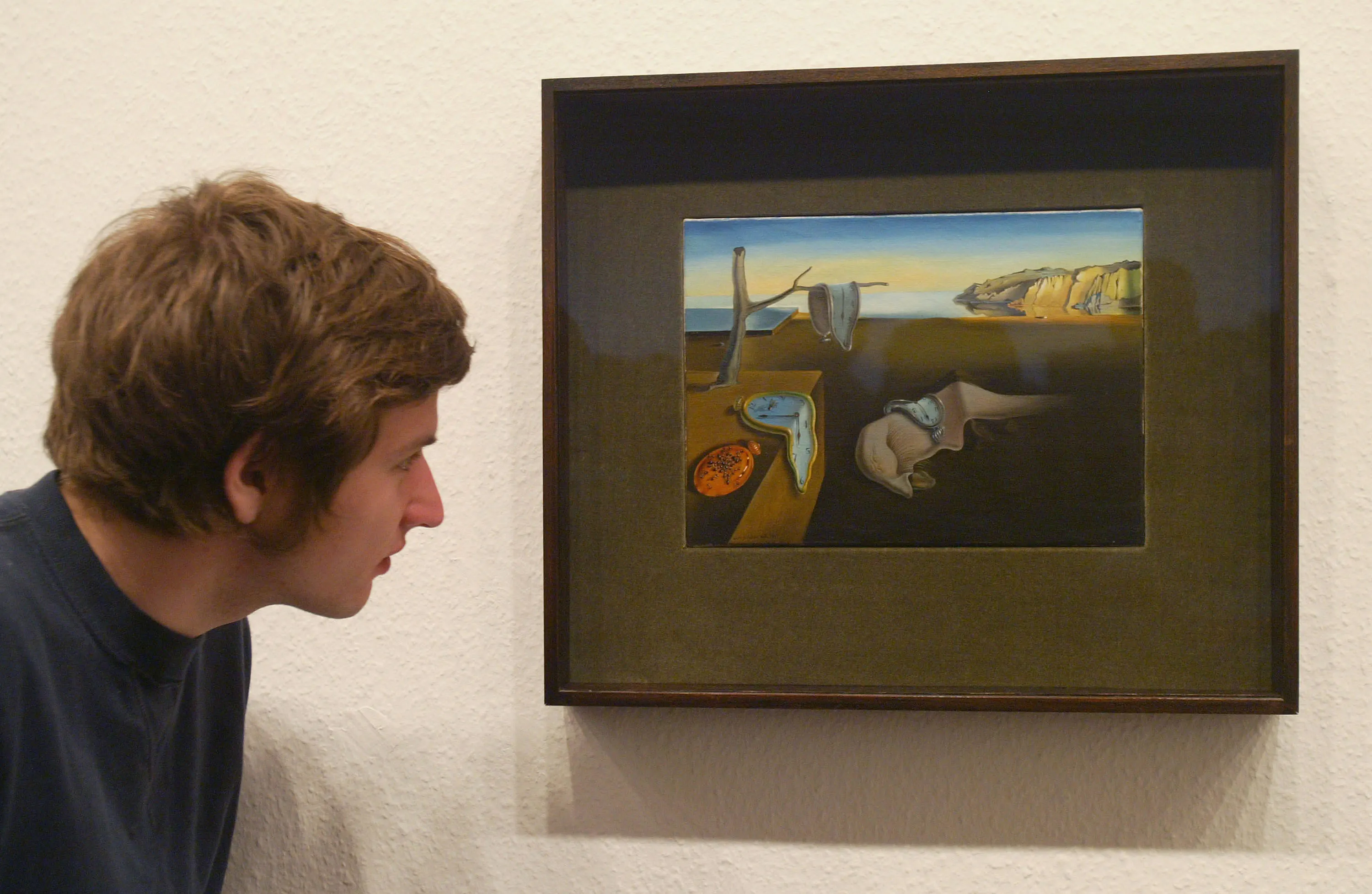
What does the sight of melting Camembert evoke in you? Hunger, or perhaps disgust—depending on whether you're a fan or not of the soft French cheese. For Salvador Dalí, the sight certainly triggered a need to paint in 1931. The result was The Persistence of Memory, one of the most famous paintings of Surrealism and Dalí's best-known work—despite measuring a mere 24.1 x 33 cm. In a barren, rocky landscape reminiscent of his native Catalonia, Dalí placed three pocket watches melting over the branch of a bare tree, the edge of a pedestal, and a form that is an abstract representation of Dalí's face. The face is depicted as asleep, making it clear that we are dealing with a dream—a dream in which the usual perception of time and space has lost its meaning. Dalí's painting is also based on his then-current theory of softness and hardness, the opposites of which he used in his surrealist works, with hardness representing reality and softness representing dreams and the subconscious. A fourth clock, however, is still intact. Perhaps because its lid is closed? However, it is being attacked by ants—a symbol of decay for Dalí—so the fate of the other clocks may yet await it.
See also: Salvador Dalí: Art Crazy
Pablo Picasso, Les Demoiselles d'Avignon
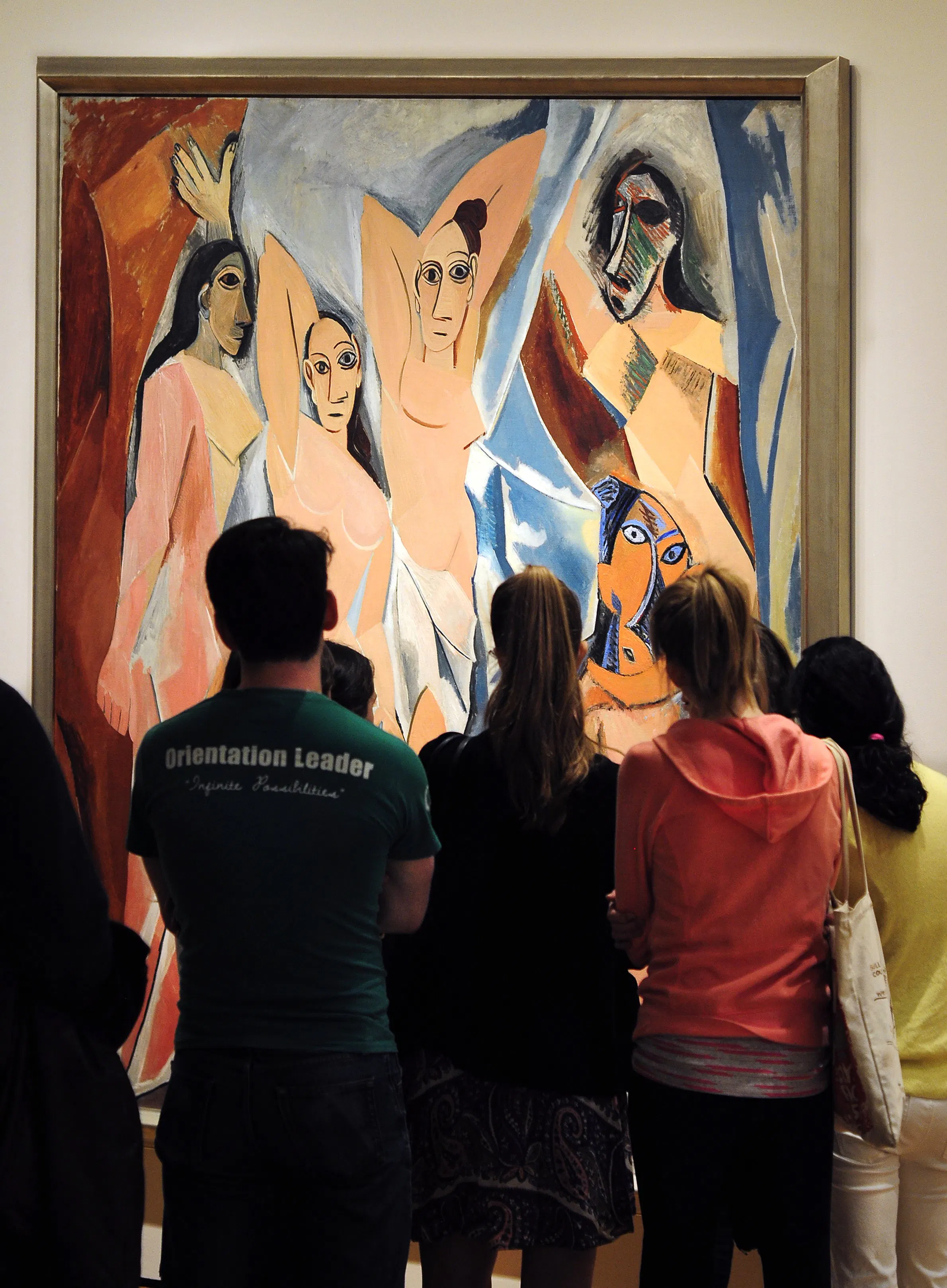
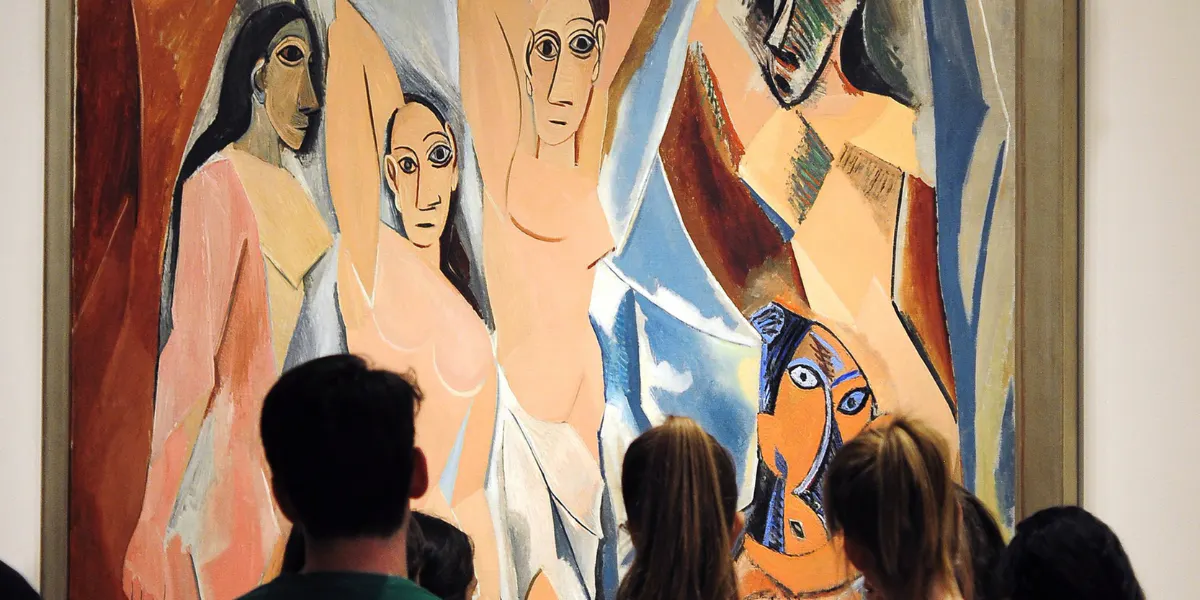
Anyone wondering what Picasso was up to between autumn 1906 and summer 1907 could be certain that the answer was "Working!" After spending the summer in the Pyrenean village of Gosol, Picasso returned to his studio in the dilapidated Bateau-Lavoir artists' residence in Montmartre. There, inspired by the impressions he had gathered in Gosol, he created a work that would turn art history on its head: Les Demoiselles d'Avignon, the painting that founded Cubism. The fact that he produced over 800 sketches and studies for the painting demonstrates just how much this project meant to him and how firmly he believed it was significant. The finished painting depicted five female nudes, though Picasso had originally planned the scene to portray a brothel on Carrer d'Avinyó in Barcelona. The name Avinyó was changed to Avignon, but only several years after the painting's completion. Picasso initially showed the work only to friends and art dealers, who were all rather unenthusiastic. The first public exhibition took place in 1916. Picasso wasn't able to sell the painting until 1924 (to the fashion designer Paul Doucet), when opinions on Les Demoiselles d'Avignon gradually shifted and the true significance of the work was recognised.
See also: How Cubism Changed the World
Francisco de Goya, The Third of May 1808

On May 2, 1808, the citizens of Madrid had had enough: the French troops, who had supposedly invaded Spain as allies, were increasingly behaving like an occupying force. An uprising broke out in the capital, whose inhabitants fought against Napoleon's well-equipped soldiers with the simplest of means. The French were victorious, and that very night, 45 insurgents were executed by firing squad at Príncipe Pio hill. This marked the beginning of the Spanish War of Independence, which would not end until 1814. In that year, Francisco de Goya created two paintings depicting the events of May 1808: El dos de mayo de 1808 en Madrid ("The second of May 1808"), which portrays the citizens' struggle against French soldiers, and El 3 de mayo en Madrid ("The third of May 1808 in Madrid"), which depicts the execution. The second painting is undoubtedly the better known and is both dramatic and modern in its depiction. It is no coincidence that the portrayal of the rebel in the light-coloured shirt is reminiscent of Christ on the cross, as those executed were generally venerated as martyrs. Many subsequent artists were inspired by the painting, including Picasso, Otto Dix, Yue Minjun, and Édouard Manet. In addition to these two paintings, Goya created another powerful work against the backdrop of the War of Independence: his graphic series Los Desastres de la Guerra ("The Disasters of War").