
The fire that destroyed the Royal Chapel of Milot in mid-April revealed a deeper tragedy: a government that is negligent of its cultural and historic treasures. Leaders in Haiti described the destruction of a famous 200-year old church as an incident "that could have been avoided."
The fire started at around 3am in an annex building, causing the collapse of the building's black wooden dome, nearly 100 feet in diameter, and incineration of all its furniture. Alain Prophète, the parish priest, was quickly informed of the situation, but since the commune did not have a fire service, the inhabitants themselves fought against the flames for almost two hours before the arrival of the firefighters from Cap-Haitien.
"[For years] we have been asking the state to ensure the protection of these colonial dwellings, which are important as monuments of slavery, yet nothing has been done," said Laënnec Hurbon, a sociologist at the State University of Haiti to The Guardian.
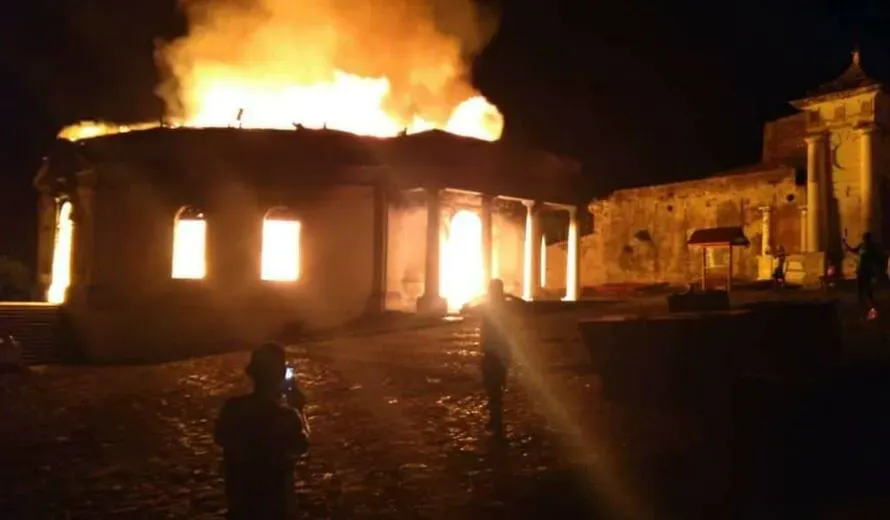
Located 12 miles south of Cap-Haitien, once the island's capital, the chapel sits at the entrance to the large historic park of Citadelle Laferrière, a UNESCO World Heritage since 1982. The religious building was built between 1810 and 1813 under direction of the hero of the Haitian war of independence, Henri Christophe, who became the self-proclaimed King Henri I in 1811. The chapel was part of King Henri's San Souci Palace, built in 1812, once considered the Versailles of the Caribbean. Henri I reigned over northern Haiti until his death by suicide in 1820, in the midst of a prolonged civil war. On his death, the church was ransacked and its dome collapsed following an earthquake in 1842. In the 1970s, the famous Haitian architect Albert Mangonès restored the complex, classified as a UNESCO site 12 years later.
See also: Multi-million Whisky Auction Hit by Cyber Attack
As Unesco explains, these monuments "are charged with a universal symbolism because they are the first to have been built by black slaves who conquered their freedom". With the considerable damage caused by the tragedy comes the delicate question of the reconstruction of the chapel.
“Given that this is a monument classified as World Heritage, the restoration must be identical and the funds are not available, there is no doubt about it. So I can already tell you that we are going to row a lot to be able to redo the monument as it was”, explained Patrick Durandis, director of the Institute for the Protection of the National Heritage of ISPAN (L'institut de sauvegarde du patrimoine national), during a press conference.
See also: An Artemisia Gentileschi Painting is Rediscovered
In a letter to the government after the fire, citizens and representatives of the country's private, socio-professional and academic institutions called on political leaders to "end this denial of our history as a people [because] only these monuments remain, testimonies of our history strewn with struggles, suffering and hope".